

Data processing using etl system





Try Before you Buy Download Free Sample Product
 Impress Your
 Audience
 100%
100% Editable
 Save Hours
 of Time


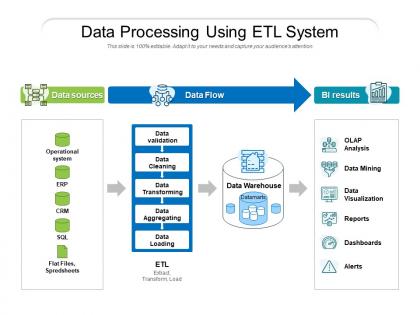
ETL is the process of extracting data from non-optimized data sources and moving it to a centralised host (which is). The particular stages in that procedure may alter with ETL tools, but the ultimate outcome is the same. The ETL process, in its most basic form, involves data extraction, transformation, and loading. If you are looking for a comprehensive guide to data processing and want to learn about ETL system, then SlideTeam’s data analytics PowerPoint templates are the perfect resource for you. With our templates, you can get in-depth information about how data is processed and transformed into valuable insights. Plus, our templates are easy to use and customizable, so you can create presentations that fit your specific needs. Download our data analytics ppt templates now and start learning about data processing today.
People who downloaded this PowerPoint presentation also viewed the following :
Data processing using etl system with all 2 slides:
Earn greater appreciation with our Data Processing Using ETL System. You will benefit hands over fist.
FAQs for Data processing
So ETL is basically extract, transform, load - pretty straightforward. You pull data from wherever it lives (databases, APIs, random CSV files). Transform is honestly the worst part because that's where you're cleaning up all the garbage data and reshaping it to actually fit where it needs to go. Then you load it into your warehouse or whatever system you're using. Oh, and you'll want to build in error handling from the start because things will definitely break. The whole point is keeping your data clean as it moves through each step - sounds simple but it gets complicated fast!
So basically, ETL cleans your data first, then loads it. ELT does the opposite - dumps everything raw into your warehouse, then transforms it there. I used to think ETL was always better, but honestly? ELT's pretty awesome now that cloud warehouses like Snowflake can handle massive processing. With ETL you're doing all the heavy work upfront in your pipeline. ELT lets you be lazy initially but gives you way more flexibility later. Go with ETL if you need squeaky clean data right away, otherwise ELT's probably your best bet.
For open-source stuff, Talend's solid. Informatica if you need enterprise-level horsepower. Cloud options like AWS Glue and Azure Data Factory are nice because they scale themselves - less headache for you. Apache Airflow's fantastic for orchestration, gives you crazy control over scheduling. Oh, and dbt is having a total moment right now, everyone's using it for transformations. Honestly depends on your situation though. Got massive data volumes? Go Informatica. Complex transformations? Talend's your friend. I'd start by figuring out your budget and what your team actually knows how to use.
Build validation into every step of your ETL. Check for nulls, dupes, and type mismatches right when you're extracting data. During transforms, catch those weird edge cases that'll absolutely wreck your pipeline later - I've learned this the hard way. Your load process needs reconciliation checks comparing record counts between source and target. Set up alerts for when stuff breaks and create profiling reports so you actually know what's happening. Oh, and build a feedback loop to trace problems back upstream. Way easier to fix things at the source than downstream.
So ETL is basically how you get your data warehouse to not suck. You're pulling data from all these different systems, cleaning it up (duplicates are the worst), and making everything play nice together format-wise. Then you dump it all into your warehouse where people can actually use it. Without this process, you'd just have a really expensive pile of junk data sitting there. Oh, and definitely map out what data you're working with first - trust me on that one. Otherwise you'll be fixing problems later that could've been avoided.
Honestly, start with the stuff that's eating up most of your time - those repetitive jobs you're sick of babysitting. Airflow's pretty solid for scheduling, or AWS Glue if you're already in their ecosystem. Hell, even basic cron jobs work fine for simple stuff. Build in some quality checks so things don't just silently break on you - trust me on this one. Cloud platforms handle the scaling automatically now, which is nice. You'll want monitoring set up though, otherwise you won't know when everything's on fire. Just tackle one pipeline at a time instead of trying to automate everything at once.
Ugh, data quality issues will be your worst nightmare - dirty data makes everything awful. Performance bottlenecks hit hard with large volumes too, especially when transformations get complex. Schema changes from upstream systems? They literally always break at 3am or right before a demo. Error handling becomes super critical because production failures are the worst. Oh and monitoring - you need solid logging or you'll spend hours trying to figure out what went wrong. My take: spend time early on data validation and build schemas that won't completely fall apart when things change. Trust me on this one.
Break your data into smaller chunks instead of loading everything at once - trust me on this one. I crashed our entire system trying to process 50GB in a single thread like an idiot. Parallel processing saves your life here, so spin up multiple workers for different partitions. Streaming ETL beats batch processing when you can swing it. Oh and don't forget proper indexing on your target tables, that's huge. First step though? Figure out if extraction, transformation, or loading is your actual bottleneck. No point optimizing the wrong thing.
If you need real-time ETL, go with streaming stuff like Kafka or AWS Kinesis - perfect for fraud detection when seconds matter. But honestly? Batch processing still handles the heavy lifting better. Airflow and Spark are solid choices, or just use cron jobs if you're keeping it simple. The real question is whether your business actually cares if data is 5 minutes old vs 5 hours old. Most of the time it doesn't matter as much as people think. Volume matters too - streaming gets expensive fast with massive datasets.
Auto-scaling and serverless stuff like AWS Glue will save you so much money since you're not paying for resources just sitting there doing nothing. Split your ETL jobs into smaller chunks that can run at the same time - way faster that way. Parquet files are your friend for storage, and partition by whatever fields you query most. Oh, and streaming ETL beats batch processing if you need real-time data. I'd start by figuring out where your current jobs are choking up first though. That'll show you what's actually worth fixing.
Metadata is like your GPS for ETL - tracks where data comes from and where it's headed. Document your transformations and data sources religiously. Trust me, you'll need it when debugging at ungodly hours. Good metadata lets you trace data lineage and spot quality issues fast. Without it? You're basically guessing when pipelines break. Short sentences help readability. Start mapping out your data dependencies now - seriously, don't put this off. I learned this the hard way after spending way too many late nights trying to reverse-engineer broken workflows.
So basically you want modular designs that don't require rebuilding everything when stuff changes. Configuration-driven setups are your friend here - just tweak parameters instead of rewriting code. Way better than the old hardcoded nightmare scripts we used to deal with! Build with change in mind from day one: version control, testing, staging environments. Business requirements always shift (trust me on this), so you'll need to add fields or swap data sources pretty regularly. Document what you're doing now though, because future-you will thank you when things get messy later.
Break your pipelines into small, independent pieces that can run at the same time - basically microservices for data. Horizontal scaling is your friend here. Build in solid error handling with retries from the start. I learned this the hard way when I got woken up at 2 AM by broken jobs, so set up monitoring and alerts early. Make your transformations idempotent so you can safely rerun stuff when it fails. Start simple but design with growth in mind. Oh, and parallel processing will save your sanity later - don't underestimate how much faster things get when components aren't waiting around for each other.
Honestly, just build the governance stuff directly into your ETL flow instead of treating it like some separate thing. Set up schema validation right when you're extracting data, then add profiling and anomaly detection during transforms. I wasted way too many hours last month debugging garbage data that should've been flagged way earlier - learn from my mistakes! Audit logging is huge too. Track your metadata, transformations, who touched what. The whole point is making it automatic so you're not constantly babysitting compliance. Short checks work better than complex ones.
Look, ETL is basically what makes your data actually useful for analytics. Raw data is just a mess scattered everywhere - you can't do anything with it. ETL cleans it up and puts it in a format your tools can understand. Like... imagine trying to cook with ingredients still in their packaging, you know? Your reports are only as good as your ETL process. If something looks off in your dashboards, honestly the ETL pipeline is usually the culprit. Skip this step and your whole BI setup falls apart.
No Reviews