Design Of Experiments Doe Process And Application Phases QCP Templates Set 1

Rating:
90%
Design Of Experiments Doe Process And Application Phases QCP Templates Set 1
Slide 1 of 6
Favourites Favourites

Try Before you Buy Download Free Sample Product

Audience Impress Your
Audience
Editable 100%
Editable
Time Save Hours
of Time
The Biggest Sale is ending soon in
0
0
:
0
0
:
0
0
Rating:
90%
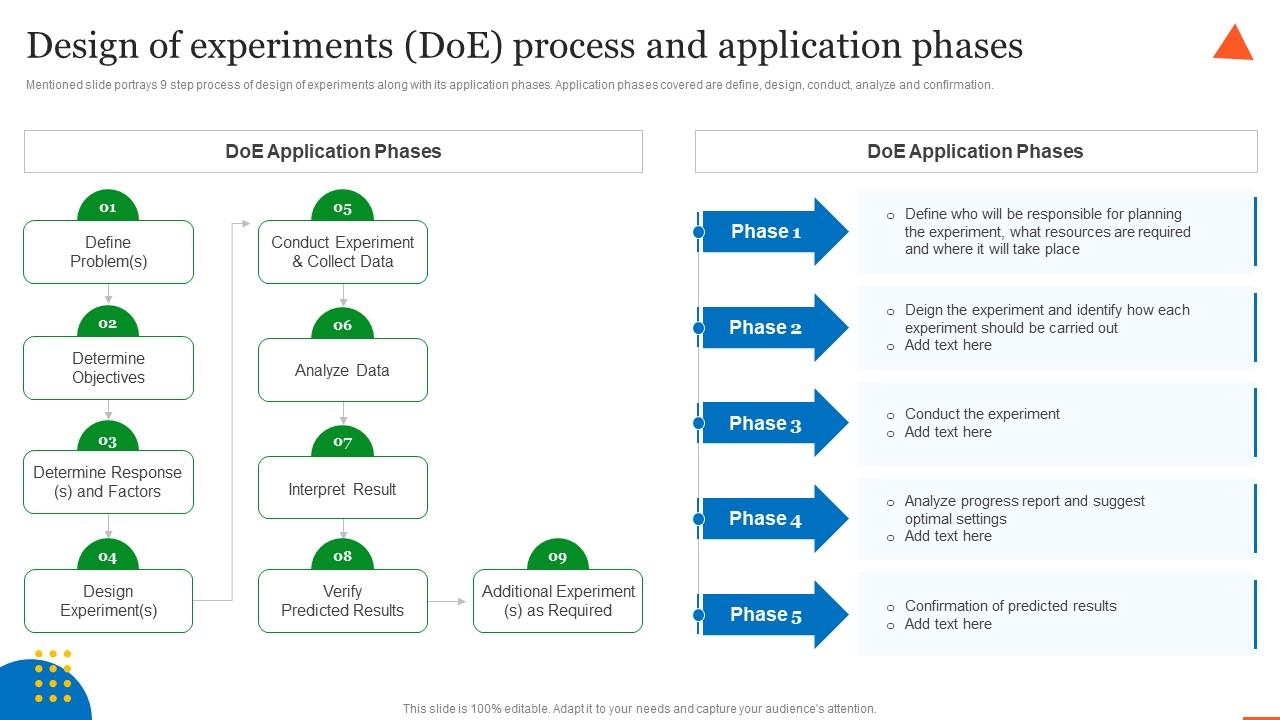
Mentioned slide portrays 9 step process of design of experiments along with its application phases. Application phases covered are define, design, conduct, analyze and confirmation.Deliver an outstanding presentation on the topic using this Design Of Experiments Doe Process And Application Phases QCP Templates Set 1. Dispense information and present a thorough explanation of Conduct Experiment, Design Experiment, Confirmation Predicted using the slides given. This template can be altered and personalized to fit your needs. It is also available for immediate download. So grab it now.

FAQs for Design Of Experiments Doe Process And Application Phases QCP

DOE principles include systematic factor manipulation, randomization, replication, blocking, and statistical control, unlike traditional one-factor-at-a-time approaches. These methodologies streamline research processes by reducing experimental runs, controlling variability, and identifying factor interactions simultaneously, with manufacturing, pharmaceutical, and technology organizations finding that DOE delivers faster innovation cycles and significantly improved product optimization outcomes.

DOE systematically varies multiple factors simultaneously through structured experimental designs like factorial and fractional factorial experiments, enabling researchers to detect interaction effects that single-factor testing would miss. Through strategic factor combinations, organizations in manufacturing, pharmaceuticals, and product development can identify synergistic relationships between variables, ultimately optimizing processes more efficiently than traditional one-factor-at-a-time approaches.

Common DOE experimental designs include factorial designs for multiple factor interactions, response surface methodology for optimization, randomized complete block designs for controlling variability, Latin square designs for two blocking factors, and fractional factorial designs for screening many factors efficiently. These approaches enable organizations to systematically improve processes, optimize product formulations, and enhance quality control across manufacturing, pharmaceutical, and service industries, with many companies finding that strategic design selection significantly reduces experimentation time while maximizing actionable insights.

Randomization in DOE eliminates systematic bias by ensuring each experimental unit has equal probability of receiving any treatment, while controlling for unknown variables that could skew results. Through random assignment, organizations conducting product testing, pharmaceutical trials, and manufacturing optimization can confidently attribute observed differences to actual treatment effects rather than confounding factors, ultimately delivering more reliable data for strategic decision-making.

Sample size determination in DOE is crucial for ensuring statistical power, detecting meaningful effects, and achieving reliable results while optimizing resource allocation. Proper sample sizing enables researchers to minimize Type I and Type II errors, reduce variability in conclusions, and maximize cost-effectiveness, with manufacturing and pharmaceutical industries finding that strategic sample planning ultimately delivers more robust experimental outcomes and competitive advantage.

Factorial designs optimize manufacturing processes by systematically testing multiple variables simultaneously, identifying optimal parameter combinations, and revealing interaction effects between factors like temperature, pressure, and timing. Through statistical analysis of these controlled experiments, manufacturers can minimize defects, reduce waste, and enhance product quality while streamlining production workflows, ultimately delivering improved efficiency and competitive advantage in quality control operations.

Researchers implementing DOE in agriculture and pharmaceuticals face challenges including extended timeframes, high costs, ethical constraints, environmental variability, and regulatory complexity. While agricultural studies must account for seasonal cycles, weather variations, and soil differences, pharmaceutical research navigates strict FDA protocols and patient safety considerations, with many organizations finding that strategic planning and adaptive methodologies ultimately deliver more robust data and competitive advantages.

Popular DOE software includes Minitab, JMP, Design-Expert, R, and MATLAB, each offering experiment design wizards, statistical analysis capabilities, and response surface methodology. These platforms streamline experimental planning through automated design generation, real-time statistical modeling, and comprehensive visualization tools, with many manufacturing and research organizations finding that integrated analysis features significantly reduce time-to-insight while enhancing decision-making accuracy.

Response surface methodology integrates into DOE by using sequential experimental designs, mathematical modeling techniques, and optimization algorithms to map relationships between variables and responses. This strategic combination enables organizations in manufacturing, pharmaceuticals, and chemical processing to predict optimal operating conditions, minimize variability, and maximize product quality, ultimately delivering enhanced process control and competitive advantage.

Replication in DOE involves conducting multiple runs of each experimental condition to enhance statistical validity, reduce experimental error, estimate variance, and increase confidence in results. Through systematic replication, organizations can distinguish true effects from random variation while improving precision of estimates, with manufacturing companies and research institutions finding that replicated experiments deliver more reliable process optimization and robust decision-making capabilities.

DOE methodologies can be adapted for smaller-scale experiments through fractional factorial designs, screening experiments, sequential approaches, and simplified response surface methods that require fewer runs while maintaining statistical validity. These streamlined approaches enable researchers and organizations to identify key variables, optimize processes, and generate actionable insights with limited resources, with many startups and research teams finding that strategic DOE adaptation accelerates innovation cycles.

Ethical considerations in DOE include informed consent, data privacy protection, minimizing participant risk, ensuring representative sampling, and maintaining transparency in methodology and results reporting. These principles enhance research integrity by building stakeholder trust, reducing bias, and delivering reliable outcomes, with organizations across healthcare, manufacturing, and social research finding that ethical frameworks ultimately strengthen both credibility and competitive advantage.

Practitioners can effectively communicate DOE results by translating statistical findings into clear business language, using visual dashboards with charts and graphs, and focusing on actionable recommendations rather than technical details. Through simplified executive summaries and interactive presentations, organizations in manufacturing, healthcare, and service industries streamline decision-making processes, ultimately delivering faster implementation and enhanced stakeholder buy-in across all organizational levels.

Simulation enables organizations to test experimental designs virtually before implementation, optimizing factor combinations, predicting outcomes, and identifying potential issues without resource expenditure. Through Monte Carlo methods and predictive modeling, manufacturers, pharmaceutical companies, and research institutions can refine their DOE frameworks, minimize experimental runs, and enhance statistical power, ultimately delivering more efficient research processes and reliable results.

Businesses leverage DOE principles by systematically testing multiple variables simultaneously, optimizing resource allocation, and accelerating development cycles through structured experimentation. Manufacturing companies, pharmaceutical firms, and tech organizations use DOE to minimize costly trial-and-error approaches, identify optimal product configurations faster, and reduce time-to-market, ultimately delivering competitive advantages through data-driven innovation strategies.

Ratings and Reviews

90% of 100
Review Form
Write a review
Most Relevant Reviews
  1. 80%

    by Jake Smith

    “Slides are formally built and the color theme is also very exciting. This went perfectly with my needs and saved a good amount of time.”
  2. 100%

    by Miller Rogers

    Easy to edit slides with easy to understand instructions.

2 Item(s)

per page: