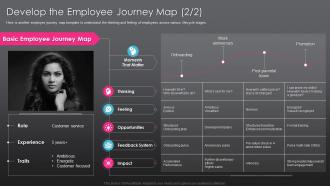
Develop the employee journey map developing employee experience strategy organization
Try Before you Buy Download Free Sample Product
Audience
Editable
of Time
Here is another employee journey map template to understand the thinking and feeling of employees across various lifecycle stages.
People who downloaded this PowerPoint presentation also viewed the following :
Develop the employee journey map developing employee experience strategy organization with all 6 slides:
Use our Develop The Employee Journey Map Developing Employee Experience Strategy Organization to effectively help you save your valuable time. They are readymade to fit into any presentation structure.
FAQs for Develop the employee journey map developing employee
Start with surveying your current people to find the biggest pain points - that's your roadmap right there. Focus on employee journey mapping, feedback loops, and training your managers better. Career development paths matter too, but honestly? Most people quit bad bosses, not bad jobs. Recognition programs help a lot. Track engagement scores and retention rates so you know if anything's actually moving the needle. Oh, and be consistent from onboarding all the way through exit interviews - can't just fix one piece and expect miracles. Fix the worst stuff first, then work your way down.
Track your usual stuff first - engagement scores, retention rates, eNPS. Surveys only go so far though. Exit interviews tell you way more about what's actually broken. I'd also watch internal mobility rates and productivity metrics. Pulse surveys are clutch for understanding the "why" behind numbers. Oh, and definitely set baselines before you change anything - learned that the hard way. Focus groups work too but honestly can be hit or miss depending on who shows up. Stick to maybe 3-5 key metrics max. You don't want to drown in spreadsheets trying to measure everything.
Look, company culture is literally the foundation of everything - it's what makes people either dread Monday mornings or actually feel excited about work. When your culture's solid, employees feel safe speaking up, valued for their contributions, and genuinely connected to their teammates. Think of it as the invisible force that shapes how feedback gets delivered, how mistakes are handled, even whether people grab drinks after work. Here's the thing though - culture isn't those motivational posters on your wall. It's what really happens when leadership isn't around. I'd start by honestly looking at the gap between what you say your culture is versus what employees actually experience day-to-day.
Honestly, tech can make or break how your employees feel about work. Good tools that actually talk to each other? Your team will love you for it. But when people are stuck wrestling with buggy software or switching between a million different apps just to get basic stuff done - ugh, that's when morale tanks. I'd start by just asking your team what's driving them crazy on a daily basis. Short sentences work too. Focus on fixing real pain points instead of buying shiny new toys that nobody asked for. When tech actually works, people can do the meaningful stuff they were hired for.
Send them a welcome email before day one with all the basics - equipment info, schedule, that kind of stuff. Nobody wants to show up completely clueless. Pair them with a buddy who isn't their boss, someone who can answer random questions like where to find decent coffee (trust me, this matters more than you think). Map out their first 30-60-90 days with clear goals and check-ins. Don't just dump PowerPoints on them though - mix in real work so they actually learn how things work. Ask for their feedback throughout and use it to make the process better next time.
Look, you've gotta bake feedback collection into your plan right from day one - can't just slap it on later. Regular pulse surveys work great, plus exit interviews and focus groups. Coffee chats are honestly underrated for this stuff. But here's the thing that trips everyone up: you HAVE to close the loop. People share feedback, you act on it, then tell them what changed. Skip that last part and they'll stop bothering because they feel ignored. Set up a feedback calendar so you're hitting different points throughout someone's time there. Oh, and start small - pick one thing that works well before adding more.
Honestly, start by just asking your team what actually drives them - way better than guessing. Three things work well: recognition (celebrate wins publicly, people eat that up), growth opportunities like mentorship or workshops, and real connection. Remote coffee chats totally count here! Career stagnation is engagement poison, so the development piece is huge. Don't do one-off initiatives though - consistency matters more than flashy programs. Regular feedback loops help too. Build your strategy around what your specific people tell you motivates them, not some generic playbook.
Yeah, remote work isolation is such a pain - probably the worst part of managing distributed teams tbh. People miss those random hallway chats and lunch conversations that used to happen naturally. What's worked for us is being super intentional about connection stuff. Regular one-on-ones, virtual coffee breaks, maybe some collaborative Slack channels or whatever tools you use. Train your managers to actually notice when someone's going quiet or seeming off. Don't wait for people to raise their hand and say "hey I'm struggling" because honestly? Most won't. You've gotta create those touchpoints yourself.
Look, when you actually personalize stuff for your team - like development opportunities or how you recognize their work - people feel seen as individuals instead of just employee
-
Out of the box and creative design.
-
Great experience, I would definitely use your services further.