Developing Sales Incentive Compensation Plan

Rating:
100%
Developing Sales Incentive Compensation Plan Developing Sales Incentive Compensation Plan
Slide 1 of 6

or

Favourites Favourites

Try Before you Buy Download Free Sample Product

Audience Impress Your
Audience
Editable 100%
Editable
Time Save Hours
of Time
The Biggest Sale is ending soon in
0
0
:
0
0
:
0
0
Rating:
100%
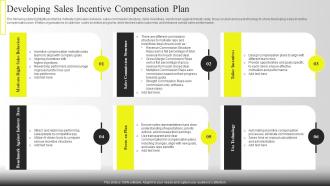
The following slide highlights points like motivate right sales behavior, sales commission structure , tailor incentives, benchmark against industry data, focus on plan and use technology to show developing sales incentive compensation plan. It helps organizations to optimize sales incentive programs, drive desired sales outcomes, and enhance overall sales performance. Introducing our premium set of slides with Developing Sales Incentive Compensation Plan Ellicudate the Six stages and present information using this PPT slide. This is a completely adaptable PowerPoint template design that can be used to interpret topics like Focus On Plan, Sales Commission Structure, Tailor Incentives. So download instantly and tailor it with your information.

FAQs for Developing Sales

Effective sales incentive compensation plans include base salary structures, performance-based commissions, quarterly bonuses, territory or product-specific incentives, and team achievement rewards. These components work together by aligning individual goals with company objectives, motivating consistent performance, and rewarding both short-term wins and long-term strategic growth, ultimately driving revenue while retaining top talent.

Organizations align sales compensation plans with business objectives by establishing clear performance metrics tied to strategic goals, incorporating both individual and team-based incentives, and regularly reviewing plan effectiveness against desired outcomes. Through balanced scorecards that reward revenue growth, customer retention, and market expansion, companies enhance sales performance while driving broader organizational success, with many finding that strategic alignment significantly improves both sales results and business profitability.

Common sales incentive performance metrics include revenue targets, quota attainment, new customer acquisition, deal closure rates, and average deal size. These metrics enable organizations to drive specific behaviors while balancing short-term results with long-term growth, with many companies finding that combining revenue-based measures with activity metrics like lead generation ultimately delivers both immediate performance and sustainable pipeline development.

Determining the optimal balance between base salary and incentive compensation involves analyzing industry benchmarks, sales cycle complexity, competitive market conditions, and individual performance expectations. Organizations typically find that roles with longer sales cycles require higher base salaries for stability, while transactional sales benefit from aggressive incentive structures, ultimately creating compensation packages that attract talent while driving revenue growth.

Sales forecasting provides the foundation for setting realistic quotas, commission structures, and performance targets within compensation plans, ensuring alignment between achievable sales goals and reward mechanisms. Through accurate forecasting, organizations can establish fair baseline expectations, allocate budgets effectively, and create incentive tiers that motivate sales teams while maintaining profitability and sustainable growth trajectories.

Companies ensure competitive compensation plans through comprehensive market research, salary benchmarking studies, industry peer analysis, and regular compensation surveys from reputable sources. This strategic approach enables organizations to attract top talent, retain high performers, and maintain market positioning, with many leading companies finding that data-driven compensation strategies ultimately deliver enhanced recruitment outcomes and reduced turnover costs.

Commission structures should incorporate clear performance metrics, tiered reward levels, achievable quotas, transparent calculation methods, and regular review cycles. These frameworks enhance sales motivation by balancing base salary with performance bonuses, aligning individual goals with company objectives, and providing predictable income streams, with many organizations finding that well-designed structures ultimately boost revenue while reducing turnover.

Sales incentive plans can be adapted through role-specific metrics, with inside sales typically rewarded for call volume, conversion rates, and lead qualification, while outside sales focus on territory growth, relationship building, and deal size. Many organizations find that inside teams benefit from shorter incentive cycles and team-based bonuses, whereas outside representatives respond better to commission structures emphasizing long-term client acquisition and retention.

Common pitfalls include unclear goal alignment, overly complex calculation methods, insufficient communication to sales teams, inadequate technology infrastructure, and failure to pilot test beforehand. These implementation challenges often result in reduced sales motivation, administrative burden, and decreased productivity, with many organizations finding that thorough planning, stakeholder involvement, and phased rollouts ultimately deliver smoother transitions and sustained performance improvements.

Technology enhances sales compensation management through automated calculations, real-time tracking, performance analytics, and streamlined reporting systems. These platforms minimize administrative burden, reduce calculation errors, and provide transparent visibility into earnings, with many organizations finding that sales teams achieve higher performance levels while HR departments significantly reduce processing time and operational costs.

Effective communication strategies include hosting interactive plan presentations, creating detailed written guides with clear examples, conducting one-on-one sessions with managers, and implementing regular check-ins throughout the plan period. These approaches ensure transparency by addressing individual questions, providing visual compensation scenarios, and maintaining ongoing dialogue, with many organizations finding that combining multiple communication channels significantly enhances team understanding and buy-in.

Sales incentive compensation plans should be reviewed quarterly for performance metrics and updated annually for structural changes, market conditions, and strategic alignment. Through regular assessment, organizations streamline goal-setting processes, enhance team motivation, and adapt to evolving market dynamics, with many companies finding that consistent updates ultimately deliver improved sales performance and competitive advantage.

Sales team feedback can improve compensation plan design by identifying unrealistic targets, highlighting market timing challenges, revealing customer behavior insights, and exposing administrative complexities that hinder performance. Through direct input from field representatives, organizations can adjust quota structures, refine territory alignments, and streamline payout processes, ultimately creating more motivating and achievable incentive structures.

Sales incentives significantly enhance employee retention and job satisfaction by providing clear performance recognition, financial rewards, and career advancement opportunities. Through well-structured compensation plans, organizations create competitive environments where top performers feel valued and motivated, ultimately reducing turnover costs while building stronger, more engaged sales teams that consistently exceed targets.

Companies measure sales incentive plan effectiveness through performance metrics like revenue growth, quota attainment, profit margins, customer acquisition costs, and employee retention rates. By analyzing these KPIs alongside program costs, organizations can calculate ROI while identifying which incentive structures drive the highest performance, with many companies finding that data-driven adjustments to compensation plans deliver significantly improved sales outcomes and competitive advantage.

Ratings and Reviews

100% of 100
Review Form
Write a review
Most Relevant Reviews
  1. 100%

    by Chauncey Ramos

    Eye-catching PPT designs, outstanding team, and best customer service. I’m a super satisfied customer here!
  2. 100%

    by Christian Brooks

    Extremely professional slides with attractive designs. I especially appreciate how easily they can be modified and come in different colors, shapes, and sizes!

2 Item(s)

per page: