Different Strategic Product Management Frameworks
Try Before you Buy Download Free Sample Product
Audience
Editable
of Time
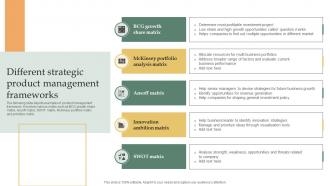
The following slide depicts examples of product management framework. It involves various matrix such as BCG growth share matrix, Ansoff matrix, SWOT matrix, McKinsey portfolio matrix and ambition matrix.
People who downloaded this PowerPoint presentation also viewed the following :
Different Strategic Product Management Frameworks with all 9 slides:
Use our Different Strategic Product Management Frameworks to effectively help you save your valuable time. They are readymade to fit into any presentation structure.
FAQs for Different Strategic
Effective strategic product management frameworks include market research and customer insights, competitive analysis, product roadmap development, cross-functional team coordination, and performance metrics tracking. These components work together by aligning product vision with business objectives, enabling data-driven decision making, and streamlining development processes, with many organizations finding that this integrated approach delivers faster time-to-market and sustained competitive advantage.
Customer personas significantly influence product management frameworks by shaping prioritization criteria, feature development processes, user story creation, and success metrics alignment. Through persona-driven frameworks, product managers can streamline decision-making around customer needs, enhance resource allocation toward high-impact features, and ultimately deliver more targeted user experiences, with many organizations finding that persona-integrated frameworks reduce development costs while accelerating market fit.
Market research serves as the foundation for strategic product management frameworks by providing customer insights, competitive intelligence, market trends analysis, and demand forecasting capabilities. Through comprehensive research methodologies, organizations can identify unmet customer needs, validate product concepts, and assess market opportunities, while reducing development risks and ensuring product-market fit, ultimately delivering more targeted solutions and sustainable competitive advantage.
Agile methodologies integrate into product management frameworks through iterative planning, continuous customer feedback loops, cross-functional collaboration, and adaptive roadmapping that responds to market changes. These approaches enable product teams to deliver incremental value, reduce time-to-market, and pivot strategies based on real user data, with many organizations finding that agile integration ultimately enhances product-market fit and competitive responsiveness.
Essential metrics for evaluating product management strategy success include customer acquisition cost, lifetime value, monthly recurring revenue, user engagement rates, and time-to-market for new features. These metrics enable organizations to track financial performance, customer satisfaction, and operational efficiency simultaneously, with many companies finding that combining leading indicators like user engagement with lagging indicators like revenue growth ultimately delivers comprehensive insights into strategic effectiveness and competitive positioning.
Cross-functional collaboration enhances product management frameworks by breaking down silos, accelerating decision-making, and ensuring diverse perspectives inform product strategy throughout development cycles. Teams spanning engineering, marketing, sales, and customer success streamline communication, reduce time-to-market, and deliver more customer-centric solutions, with many organizations finding that integrated approaches ultimately drive higher product adoption and competitive advantage.
Common pitfalls include inadequate stakeholder alignment, insufficient market research, over-engineering initial versions, neglecting user feedback loops, and failing to establish clear success metrics. Many organizations struggle with balancing feature complexity against user needs, while others rush implementation without proper cross-functional collaboration, ultimately delivering products that miss market expectations and competitive positioning opportunities.
Product managers can best align their frameworks with business objectives by establishing clear success metrics, conducting regular stakeholder alignment sessions, and integrating customer feedback loops directly into strategic planning processes. Through frameworks like OKRs and balanced scorecards, organizations streamline decision-making, enhance cross-functional collaboration, and accelerate time-to-market, ultimately delivering measurable revenue growth and competitive advantage.
Strategies include continuous market monitoring, agile framework modifications, stakeholder feedback loops, competitive analysis integration, and flexible roadmap planning. These approaches enable product managers to pivot quickly through real-time data analysis, iterative testing, and cross-functional collaboration, with many technology and retail organizations finding that adaptive frameworks deliver faster market responses and sustained competitive advantage.
Emerging technologies impact strategic product management frameworks by enabling data-driven decision making, accelerating development cycles, and enhancing customer experience personalization through AI, IoT, and analytics integration. These technologies streamline market research, automate testing processes, and facilitate real-time feedback loops, with organizations in retail, healthcare, and fintech finding that technology-enhanced frameworks deliver faster time-to-market and improved competitive positioning.
Feedback loops are essential for continuous product improvement, enabling product managers to gather user insights, validate assumptions, measure performance metrics, and identify market shifts throughout the development cycle. Through systematic feedback collection from customers, stakeholders, and analytics, organizations can pivot strategies faster, reduce development costs, and enhance user satisfaction, ultimately delivering more competitive products that align with evolving market demands.
Data analytics optimizes product management frameworks by enabling data-driven decision making, predictive market analysis, customer behavior insights, and performance tracking across product lifecycles. Through advanced analytics tools, organizations streamline resource allocation, enhance feature prioritization, and accelerate time-to-market strategies, while delivering improved customer experiences and competitive advantage in increasingly dynamic markets.
Product management frameworks support innovation by establishing structured ideation processes, creating clear evaluation criteria for new concepts, facilitating cross-functional collaboration, and implementing systematic testing methodologies. These frameworks enable organizations to streamline innovation pipelines, minimize resource waste on unviable ideas, and accelerate time-to-market, with many companies finding that structured approaches ultimately deliver more breakthrough products and sustainable competitive advantage.
Effective stakeholder engagement practices include regular communication cadences, collaborative roadmap planning, transparent priority setting, cross-functional alignment workshops, and data-driven progress reporting. These approaches streamline decision-making by building consensus early, managing expectations proactively, and ensuring strategic alignment, with many product teams finding that structured stakeholder involvement accelerates development cycles and enhances market success.
Strategic product management frameworks differ between B2B and B2C companies primarily through customer engagement cycles, decision-making complexity, and value proposition focus. B2B frameworks emphasize longer sales cycles, multi-stakeholder approval processes, and relationship-based selling, while B2C approaches prioritize rapid user acquisition, emotional engagement, and individual purchasing decisions, with many organizations finding that B2B requires deeper customization and ongoing support structures.
-
Very unique and reliable designs.
-
What a stunning collection of customizable templates! Really a time-saver..Â