Different Types Of Blockchain Business Models
Try Before you Buy Download Free Sample Product
Audience
Editable
of Time
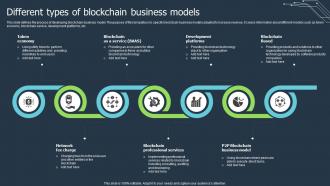
This slide defines the process of developing blockchain business model. The purpose of this template is to specify blockchain business models adopted to increase revenue. It covers information about different models such as token economy, blockchain service, development platforms, etc.
People who downloaded this PowerPoint presentation also viewed the following :
Different Types Of Blockchain Business Models with all 6 slides:
Use our Different Types Of Blockchain Business Models to effectively help you save your valuable time. They are readymade to fit into any presentation structure.
FAQs for Different Types Of
Blockchain business models include decentralized finance (DeFi), supply chain management, digital identity solutions, non-fungible tokens (NFTs), and secure data storage. These technologies streamline operations by enhancing transparency, reducing fraud, and automating processes, with many financial services and retail organizations finding that these models deliver significant cost reductions and improved customer experiences.
Decentralized Finance (DeFi) platforms generate revenue through transaction fees, lending interest, and liquidity mining rewards, while also utilizing governance tokens and yield farming. These technologies streamline financial processes by disintermediating traditional institutions, with many fintech companies finding that automated market makers and flash loans deliver significant operational efficiency and new revenue streams. Ultimately, this enables enhanced transparency and accessibility in an increasingly competitive financial landscape.
Blockchain technology enhances supply chain transparency and efficiency by enabling immutable record-keeping, automated processes, and real-time tracking of goods. While implementation presents both challenges and opportunities, organizations—from food producers to pharmaceutical companies—are finding that this streamlines operations by minimizing disputes, reducing counterfeiting, and accelerating product recalls. Ultimately delivering enhanced trust and optimized resource allocation across complex networks.
Tokenomics strategies encompass token distribution, utility, and incentive mechanisms, including staking, burning, and governance rights, to foster a thriving ecosystem. These approaches streamline value accrual by aligning stakeholder interests, with many DeFi platforms finding that well-designed tokenomics enhance network participation and long-term sustainability, ultimately delivering increased liquidity and competitive advantage.
Blockchain enhances customer engagement and loyalty in retail by streamlining loyalty programs, personalizing offers, and ensuring secure data management. Through tokenized rewards and transparent transactions, retailers can foster trust and incentivize repeat purchases, with many brands finding that gamified experiences drive significant participation. Ultimately delivering increased customer lifetime value and a competitive advantage in an increasingly experience-driven landscape.
Smart contract automation reduces operational costs by streamlining processes, minimizing manual errors, and accelerating transaction speeds. These self-executing agreements eliminate intermediaries—like escrow services—and automate tasks such as invoice processing and supply chain management. With many financial services institutions finding that automated compliance delivers significant efficiency, ultimately enhancing transparency and reducing administrative overhead.
NFTs are witnessing startup innovation through decentralized finance (DeFi) integrations, fractional ownership models, and dynamic NFT applications—evolving beyond digital collectibles. These technologies enhance revenue streams by enabling artists, creators, and brands to monetize digital assets, with many gaming companies finding that NFTs foster player engagement and in-game economies, ultimately delivering new monetization avenues and enhanced customer experiences.
Blockchain business models face regulatory challenges including data privacy, security, and jurisdictional uncertainties, alongside evolving KYC/AML requirements. These technologies are navigating complexities by prioritizing compliance frameworks, embracing sandbox environments, and fostering collaboration with regulatory bodies, ultimately delivering transparency and building trust with many financial services and supply chain institutions finding that proactive engagement minimizes risk and enables seamless integration.
Enterprise blockchain solutions differ from public blockchains by prioritizing permissioned access, data privacy, and regulatory compliance, while public blockchains emphasize decentralization and open participation. These technologies streamline supply chains for manufacturers, enhance data security for financial services, and facilitate transparent transactions for healthcare institutions, ultimately delivering enhanced operational efficiency and competitive advantage. With many organizations finding that controlled ecosystems foster trust and innovation, enterprise blockchain presents both challenges and opportunities for scalable business integration.
Blockchain initiatives require tracking transaction costs, processing speeds, and network scalability, alongside security breach incidents and data immutability rates. These technologies enhance transparency by providing auditable trails, streamline supply chains, and ultimately deliver cost reductions and improved efficiency, with many financial services institutions finding that real-time settlement reduces risk.
Blockchain technology can be integrated by focusing on incremental improvements to existing processes, such as supply chain tracking, digital identity management, and secure data sharing. While complete overhauls present both challenges and opportunities, organizations are finding that pilot programs in areas like loyalty programs and contract automation streamline operations and enhance transparency. These technologies enable faster transactions, minimize fraud, and ultimately deliver cost reduction and competitive advantage across industries.
Blockchain business models include supply chain tracking, digital identity management, secure voting systems, decentralized finance (DeFi), and non-fungible tokens (NFTs). These technologies streamline operations by enhancing transparency, reducing fraud, and automating processes, with many financial services firms finding that smart contracts accelerate loan approvals and settlements. Ultimately delivering increased efficiency and competitive advantage across industries like retail and healthcare.
Blockchain business models, while transformative, present both challenges and opportunities regarding security, scalability, and regulatory uncertainty. These risks can be mitigated through robust encryption, permissioned blockchains for controlled access, and proactive engagement with evolving legal frameworks. With many financial services and supply chain institutions finding that comprehensive risk assessments and phased implementations ultimately deliver enhanced transparency and operational efficiency.
Blockchain fundamentally alters ownership by enabling decentralized, transparent, and immutable records of asset control through cryptographic keys. While traditional ownership relies on intermediaries, blockchain facilitates direct peer-to-peer transactions, streamlining processes for sectors like real estate and supply chain management. These technologies enhance security by minimizing fraud and disputes, ultimately delivering greater trust and efficient resource allocation with many institutions finding that fractional ownership becomes viable.
Blockchain technology significantly impacts traditional payment systems by enabling decentralized, secure, and transparent transactions, reducing reliance on intermediaries like banks. While offering benefits such as lower fees and faster processing, it also presents challenges regarding scalability and regulation. With many financial institutions finding that smart contracts streamline processes, new business models—including decentralized finance (DeFi) and micro-payment systems—are evolving, ultimately delivering enhanced efficiency and competitive advantage.
-
Awesome presentation, really professional and easy to edit.
-
If you are looking for satisfactory PowerPoint services, SlideTeam is your go-to place. I am fully contented with their research and development team.