Digitales Reifegradmodell
Try Before you Buy Download Free Sample Product
Audience
Editable
of Time
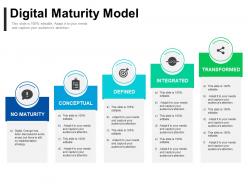
Verteilen Sie Ihre Geschäftseinblicke auf professionelle Weise mit unserer digitalen PowerPoint-Diashow mit Reifegradmodell. Ein elegantes Visual eines fünfstufigen horizontalen Prozesses mit Symbolen und Textfeldern wurde hier implementiert, um dieses PPT-Layout mit digitaler Reife zu erstellen. Unterschiedliche Reifegradmodelle werden hier als kein Reifegrad, konzeptionell definiert, integriert transformiert dargestellt. Verwenden Sie diese PowerPoint-Folie des digitalen Reifegradmodells, um die Reife Ihres Unternehmens darzustellen, vergleichende Benchmarks anzubieten und Ihre Maßnahmen zur Verbesserung Ihrer digitalen Fähigkeiten zu leiten. Wettbewerbsgeist ist etwas, das Gewinnern gemeinsam ist, sei es im Wettbewerb mit sich selbst um internes Wachstum oder um sich in der Geschäftswelt abzuheben, um Ihre Einzigartigkeit zu erhalten. Die Visuals dieser PowerPoint-Präsentation spiegeln das Motiv klar wider, wobei alle Themen direkt in den Blickpunkt des Kunden projiziert, heruntergeladen und Änderungen angezeigt werden. Teilen Sie Ihre Geschäftskonzepte professionell mit unserer digitalen PowerPoint-Diashow mit Reifegradmodell. Unser engagiertes Designteam hat dieses brillante PPT-Visual möglich gemacht. Mit unserem digitalen Reifegradmodell PPT-Diagramm können Sie Ihre digitale Zukunftsplanung zur Erreichung Ihrer Geschäftsziele darstellen. Ein wunderschönes Bild eines fünfstufigen horizontalen Prozesses mit Symbolen und Textfeldern wurde verwendet, um diese Präsentationsvorlage für digitale Reife zu erstellen. Dieses PPT-Visual des digitalen Reifegradmodells enthält das Konzept der digitalen Strategie und Prozessgestaltung. Verwenden Sie diese PowerPoint-Folie des digitalen Reifegradmodells, um die Reife Ihres Unternehmens darzustellen, vergleichende Benchmarks anzubieten und Ihre Maßnahmen zur Verbesserung Ihrer digitalen Fähigkeiten zu leiten. Mit diesem attraktiven PPT-Visual für digitale Reife in Ihrem Geschäftsbetrieb können Sie die Essenz der Reise Ihres Unternehmens im Laufe der Jahre festhalten. Außerdem können Sie Ihre Geschäftsstrategien entsprechend dem Zeitraum festlegen, in dem Sie sie implementieren möchten. Stellen Sie mit unserem Digital Maturity Model Ihren hohen Intentionsgrad fest. Zeigen Sie Ihre Entschlossenheit als Einzelperson.
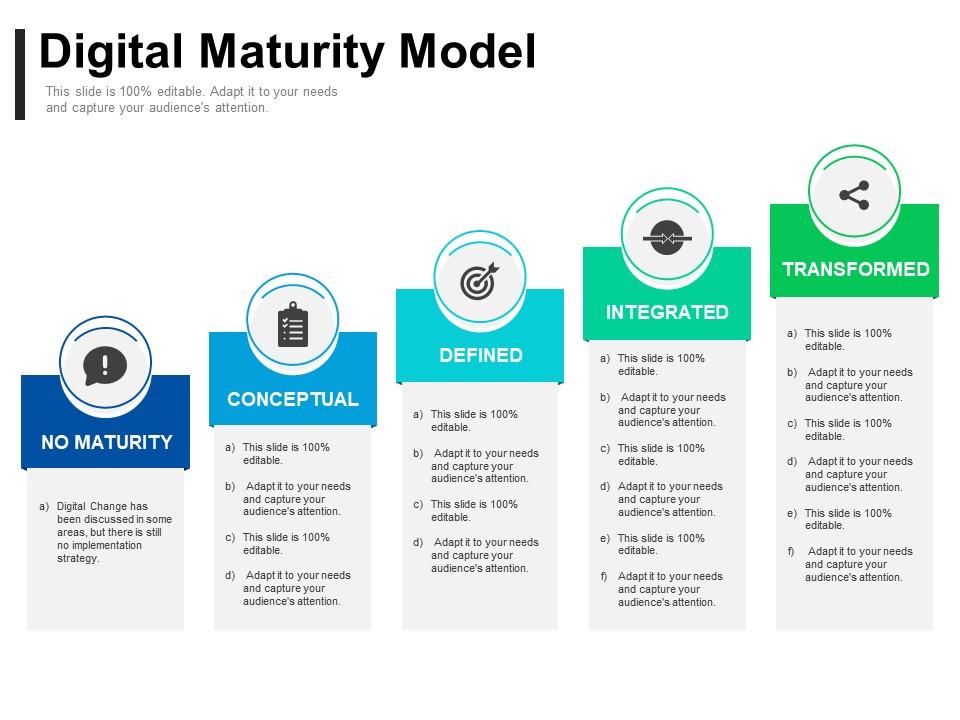
Merkmale dieser PowerPoint-Präsentationsfolien:
Präsentieren Sie das digitale Reifegradmodell PPT-Design. Diese PowerPoint-Folie kann von einem Geschäftsprofi geübt werden, um seine verschiedenen Agenden im Geschäft anzuzeigen. Sie können die Textpunkte einfach bearbeiten und auch die Farbe des Hintergrunds und des Layouts nach Ihren Wünschen ändern und sogar die Farbe der angezeigten Häkchen verbessern. Dieses Design ist im 4:3-Standard und in der Vollbildversion 16:9 verfügbar und mit Google Slides kompatibel.
People who downloaded this PowerPoint presentation also viewed the following :
Digitales Reifegradmodell mit allen 5 Folien:
Unser Digital Maturity Model hat eine makellose Qualität. Sie tragen zur Reinheit Ihrer Gedanken bei.
FAQs for
Honestly, cloud computing and AI/ML are pretty much non-negotiable now - everyone's doing it. Data analytics too. IoT is massive if you're in manufacturing or retail, gives you those real-time insights you actually need. Your mobile app better not suck because that's how customers judge you these days (learned that one the hard way). Automation and RPA are cleaning up operations everywhere. But here's the thing - don't go crazy trying to implement everything. Pick one or two that actually make sense for what you're trying to accomplish. Way better than spreading yourself thin.
Track the obvious stuff first - ROI, cost savings, revenue from new digital channels. But honestly? Customer experience metrics matter just as much. Net Promoter Score, satisfaction ratings, faster issue resolution times. Your internal team's adoption rates are huge too - if people aren't actually using the new tools, you're screwed. I'd set up maybe 3-5 key metrics on a dashboard. Check monthly so you can pivot fast if something's not working. Oh, and productivity gains - that's where you'll see if the change is really sticking.
Dude, your leaders have to be all-in from the start. If the CEO's still faxing stuff while preaching digital change, nobody's buying it. Culture's the other huge thing - people get freaked out when you mess with how they work. Make it safe to screw up and try new things. I've seen too many companies skip this part and wonder why their fancy new systems just collect dust. Get your leadership team on the same page first, then build a culture where learning beats being perfect every time.
Honestly, it all comes down to getting your team excited from day one. Talk to them constantly - explain why you're doing this and what they'll actually get out of it, not just corporate benefits. Small wins first to get momentum going. Budget way more for training than feels reasonable (trust me on this one). Leadership always thinks people will just figure it out, but that's how projects die. Oh, and find champions in each department who genuinely believe in the changes - they'll sell it better than you ever could. Even the slickest technology won't save you if your people aren't on board.
Honestly, the hardest part is dealing with people who just hate change - your team will fight you on new tools even when they're obviously better. Plus the money side is rough. Digital stuff costs a fortune upfront and takes forever to pay off. Your current people probably don't know how to use half the new tech either, which means tons of training. Oh and trying to connect new systems with old ones? Total headache - I've been there. Start with something small first, like a pilot program. Get your boss fully on board before you do anything major, and yeah, budget way more for training than you think you'll need.
So digital transformation is honestly a game-changer for customer experience. You can set up AI chatbots for round-the-clock support, plus analytics help you figure out what people want before they even know it themselves. Omnichannel stuff across web, mobile, and physical stores makes everything flow better. Self-service portals are huge too - customers love solving things on their own timeline. I'd start by mapping out your customer journey first and spotting the biggest headaches. That's where you'll see the fastest wins. Real-time feedback and automated workflows just make everything smoother overall.
Honestly, data analytics is like having x-ray vision for your business decisions. You stop guessing what customers actually want and start seeing real patterns in the data. I've watched teams get totally hooked once they realize they can predict trends before competitors even notice them. Short wins, long-term strategy - it all gets clearer. The trick is keeping your data clean and accessible so people don't waste weeks waiting for some report that's already outdated. Risk management becomes way easier too since you'll spot problems early instead of playing catch-up later.
So digital transformation basically tears down those old management hierarchies - info moves way faster when it's all digital. Teams start working together instead of staying in their little departments. Most of the tedious manual stuff? Gone through automation. Honestly, it's pretty crazy how much busywork just vanishes. Decision-making gets pushed down to people actually doing the work, and everything becomes more data-focused. The whole thing shifts from those rigid step-by-step processes to something way more flexible. I'd start by mapping out what you're doing now and finding where things get stuck.
Here's the thing - small businesses can actually move way faster than those giant corporations stuck with ancient systems and tons of red tape. Start with your website and make it actually good, then get on social media but don't be fake about it. Tools like Zapier can automate the boring stuff without breaking the bank. Cloud tech is honestly a game-changer since you get the same tools big companies use for a fraction of the cost. Don't try to digitize everything at once though - pick one thing and nail it first. You'll save money and sanity.
Honestly, digital transformation usually does wonders for getting people more engaged at work. Better communication tools and real-time sharing means teams actually connect instead of sending endless email chains. Plus people can focus on stuff that matters rather than fighting with ancient systems all day. Remote workers especially love it since everyone's finally on equal footing. The trick is bringing employees into the process when you're picking tools - nobody wants software dumped on them from corporate. Oh, and workflows get way less clunky which is huge for morale.
Honestly, don't even think about adding security after the fact - it's a nightmare and costs way more. Get your security people involved right from the planning stage, like actually sitting in those early meetings. Do assessments before you implement anything new. Zero-trust should be built right into whatever systems you're putting in place, plus encrypt everything you can. Oh, and don't forget to train people as you roll stuff out - they'll be your weakest link otherwise. I know it sounds like extra work, but security should help your transformation happen smoother, not slow it down.
So there are three big things that'll bite you if you ignore them. Job displacement is huge - don't just fire people, actually invest in retraining them. Algorithmic bias is sneaky because your AI will just amplify whatever biases already exist in your data (I've seen this mess up so many companies). Also, you need clear policies about customer data and how you're using it to train your systems. Honestly, most places treat ethics like an afterthought but you should bake it into your planning from the start. Way easier than fixing disasters later.
Healthcare and finance definitely have some crazy advantages other industries don't get. AI diagnostics can catch diseases way before doctors do, and telemedicine reaches people in the middle of nowhere. Finance has real-time fraud detection - like, we're talking millions of transactions processed instantly. That speed still blows my mind honestly. Both fields get better data security too, which matters since they're so heavily regulated. Oh, and compliance becomes way more automated. I'd say figure out what's causing your biggest headaches first, then see which digital tools actually solve those specific problems.
Honestly, get your leadership on board first or you're screwed from the start. Don't try to change everything at once - that's a recipe for disaster. Roll it out piece by piece instead. Your employees need to be involved early since they're actually using this stuff daily, and they usually know where the real problems are anyway. Training is huge - I can't stress this enough. Pick tools that fix actual issues, not whatever's trendy right now. Oh, and track your results with real numbers so you can prove it's working. Start small, show it works, then expand.
So digital transformation basically fixes all those supply chain headaches you're dealing with. Instead of drowning in spreadsheets, you get real-time tracking and AI that actually predicts what you'll need. IoT sensors follow your shipments around, blockchain keeps everything transparent - honestly it's pretty crazy how much better things work when your systems can actually communicate. I mean, who knew? Your whole operation becomes way more flexible, costs go down, and you catch problems before they blow up. My advice? Figure out what's driving you most insane right now and find the tech that'll solve that specific mess first.
No Reviews