


Digital Transformation Integrating Front And Back Office Processes For Workflow Automation DT SS




Try Before you Buy Download Free Sample Product
 Impress Your
 Audience
 100%
100% Editable
 Save Hours
 of Time


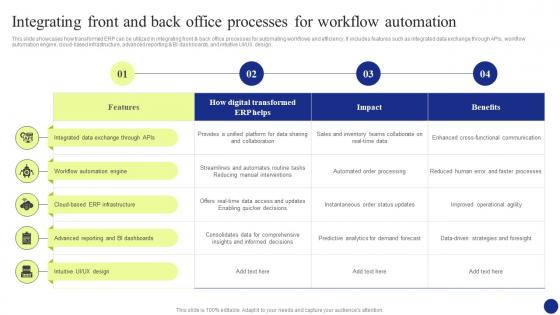
This slide showcases how transformed ERP can be utilized in integrating front and back office processes for automating workflows and efficiency. It includes features such as integrated data exchange through APIs, workflow automation engine, cloud-based infrastructure, advanced reporting and BI dashboards, and intuitive UI UX design.
People who downloaded this PowerPoint presentation also viewed the following :
Digital Transformation Integrating Front And Back Office Processes For Workflow Automation DT SS with all 9 slides:
Use our Digital Transformation Integrating Front And Back Office Processes For Workflow Automation DT SS to effectively help you save your valuable time. They are readymade to fit into any presentation structure.








FAQs for Digital Transformation Integrating Front And Back Office Processes For Workflow
Key components of a successful digital transformation strategy include technology modernization, data analytics integration, cultural change management, customer experience enhancement, and operational process redesign. These elements work together by streamlining workflows, enabling data-driven decisions, and fostering organizational agility, with many companies finding that strategic combination ultimately delivers competitive advantage and sustainable growth.
Organizational culture significantly impacts digital transformation success by influencing employee adoption, change resistance, and innovation capacity throughout the implementation process. Companies with collaborative, adaptable cultures typically see faster technology integration and higher user engagement, while rigid organizational structures often struggle with transformation initiatives, ultimately requiring cultural alignment strategies to deliver sustainable competitive advantages and operational efficiency.
Customer experience serves as the primary catalyst for digital transformation, driving organizations to modernize their technology infrastructure, streamline processes, and enhance service delivery channels. Companies across retail, banking, and healthcare increasingly recognize that superior customer experiences directly translate to competitive advantage, with many finding that digital initiatives focused on user satisfaction ultimately deliver higher retention rates, increased revenue, and stronger market positioning.
Businesses can measure digital transformation ROI through key performance indicators like operational efficiency gains, cost reduction percentages, customer satisfaction scores, revenue growth metrics, and time-to-market improvements. Through comprehensive analytics platforms, organizations track productivity increases, streamlined processes, and enhanced customer experiences, with many finding that combining quantitative financial data with qualitative outcomes delivers the most accurate transformation value assessment.
Common digital transformation challenges include resistance to change, legacy system integration complexities, skills gaps, cybersecurity concerns, and insufficient budget allocation. Organizations frequently encounter cultural barriers and employee hesitancy, while technical hurdles around data migration and system compatibility can slow progress, though companies increasingly find that strategic change management and phased implementation approaches help overcome these obstacles while delivering enhanced operational efficiency.
AI and IoT revolutionize digital transformation strategies by enabling real-time data collection, predictive analytics, and automated decision-making across business operations. These technologies streamline processes through intelligent automation, enhanced customer insights, and operational efficiency, with manufacturing companies leveraging IoT sensors for predictive maintenance while retailers use AI for personalized experiences, ultimately delivering competitive advantage and scalable growth.
Digital transformation enhances operational efficiency in traditional industries through automation, data analytics, cloud computing, IoT integration, and AI-powered decision making. These technologies streamline processes by reducing manual tasks, optimizing resource allocation, and enabling real-time monitoring, with many manufacturing and logistics companies finding that digital solutions ultimately deliver faster production cycles, lower operational costs, and improved quality control.
Leadership can foster innovation during digital transformation by encouraging experimentation, investing in employee upskilling, creating cross-functional collaboration teams, and establishing safe-to-fail environments where creative risk-taking is rewarded. These approaches enable organizations to streamline change management, enhance workforce adaptability, and accelerate technology adoption, with many companies finding that empowered teams deliver breakthrough solutions and sustained competitive advantage.
Best practices for integrating legacy systems with new digital solutions include API development, middleware implementation, data migration strategies, phased rollouts, and comprehensive testing protocols. These approaches streamline operations by maintaining existing functionality while enabling modern capabilities, with many financial institutions and healthcare organizations finding that strategic integration delivers enhanced efficiency, reduced costs, and improved customer experiences without disrupting critical business processes.
Data analytics contributes to informed decision-making by providing real-time insights, predictive modeling capabilities, performance tracking, and trend identification across organizational operations. Through advanced analytics platforms, companies can assess transformation progress, optimize resource allocation, and identify emerging opportunities, with many enterprises finding that data-driven insights significantly accelerate their digital initiatives while minimizing implementation risks.
Digital transformation fundamentally reshapes workforce training through personalized learning platforms, virtual reality simulations, microlearning modules, AI-powered skill assessments, and remote collaboration tools. These technologies streamline training delivery by reducing costs, accelerating skill acquisition, and enabling continuous development, with many organizations finding that strategic upskilling ultimately delivers competitive advantage and enhanced employee retention.
Companies ensure data security and privacy during digital transformation by implementing robust encryption protocols, establishing comprehensive access controls, conducting regular security audits, and adopting zero-trust architectures. Through strategic cybersecurity frameworks, organizations streamline compliance with regulations like GDPR and HIPAA, while enhancing threat detection capabilities, ultimately delivering secure customer experiences and maintaining competitive advantage in increasingly digital markets.
Technology, financial services, retail, healthcare, and manufacturing currently lead digital transformation due to competitive pressures, regulatory demands, and customer expectations driving innovation. These sectors leverage cloud computing, AI, and automation to streamline operations, enhance customer experiences, and reduce costs, with many finding that early adoption delivers significant competitive advantages in increasingly digital markets.
SMEs can leverage digital transformation by adopting cloud-based solutions, implementing automation tools, utilizing data analytics for decision-making, and embracing e-commerce platforms to expand market reach. These technologies enable smaller organizations to streamline operations, reduce overhead costs, and deliver personalized customer experiences that rival larger competitors, with many SMEs finding that strategic digital investments ultimately provide the agility and efficiency needed to compete effectively in increasingly competitive markets.
Partnerships and collaborations accelerate digital transformation by providing access to specialized expertise, cutting-edge technologies, and shared resources that organizations might lack internally. Through strategic alliances, companies can leverage external innovation, reduce implementation costs, and minimize transformation risks, with many enterprises finding that collaborative approaches deliver faster market entry and enhanced competitive positioning.
-
Excellent products for quick understanding.
-
I can say with full confidence that all your business, academic, or professional work requirements will be sufficed with SlideTeam. Their gallery is as rich as 2Million+!!
-
I was able to find the right choice of PPT template for my thesis with SlideTeam. Thank you for existing.
-
“Immediate response, professional support, and effective solutions that were customized and immediately provided. Well done- Thank you!”