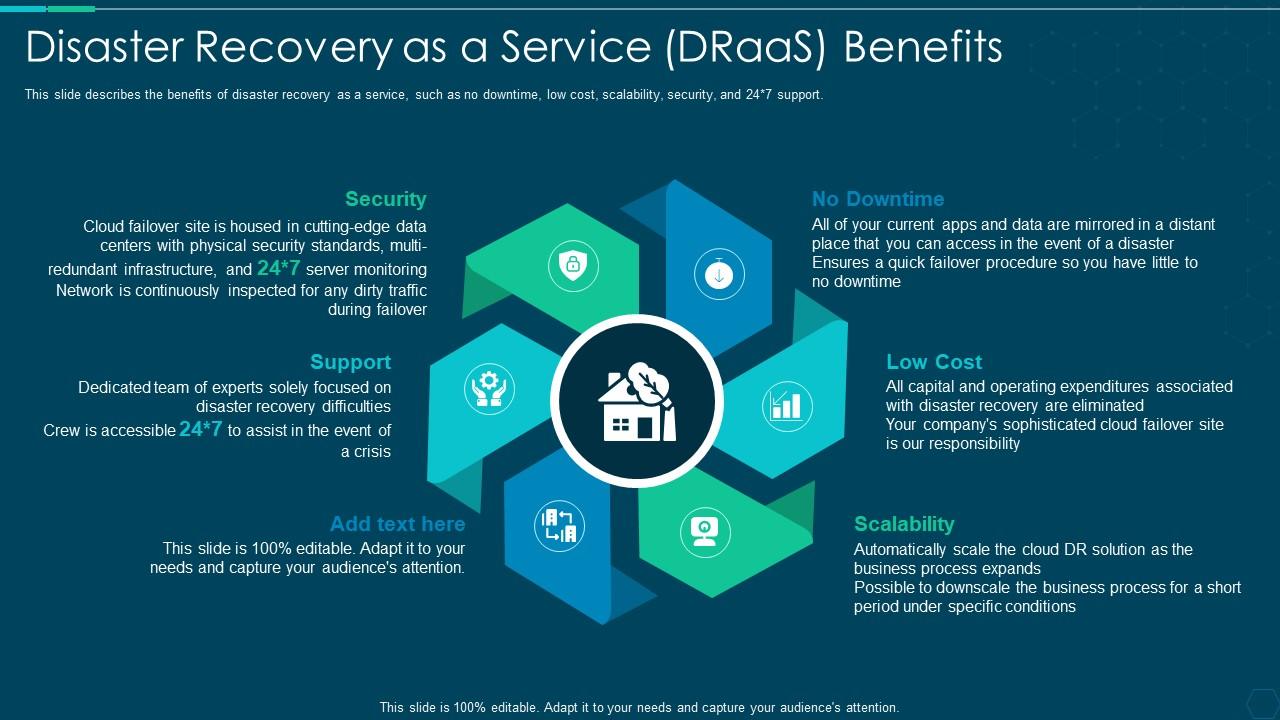
Disaster recovery as a service draas benefits ppt ideas diagrams
Try Before you Buy Download Free Sample Product
Audience
Editable
of Time
Our Disaster Recovery As A Service Draas Benefits Ppt Ideas Diagrams are topically designed to provide an attractive backdrop to any subject. Use them to look like a presentation pro.
People who downloaded this PowerPoint presentation also viewed the following :
Disaster recovery as a service draas benefits ppt ideas diagrams with all 6 slides:
Use our Disaster Recovery As A Service Draas Benefits Ppt Ideas Diagrams to effectively help you save your valuable time. They are readymade to fit into any presentation structure.
FAQs for Disaster recovery as a service draas benefits
Key DRaaS components include cloud-based backup infrastructure, automated failover systems, real-time data replication, recovery orchestration tools, and continuous monitoring capabilities. These technologies streamline business continuity by minimizing downtime, ensuring data integrity, and enabling rapid system restoration, with many organizations finding that comprehensive DRaaS solutions deliver faster recovery times and significantly lower operational costs.
DRaaS enhances business continuity planning by providing automated backup systems, faster recovery times, and scalable cloud infrastructure that eliminates traditional disaster recovery complexities. Through cloud-based replication and testing capabilities, organizations streamline their continuity strategies while reducing costs, ensuring reliable failover processes, and maintaining operational resilience, with many enterprises finding significantly improved recovery objectives and reduced downtime risks.
DRaaS significantly reduces costs by eliminating expensive hardware investments, minimizing dedicated facility requirements, and reducing IT staff overhead compared to traditional disaster recovery. Organizations typically achieve 40-60% cost savings through pay-as-you-use pricing models, automated testing processes, and streamlined recovery operations, with many enterprises finding that cloud-based approaches deliver faster implementation and lower total ownership costs.
DRaaS improves RTO and RPO through automated failover systems, pre-configured recovery environments, continuous data replication, and cloud-based infrastructure that eliminates traditional backup delays. These capabilities enable organizations to achieve recovery times of minutes rather than hours, minimize data loss through real-time synchronization, and maintain business continuity, with many enterprises finding that cloud-based disaster recovery delivers significantly faster restoration than on-premise solutions.
DRaaS integrates with existing IT infrastructure through APIs, virtualization technologies, and hybrid cloud architectures, enabling seamless data replication and system coordination across on-premises and cloud environments. Through automated orchestration tools, organizations streamline backup processes, minimize integration complexity, and maintain operational continuity, with many enterprises finding that strategic DRaaS deployment enhances their overall resilience while reducing infrastructure management overhead.
Essential DRaas security measures include multi-factor authentication, end-to-end encryption, network segmentation, continuous monitoring, and compliance certifications like SOC 2 and ISO 27001. These safeguards work together by protecting data in transit and at rest, enabling automated threat detection, and ensuring regulatory compliance, with many financial services and healthcare organizations finding that layered security approaches ultimately deliver both operational resilience and customer trust.
DRaaS addresses diverse regulatory requirements by offering customizable compliance frameworks, automated documentation, industry-specific data protection protocols, and regulatory reporting capabilities tailored to sectors like healthcare, finance, and government. Through configurable retention policies, encryption standards, and audit trails, organizations streamline compliance with regulations like HIPAA, SOX, and GDPR, ultimately reducing regulatory risk while maintaining operational continuity.
Automation in Disaster Recovery as a Service streamlines backup processes, enables rapid failover capabilities, reduces manual intervention requirements, and ensures consistent recovery procedures across all systems. Through automated monitoring and orchestration, organizations achieve faster recovery times, minimize human error risks, and maintain business continuity seamlessly, with many enterprises finding that automated DRaaS delivers significant operational efficiency improvements.
Organizations assess DRaaS provider effectiveness through recovery time objectives (RTO), recovery point objectives (RPO), uptime guarantees, compliance certifications, and regular testing protocols. Through comprehensive disaster simulations and performance audits, companies evaluate failover speeds, data integrity, customer support responsiveness, and cost predictability, with many enterprises finding that quarterly testing and detailed SLA monitoring ultimately delivers confidence in business continuity preparedness.
Common DRaaS misconceptions include believing it's only for large enterprises, that it's too expensive for small businesses, that it replaces all backup needs, and that recovery is always instantaneous. In reality, DRaaS offers scalable solutions for organizations of all sizes, with many finding that cloud-based recovery delivers faster restoration times and lower costs than traditional disaster recovery methods, ultimately providing strategic competitive advantage.
DRaaS supports remote workforce considerations by providing cloud-based access to critical applications, automated data synchronization across multiple locations, and scalable infrastructure that adapts to sudden workforce distribution changes. Through virtualized desktop environments and secure connectivity protocols, organizations enable employees to maintain productivity from any location during disasters, while ensuring data integrity and business continuity, ultimately delivering operational resilience.
Organizations should track Recovery Time Objective (RTO), Recovery Point Objective (RPO), system availability percentages, data integrity rates, and cost per recovery incident. These metrics enable businesses to measure operational continuity, minimize downtime costs, and ensure regulatory compliance, with many financial services and healthcare organizations finding that comprehensive tracking ultimately delivers competitive advantage through faster disaster response.
DRaaS enables SMEs to access enterprise-grade disaster recovery capabilities without massive infrastructure investments, providing automated backups, rapid recovery times, and 24/7 monitoring through cloud-based solutions. This strategic approach allows smaller businesses to achieve the same resilience as larger competitors, with many finding that DRaaS delivers cost-effective protection while freeing resources for core business growth.
DRaaS significantly enhances data management and governance by providing centralized backup systems, automated compliance monitoring, standardized recovery protocols, and real-time data synchronization capabilities. Through cloud-based infrastructure, organizations streamline regulatory reporting, ensure consistent data quality across multiple locations, and maintain audit trails, with financial services and healthcare institutions finding that automated governance reduces compliance costs while improving data integrity.
Businesses can ensure seamless DRaaS transition by conducting thorough data assessments, establishing clear recovery objectives, selecting compatible cloud providers, and implementing phased migration strategies. Through comprehensive testing protocols and staff training programs, organizations streamline operations while minimizing downtime risks, ultimately delivering enhanced business continuity and operational resilience across their infrastructure.
-
Really like the color and design of the presentation.
-
Awesome use of colors and designs in product templates.