Download network performance assessment ppt powerpoint slides

Rating:
90%
Download network performance assessment ppt powerpoint slides
Slide 1 of 7
Favourites Favourites

Try Before you Buy Download Free Sample Product

Audience Impress Your
Audience
Editable 100%
Editable
Time Save Hours
of Time
The Biggest Sale is ending soon in
0
0
:
0
0
:
0
0
Rating:
90%
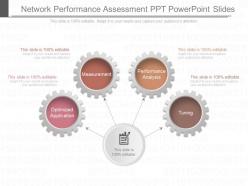
Presenting download network performance assessment ppt powerpoint slides. This is a network performance assessment ppt powerpoint slides. This is a four stage process. The stages in this process are optimized application, measurement, performance analysis, tuning.

FAQs for Download network performance assessment

Essential KPIs include latency, throughput, packet loss, bandwidth utilization, network availability, and error rates. These metrics enable organizations to streamline operations by identifying bottlenecks, optimizing resource allocation, and enhancing user experiences, with many enterprises finding that comprehensive monitoring ultimately delivers improved productivity and competitive advantage.

High latency significantly degrades user experience by causing slow web page loading, buffering during video streaming, delayed file transfers, and poor real-time communication quality. In business environments, excessive latency disrupts critical applications like VoIP systems, video conferencing, and cloud-based software, ultimately reducing productivity, frustrating users, and potentially impacting customer satisfaction and operational efficiency.

**INPUT**: What tools are best suited for real-time network performance monitoring? **OUTPUT**: Real-time network performance monitoring tools include PRTG, SolarWinds NPM, Nagios, Wireshark, and ManageEngine OpManager, each offering comprehensive visibility into network health and traffic patterns. These solutions streamline operations by detecting bottlenecks, predicting failures, and automating alerts, with many enterprises finding that proactive monitoring ultimately delivers faster issue resolution and enhanced user experiences. [Word count: 58 words]

Network performance assessments should be conducted monthly for baseline monitoring, with quarterly comprehensive reviews and immediate assessments following major changes or incidents. This strategic approach enables organizations to proactively identify bottlenecks, optimize resource allocation, and maintain competitive advantage, with many enterprises finding that regular assessments reduce downtime costs and enhance overall operational efficiency.

Network bandwidth and throughput serve as fundamental metrics for measuring network capacity and actual data transfer rates, directly impacting application performance, user experience, and operational efficiency. These measurements enable organizations to identify bottlenecks, optimize resource allocation, and ensure adequate connectivity for critical business applications, with many enterprises finding that regular monitoring prevents costly downtime and enhances productivity.

Packet loss significantly degrades application performance by causing delays, timeouts, and data retransmissions, directly impacting user satisfaction through slower response times and interrupted services. In streaming applications, VoIP systems, and financial trading platforms, even minimal packet loss creates buffering, call quality issues, and transaction delays, ultimately driving users away and reducing business productivity in increasingly competitive digital environments.

End-to-end performance testing is crucial for network assessment because it evaluates complete data paths from source to destination, identifying bottlenecks, latency issues, and capacity constraints across entire network infrastructures. This comprehensive approach enables organizations to optimize user experiences, ensure application reliability, and maintain service quality standards, with many enterprises finding that systematic end-to-end testing significantly reduces downtime and enhances operational efficiency.

Different network topologies significantly influence performance metrics through varying data flow patterns, bandwidth distribution, and fault tolerance capabilities. Star topologies deliver centralized management and predictable performance, while mesh networks provide redundancy and load distribution, and hybrid approaches enable organizations to optimize speed, reliability, and scalability based on their specific operational requirements.

Common network bottlenecks include bandwidth limitations, hardware constraints, network congestion, improper configurations, and inadequate Quality of Service settings. These issues can be identified through network monitoring tools, performance analytics, traffic analysis, and real-time diagnostics, with many organizations finding that proactive assessment enables faster troubleshooting, optimized resource allocation, and enhanced operational efficiency.

Weather and physical infrastructure significantly impact network performance through signal interference, equipment degradation, and connectivity disruptions caused by storms, temperature fluctuations, and aging hardware. These external factors can cause packet loss, increased latency, and service outages, with many telecommunications providers finding that proactive monitoring and infrastructure hardening ultimately delivers more resilient networks and consistent customer experiences.

Strategies include redundant infrastructure deployment, load balancing optimization, Quality of Service prioritization, proactive monitoring systems, and disaster recovery planning. These approaches enhance network reliability by distributing traffic efficiently, identifying bottlenecks before failures occur, and ensuring rapid recovery, with many organizations finding that strategic combinations deliver improved uptime and competitive operational advantage.

Machine learning and AI enhance network performance assessment by automating anomaly detection, predicting potential bottlenecks before they occur, and analyzing vast amounts of network data in real-time. These technologies enable IT teams to identify performance issues faster, optimize resource allocation more effectively, and deliver proactive network maintenance, with many enterprises finding that AI-driven assessment reduces downtime significantly while improving overall network reliability.

Cybersecurity considerations during network performance evaluation include encryption impact analysis, threat detection system overhead, security protocol latency, vulnerability scanning effects, and access control verification. These assessments help organizations balance performance optimization with security requirements by identifying bottlenecks in firewalls, intrusion prevention systems, and endpoint protection, ultimately delivering both robust security and optimal network efficiency.

Virtualization transforms network performance assessment by creating shared resource pools, dynamic allocation challenges, and abstracted visibility layers that require specialized monitoring tools. Through software-defined networking and hypervisor-based analytics, organizations can achieve more granular performance insights, faster troubleshooting, and optimized resource utilization, while enabling scalable assessment frameworks that adapt to changing virtual environments.

5G technology presents both challenges and opportunities for network performance measurement, requiring enhanced latency monitoring, dynamic bandwidth assessment, edge computing analytics, network slicing evaluation, and real-time quality metrics. These advanced measurement techniques enable organizations to optimize ultra-low latency applications, manage massive IoT deployments, and deliver superior customer experiences, ultimately providing significant competitive advantages in an increasingly connected landscape.

Ratings and Reviews

90% of 100
Review Form
Write a review
Most Relevant Reviews
  1. 100%

    by Doyle Andrews

    Awesome use of colors and designs in product templates.
  2. 80%

    by Darrell Crawford

    Really like the color and design of the presentation.

2 Item(s)

per page: