Driving And Restraining Forces For International Business

Rating:
100%
Driving And Restraining Forces For International Business
Slide 1 of 6
Favourites Favourites

Try Before you Buy Download Free Sample Product

Audience Impress Your
Audience
Editable 100%
Editable
Time Save Hours
of Time
The Biggest Sale is ending soon in
0
0
:
0
0
:
0
0
Rating:
100%
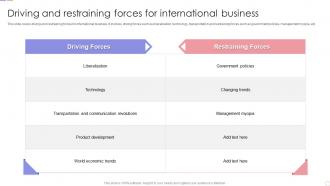
This slide covers driving and restraining forces for international business. It involves driving forces such as liberalization, technology, transportation and restraining forces such as government policies, management myopia, etc. Introducing our Driving And Restraining Forces For International Business set of slides. The topics discussed in these slides are Restraining Forces, Driving Forces, Government Policies. This is an immediately available PowerPoint presentation that can be conveniently customized. Download it and convince your audience.

People who downloaded this PowerPoint presentation also viewed the following :

FAQs for Driving And Restraining Forces

Key economic factors influencing international business operations include exchange rate fluctuations, inflation rates, interest rate variations, GDP growth patterns, and trade policy changes. These economic forces streamline global market entry strategies, enhance risk assessment capabilities, and enable strategic resource allocation, with many multinational corporations finding that proactive economic monitoring ultimately delivers competitive advantages and operational resilience.

Political stability and government policies significantly influence foreign investment decisions by affecting regulatory predictability, tax structures, property rights protection, and operational security. Investors typically favor countries with stable governance, transparent legal frameworks, and consistent policy environments, while political volatility, frequent policy changes, or restrictive regulations can deter investment, ultimately impacting economic growth and competitive positioning.

Cultural diversity significantly influences international business negotiations through communication styles, decision-making processes, relationship-building approaches, trust establishment methods, and conflict resolution preferences. While presenting both challenges and opportunities, diverse cultural perspectives enhance creative problem-solving, expand market insights, and strengthen global partnerships, with many multinational organizations finding that culturally aware negotiation strategies ultimately deliver more sustainable agreements and competitive advantage.

Tariffs and trade agreements significantly reshape global supply chain strategies by influencing sourcing decisions, manufacturing locations, and distribution networks. Companies increasingly diversify suppliers across multiple regions, establish regional production hubs, and negotiate long-term contracts to mitigate tariff risks, while trade agreements enable streamlined operations, reduced costs, and enhanced market access for competitive advantage.

Currency fluctuations significantly impact international pricing strategies through exchange rate volatility, competitive positioning shifts, profit margin compression, and market access considerations. Companies increasingly adopt dynamic pricing models, natural hedging strategies, and multi-currency approaches to mitigate risks, with many multinational organizations finding that flexible pricing frameworks ultimately deliver greater market resilience and competitive advantage.

Technological advancements reshape market entry strategies by enabling digital-first approaches, reducing physical infrastructure requirements, and facilitating data-driven market analysis before expansion. Through e-commerce platforms, cloud services, and AI-powered market research, companies streamline entry processes, minimize upfront costs, and accelerate market penetration, with many organizations finding competitive advantages through technology-enabled scaling strategies.

Multinational corporations drive global economic trends through cross-border investments, technology transfer, supply chain integration, and market standardization across regions. These organizations influence international trade patterns, employment opportunities, and economic policies, with companies like Apple, Samsung, and Unilever ultimately delivering innovation diffusion and competitive market dynamics worldwide.

Social and environmental responsibilities significantly influence international business reputation by building consumer trust, attracting ethical investors, and enhancing brand credibility across diverse markets. Companies demonstrating strong sustainability practices and social impact, such as those in retail and manufacturing sectors, often experience improved customer loyalty, reduced regulatory risks, and competitive advantages in increasingly conscious global markets.

Emerging markets offer higher growth potential, lower competition, and cost advantages, while presenting currency volatility, regulatory uncertainty, and infrastructure challenges compared to developed markets' stability and predictability. While developed markets provide reliable returns and established frameworks, emerging markets like India, Brazil, and Southeast Asia increasingly deliver accelerated expansion opportunities, with many multinational corporations finding that strategic diversification across both market types ultimately enhances long-term competitive positioning.

Businesses can effectively navigate international labor laws through comprehensive legal research, local expert partnerships, standardized compliance frameworks, and region-specific HR policies. Many multinational corporations streamline this complexity by establishing dedicated international compliance teams, leveraging local legal counsel, and implementing scalable HR management systems, ultimately ensuring regulatory adherence while maintaining operational efficiency across diverse markets.

Consumer behavior varies internationally through cultural preferences, purchasing power, digital adoption rates, brand loyalty patterns, and decision-making processes influenced by local traditions and economic conditions. Companies should adapt by conducting market-specific research, localizing product offerings and marketing messages, adjusting pricing strategies for regional economies, and partnering with local distributors, ultimately delivering culturally relevant experiences that resonate with diverse consumer expectations.

Firms can mitigate geopolitical risks through diversification across multiple markets, strategic partnerships with local entities, comprehensive political risk insurance, scenario planning, and maintaining flexible supply chains. These approaches enable organizations to minimize exposure by spreading operations geographically, leveraging local expertise, and quickly adapting to political changes, with many multinational corporations finding that proactive risk assessment ultimately delivers operational resilience and competitive advantage.

Digital transformation intensifies global competition by enabling businesses to reach international markets more efficiently, automate operations, and deliver personalized customer experiences at scale. Through cloud technologies, AI-powered analytics, and digital platforms, companies can reduce operational costs, accelerate market entry, and compete with established players regardless of geographic location, ultimately leveling the competitive playing field.

E-commerce in international business presents both challenges and opportunities, including cross-border logistics complexities, currency fluctuations, regulatory compliance, market access barriers, and cultural adaptation requirements. While these factors create operational hurdles, they also enable global market expansion, streamlined customer acquisition, and enhanced supply chain efficiency, with many retailers finding that digital platforms ultimately deliver competitive advantage and accelerated international growth.

International business forces significantly impact sustainability and ethical practices through regulatory compliance requirements, stakeholder pressure for transparency, supply chain accountability standards, and competitive market demands for responsible operations. These forces drive organizations to adopt sustainable sourcing, ethical labor practices, and environmental stewardship, with many multinational corporations finding that sustainable operations ultimately deliver cost savings, enhanced brand reputation, and competitive advantage in increasingly conscious global markets.

Ratings and Reviews

100% of 100
Write a review
Most Relevant Reviews
  1. 100%

    by Damian Stevens

    You guys are life-saver when it comes to presentations. Honestly I cannot do much without your services. Thank you!!!
  2. 100%

    by O'Kelly Phillips

    It’s really cool, and you can find pretty much everything you could need for your work or school.

2 Item(s)

per page: