


Ecommerce platform pitch deck ppt template





Try Before you Buy Download Free Sample Product
 Impress Your
 Audience
 100%
100% Editable
 Save Hours
 of Time


Here is a professionally designed pitch deck on the E commerce Platform specifically designed to present a summary of an emerging eCommerce platform with details about its mission statement and features, critical statistics of the eCommerce platform. The pitch deck presentation serves as an effective tool in attracting investors. It covers slides about various concerns prospects face in terms of difficulty setting up an online store, higher initial cost, and no integration of payment and shipping. It covers slides regarding unified solutions to handle concerns such as localized, agile eCommerce platforms. The eCommerce platform caters to the total addressable market for the eCommerce platform, extensive ad effective partner ecosystem, the unique value proposition. The pitch deck comprises growth vectors, key financial highlights, competitive positioning, and investment highlights of the eCommerce platform. It caters to slide about e-commerce platform SWOT analysis and competitive landscape. Details about the client associated with the forum, key people involved in the executive team, and the board of directors involved. Financial projections and future initiatives of the eCommerce platform are presented. Talk to our expert team for all your queries and access the pitch deck on the eCommerce Platform. Download the template and book a free demo now.
People who downloaded this PowerPoint presentation also viewed the following :
Content of this Powerpoint Presentation
Slide 1: This slide displays the title i.e. 'Ecommerce Platform Pitch Deck' and your company name.
Slide 2: This slide presents the table of contents for the pitch deck.
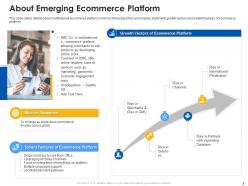
Slide 3: This slide shows multinational ecommerce platform, in terms of headquarters and mission statement, growth vectors and salient features of ecommerce platform.
Slide 4: This slide caters details about key statistics associated to ecommerce platform in terms of number of employees, estimated annual revenue, active merchants, etc.
Slide 5: This slide caters details about characteristics of multi channel ecommerce platform as single and easy to use back office, etc.
Slide 6: This slide presents concerns faced by clients in terms of difficulty associated to online store setting up, cost concerns and manual payment and shipping process.
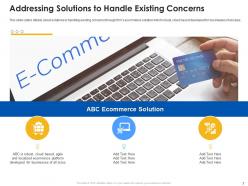
Slide 7: This slide exhibits solutions in handling existing concerns through firm’s ecommerce solution which robust, cloud based developed for businesses of all sizes.
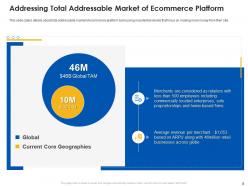
Slide 8: This slide caters details about total addressable market of ecommerce platform by focusing on potential clients that focus on making more money from their site.
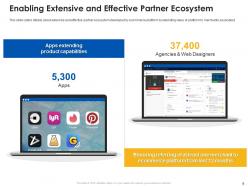
Slide 9: This slide caters details about extensive and effective partner ecosystem developed by ecommerce platform by extending value of platform to merchants associated.
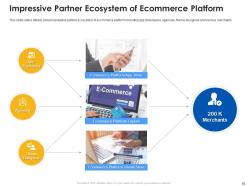
Slide 10: This slide caters details about impressive partner ecosystem of ecommerce platform including app developers, agencies, theme designers and various merchants.
Slide 11: This slide displays key partners associated with ecommerce platform in terms of strategic partners, app and integration partners, design and development agencies.
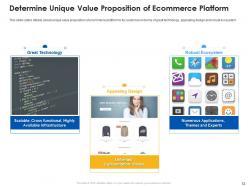
Slide 12: This slide shows unique value proposition of ecommerce platform to its customers in terms of great technology, appealing design and robust ecosystem.
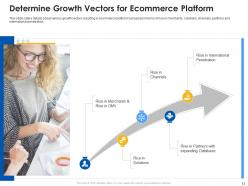
Slide 13: This slide presents various growth vectors resulting in ecommerce platform’s progress in terms of rise in merchants, partners and international penetration, etc.
Slide 14: This slide caters details about key financial highlights of ecommerce platform in terms of growth, profitable business model and long-term focus.
Slide 15: This slide displays robust and competitive market position of ecommerce platform as compared to competitors in context to share of US retail ecommerce sales.
Slide 16: This slide caters details about impressive consistent revenue growth of ecommerce platform with expansion in merchant’s success with key drivers.
Slide 17: This slide exhibits increase in Gross Merchandise Volume (GMV) with merchants getting scaled and succeeding on ecommerce platform.
Slide 18: This slide shows profitable business model for ecommerce platform addressing how platform will incur revenue through different packages for merchants.
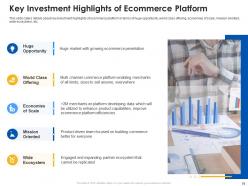
Slide 19: This slide explains key investment highlights of ecommerce platform in terms of huge opportunity, economies of scale, mission oriented, wide ecosystem, etc.
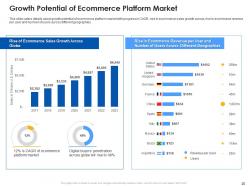
Slide 20: This slide describes growth potential of ecommerce platform market with progress in CAGR, number of users across different geographies, etc.
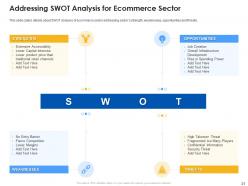
Slide 21: This slide caters details about SWOT analysis of ecommerce sector addressing sector’s strength, weaknesses, opportunities and threats.
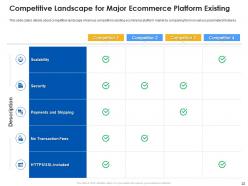
Slide 22: This slide shows competitive landscape of various competitors existing ecommerce platform market by comparing them on various parameters/ features.
Slide 23: This slide caters details about clients associated to ecommerce platform in terms of major clients and client testimonials.
Slide 24: This slide explains key people associated to executive team of ecommerce platform responsible in making key strategic decisions.
Slide 25: This slide caters details about board of directors associated to ecommerce platform.
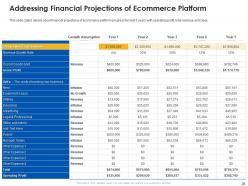
Slide 26: This slide showcases financial projections of ecommerce platform progress for next 5 years with operating profit, total revenue and Opex.
Slide 27: This slide caters details about future initiatives by ecommerce platform that will focus on leveraging connections across potential stakeholders.
Slide 28: This is the icons slide for the pitch deck.
Slide 29: This slide displays the title for additional slides.
Slide 30: This slide presents about the company, target audience and its client's values.
Slide 31: This slide exhibits the 30-60-90 days plan for the pitch deck.
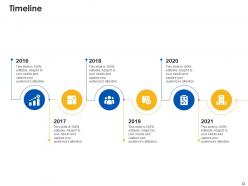
Slide 32: This slide shows the yearly timeline for the company.
Slide 33: This slide describes the posts for pasts experiences and feedbacks of the clients with the company.
Slide 34: This slide explains the circular process of the company.
Slide 35: This slide showcases the targets of the company.
Slide 36: This slide displays the puzzle related to pitch deck and company.
Slide 37: This slide exhibits the venn of the project.
Slide 38: This slide presents the ideas generated for the company.
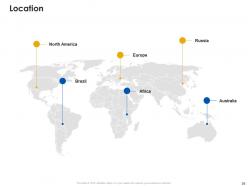
Slide 39: This slide shows the location of the company across the globe.
Slide 40: This is the thank you slide and contains contact details of the company including phone no., office address, etc.
Ecommerce platform pitch deck ppt template with all 40 slides:
Use our Ecommerce Platform Pitch Deck Ppt Template to effectively help you save your valuable time. They are readymade to fit into any presentation structure.















FAQs for Ecommerce platform pitch
Okay so you'll want the standard stuff - problem/solution, market size, business model, financials. But honestly, unit economics are make-or-break for ecommerce decks. Show your CAC and LTV numbers upfront because that's literally all investors care about. Include your product roadmap and supply chain approach too. Oh, and when you do traction slides, use actual sales data instead of just web traffic - nobody's impressed by page views anymore lol. Screenshots of your platform work way better than boring bullet points. Competitive landscape matters obviously. End with a specific funding ask and break down exactly where the money goes.
Think of your pitch like a mini movie trailer - seriously, that hook matters! Paint the customer's pain point as the villain everyone can relate to. Then your ecommerce solution becomes the hero swooping in. Real customer stories work way better than just throwing data at people. You want investors to feel something, not just get the business model. Each slide should move your story forward. Oh and definitely show the actual transformation your product creates - like before/after but for people's lives. The emotional journey is what'll stick with them after you're done talking.
Honestly, three things matter most: market size, growth rate, and how your customers actually spend money. Start with the big TAM numbers - investors want to see billions here, not some tiny niche. Growth should be at least 10% yearly or they'll think it's dead in the water. Then get into the weeds on your specific customers - how often do they buy, what's their average order, that kind of stuff. I know it sounds boring but this detail work pays off. Don't forget trends that help you out, like everyone shopping on their phones now. Big picture first, then zoom into your slice of it.
Focus on the metrics that actually matter - revenue growth, customer acquisition cost, lifetime value, and your unit economics. Monthly breakdown for year one, then quarterly after that. Honestly, most people go overboard with like 50 line items and investors just zone out. Stick to main revenue streams, COGS, and your big expense categories. The thing that kills most ecommerce decks? Unrealistic customer acquisition assumptions. Don't be that person. Throw in a simple scenario analysis with conservative and optimistic cases. Always explain what's driving your growth numbers - that's what they really want to understand.
White space is your friend - don't cram everything together. Stick to 2-3 colors from your brand and use real product screenshots, not cheesy stock photos. Investors want to see what you've actually built. Make fonts big enough to read (24pt minimum) and one main point per slide. Your charts should tell the growth story clearly. Honestly? So many pitch decks look ancient. If design isn't your thing, grab a Canva or Pitch template and customize it. Oh, and those growth metrics better be legit - that's what they're really there to see.
Give your USP its own slide for sure, but also sprinkle it through the whole deck. Problem/solution slides should nail exactly what gap you're filling that others miss. When you hit the market analysis part, position yourself against competitors and show what's different. Product demo is where you can really shine - show off those unique features or why your UX beats theirs. Don't just claim you're "better" though. Use real metrics, customer quotes, or direct comparisons. Oh, and make sure it ties to how you'll make money. If investors can't instantly see why someone would pick you over the big guys, those slides need work.
Look, you've got to nail customer segmentation in your pitch deck - it's what separates the pros from the wannabes. Break your market into real groups based on age, buying habits, whatever makes sense for your product. "Everyone will love this" is startup suicide, trust me. Your segments should connect directly to how you'll market and price things. Without solid segmentation, investors think you're just guessing. Oh and make sure you can explain which group you're going after first - that focus is what gets VCs excited. They want to see you actually get your customers, not just hope for the best.
Pick 3-5 main competitors and throw them on a 2x2 grid - maybe price vs features, or market share vs innovation, whatever makes you look good honestly. Include direct competitors plus some indirect ones who solve the same customer problems differently. Don't trash talk them though, that's always cringey in pitch decks. Just acknowledge what they do well, then highlight where you're actually different or better. The key is having real data to back up whatever you claim. I'd probably spend more time on the indirect competitors since investors sometimes miss those threats.
Honestly, revenue growth is your bread and butter - show those monthly trends climbing up. Customer acquisition cost and lifetime value are clutch too. Conversion rates will make investors' eyes light up because it proves you're not just getting traffic, you're actually closing sales. Repeat purchases and average order value matter way more than people think since they show your model isn't just a flash in the pan. Monthly active users, retention rates... oh and inventory turnover if that applies to you. Pick like 4-6 metrics that make you look best and be ready to explain any weird dips.
Dude, be super specific about your ask - exact dollar amount, timeline, equity percentage. Break down where every dollar goes: inventory, marketing, hiring, tech stuff. Vague requests kill deals instantly, trust me on this one. Show clear milestones you'll hit with their cash and how long the runway lasts. Your projections better actually match what you're asking for too. I'd put this slide near the end, right before you wrap up. Oh and don't overthink the formatting - investors just want the numbers to make sense.
So for your marketing section, break down who your customers are and how you'll actually reach them without burning cash. List your main channels - social media, paid ads, SEO, whatever - but here's the thing: explain WHY those specific channels make sense for your product. Don't just throw spaghetti at the wall. Include your CAC and LTV if you've got those numbers figured out. Any early wins? Toss in conversion rates or engagement stats. Honestly, investors want proof you can get customers profitably, not just cross your fingers and hope they show up.
Honestly, just make a whole slide about your biggest risks - don't try to hide them because investors will spot that BS immediately. Pick 3-4 real ones like supply chain problems or crazy customer acquisition costs, then right after each risk explain how you'll handle it. Show them you've actually thought this through, not just hoping problems disappear. Market saturation, regulatory stuff, competition - be upfront about it all. I've watched so many pitches crash when founders pretend everything's perfect. End the slide talking about how you'll keep tracking these issues as they change.
Dude, seriously - stop being vague about market size and how you'll actually make money. Investors want real numbers, not some "massive opportunity" BS. Most founders waste half their slides on product features when they should be showing traction instead. Oh, and don't skip the competition slide thinking you're special (you're not lol). Your projections need to be believable too - those crazy hockey stick charts just scream amateur hour. Keep it short, maybe 10-12 slides tops. Practice until you can nail the important stuff in under 10 minutes without stumbling.
I'd throw testimonials right into your traction slide or make a separate validation one. Grab quotes with actual numbers - "boosted sales 40%" or "saves me 3 hours each week." Screenshots of real reviews are honestly way better than plain text blocks, people trust them more. For case studies, pick maybe 2 customers max and show their problem, how you fixed it, and what happened after. Before/after numbers work really well here. Oh and don't just dump all your customer logos on one slide - sprinkle them throughout your deck instead.
Honestly, just go with PowerPoint, Google Slides, or Canva. PowerPoint's got the most bells and whistles if you need detailed control. Google Slides is clutch for working with your team since everyone can edit simultaneously. But Canva? That's my pick if you're not a design person - they've got these ecommerce templates that make you look way more professional than you actually are lol. Yeah, Figma and Keynote exist too, but why complicate things? Pick whichever one you already know how to use. You can always get fancy with the next deck once you've got funding.
-
Editable templates with innovative design and color combination.
-
Good research work and creative work done on every template.
-
Awesome presentation, really professional and easy to edit.
-
Informative presentations that are easily editable.
-
Unique design & color.
-
It saves your time and decrease your efforts in half.
-
Nice and innovative design.