Ecommerce Website Development Project Iteration Model
Try Before you Buy Download Free Sample Product
Audience
Editable
of Time
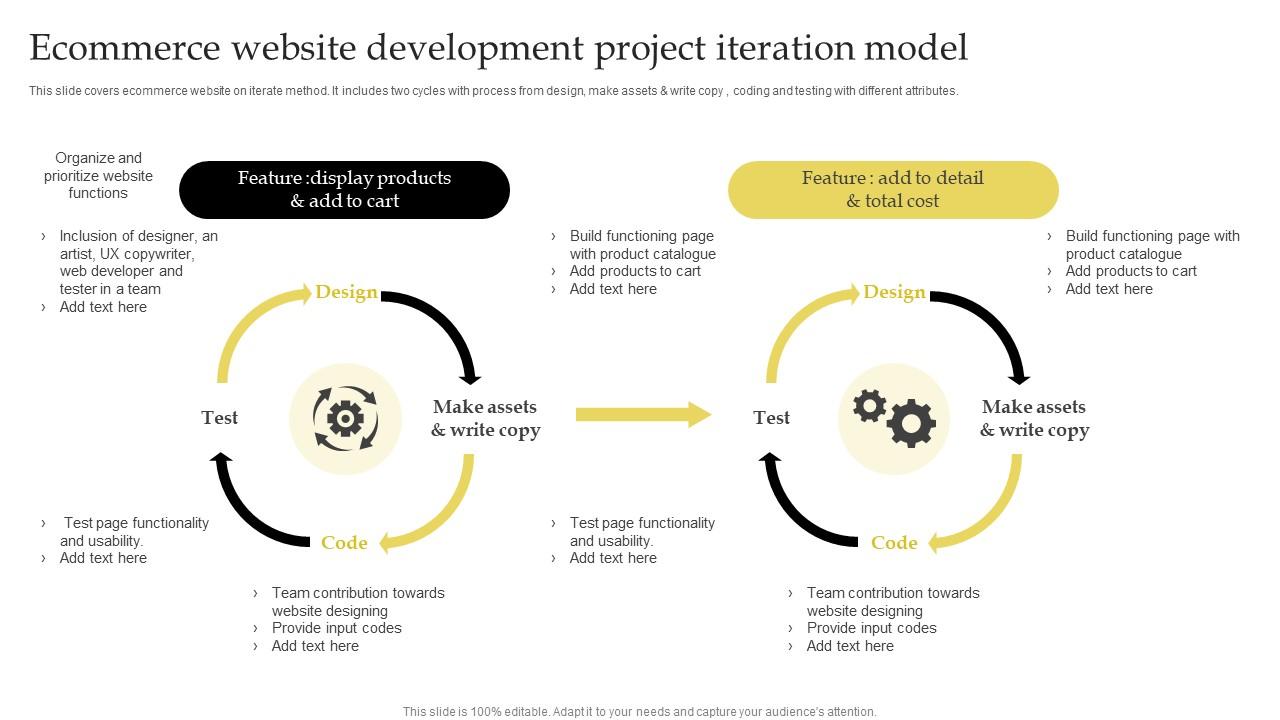
This slide covers ecommerce website on iterate method. It includes two cycles with process from design, make assets and write copy , coding and testing with different attributes.
People who downloaded this PowerPoint presentation also viewed the following :
Ecommerce Website Development Project Iteration Model with all 6 slides:
Use our Ecommerce Website Development Project Iteration Model to effectively help you save your valuable time. They are readymade to fit into any presentation structure.
FAQs for Ecommerce Website Development
Essential eCommerce features include intuitive navigation, robust search functionality, secure payment gateways, mobile responsiveness, customer reviews, and streamlined checkout processes. These elements work together to reduce cart abandonment, increase conversion rates, and build customer trust, with many online retailers finding that strategic implementation of user-centric design ultimately delivers higher sales and competitive advantage.
Responsive design significantly enhances eCommerce performance by ensuring seamless user experiences across smartphones, tablets, and desktops through adaptive layouts, optimized loading speeds, and intuitive navigation. This approach delivers improved conversion rates, reduced bounce rates, and enhanced customer satisfaction, with many retailers finding that mobile-responsive sites generate substantially higher sales and stronger competitive positioning in increasingly mobile-driven markets.
SEO plays a crucial role in eCommerce development by enhancing product visibility, driving organic traffic, and improving search rankings through optimized site structure, keyword integration, and technical performance. Effective implementation includes strategic keyword placement in product descriptions, fast-loading pages, mobile responsiveness, and schema markup, with many retailers finding that these optimizations significantly increase conversion rates and competitive advantage.
Website speed optimization significantly improves eCommerce conversion rates by reducing bounce rates, enhancing user experience, and increasing search engine rankings. Faster-loading sites enable customers to browse products seamlessly, complete checkouts without frustration, and return for future purchases, with many retailers finding that even one-second improvements deliver measurable increases in sales and customer satisfaction.
Best practices for user-friendly eCommerce checkout include guest checkout options, minimal form fields, clear progress indicators, multiple payment methods, and transparent shipping costs. These design elements streamline the purchasing process by reducing cart abandonment, accelerating transaction completion, and building customer trust, with many online retailers finding that simplified checkouts deliver significantly higher conversion rates and enhanced customer satisfaction.
Integrating social media enhances eCommerce marketing by expanding reach, enabling targeted advertising, and facilitating user-generated content that builds trust and authenticity. Through platforms like Instagram and Facebook, retailers streamline customer acquisition, boost brand visibility, and drive conversions with social proof, ultimately delivering enhanced engagement and significantly improved sales performance.
CMS platforms for eCommerce development offer streamlined content management, simplified product catalog updates, built-in SEO optimization tools, user-friendly interfaces, and seamless third-party integrations. These systems enable retailers to manage inventory, process payments, and customize storefronts without extensive technical knowledge, with many businesses finding faster time-to-market and reduced development costs ultimately deliver competitive advantage.
Businesses can ensure customer data security through SSL encryption, PCI DSS compliance, secure payment gateways, regular security audits, and multi-factor authentication systems. These comprehensive measures streamline protection by encrypting transactions, monitoring vulnerabilities, and safeguarding payment processing, with many retailers finding that robust security protocols ultimately enhance customer trust and competitive advantage.
**INPUT**: What tools can be used to analyze user behavior on eCommerce websites? **OUTPUT**: User behavior analysis tools for eCommerce include Google Analytics, Hotjar, Crazy Egg, Mixpanel, and Adobe Analytics. These platforms enhance customer understanding by tracking purchase patterns, identifying cart abandonment points, and monitoring site navigation flows, with many retailers finding that comprehensive behavior analysis ultimately delivers improved conversion rates and personalized shopping experiences.
Payment gateway integrations significantly influence customer trust and sales by providing secure, seamless transaction processing, multiple payment options, and transparent checkout experiences. These integrations enhance credibility through SSL encryption, fraud protection, and recognizable payment brands like PayPal or Stripe, with many ecommerce businesses finding that streamlined payment processes reduce cart abandonment rates and ultimately increase conversion rates.
**INPUT**: What strategies can be deployed to reduce cart abandonment rates on eCommerce websites? **OUTPUT**: Effective cart abandonment reduction strategies include streamlined checkout processes, transparent pricing, multiple payment options, guest checkout capabilities, and strategic exit-intent popups. These approaches enhance user experience by minimizing friction, building trust, and addressing common concerns, with many retailers finding that simplified forms and real-time shipping calculations ultimately deliver higher conversion rates and increased revenue. [Word count: 56 words]
Personalized product recommendations enhance user engagement by analyzing browsing history, purchase patterns, and demographic data to display relevant items, increasing time spent on site and click-through rates. Through machine learning algorithms, ecommerce platforms deliver targeted suggestions that boost conversion rates by 10-30%, with retailers like Amazon and Netflix finding that personalized experiences significantly increase customer satisfaction and average order values.
Key considerations for building a compliant eCommerce website include data protection policies, accessibility standards, tax compliance, consumer protection laws, and secure payment processing requirements. These regulatory frameworks vary by jurisdiction, with businesses operating internationally needing to address GDPR for European customers, ADA compliance for accessibility, and industry-specific regulations, ultimately ensuring legal protection while building customer trust and avoiding costly penalties.
Effective product photography and descriptions significantly boost eCommerce sales by building customer confidence, reducing return rates, and enhancing user experience through clear visual representation and detailed specifications. High-quality images with multiple angles, zoom functionality, and compelling copy help online retailers replicate in-store experiences, with many fashion and electronics businesses finding that professional photography increases conversion rates by 30-40%, ultimately delivering higher customer satisfaction and competitive advantage.
Key 2024 eCommerce trends include AI-powered personalization, voice commerce integration, augmented reality product visualization, headless commerce architectures, and sustainable checkout options. These technologies streamline customer experiences by delivering tailored recommendations, hands-free shopping capabilities, and immersive product interactions, with many retailers finding that strategic implementation significantly enhances conversion rates and competitive positioning.
-
One-stop solution for all presentation needs. Great products with easy customization.Â
-
The templates are handy and I can personalize them as per my needs. Glad to be your subscriber!