


Effective Crisis Leadership Strategies For Disaster Preparedness




Try Before you Buy Download Free Sample Product
 Impress Your
 Audience
 100%
100% Editable
 Save Hours
 of Time


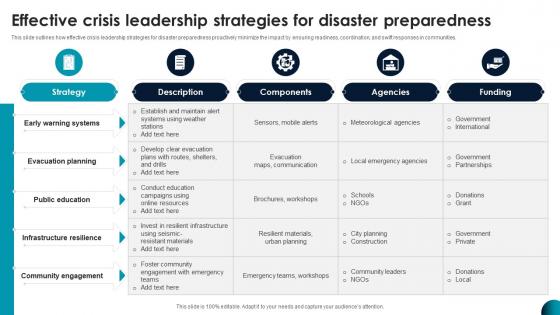
This slide outlines how effective crisis leadership strategies for disaster preparedness proactively minimize the impact by ensuring readiness, coordination, and swift responses in communities.
People who downloaded this PowerPoint presentation also viewed the following :
Effective Crisis Leadership Strategies For Disaster Preparedness with all 9 slides:
Use our Effective Crisis Leadership Strategies For Disaster Preparedness to effectively help you save your valuable time. They are readymade to fit into any presentation structure.









FAQs for Effective Crisis Leadership Strategies
Look, you've gotta be ready to make calls fast with like half the info you actually need - scary as hell but that's the job. The leaders who crush it during chaos? They're straight with people about what's happening while keeping everyone calm. Communication becomes everything because when people don't know what's going on, they panic hard. I'd honestly rather have someone tell me "I don't know yet" than feed me BS. Being adaptable is huge too since your first plan will probably blow up anyway. Practice this stuff during smaller fires so you're not learning on the fly when everything's falling apart.
Honestly, you've gotta lead by example first - be real about the stress you're feeling and don't skip sleep or breaks. Your team needs to see it's normal to struggle right now. Make sure people can actually speak up about problems without getting shut down. I know it sounds cheesy, but celebrate literally everything, even the smallest progress. Give folks some say in how they tackle their work when you can. Check in on them as humans, not just project status updates. This whole mess won't last forever, and focusing on today's controllable stuff beats spiraling about the big picture.
Dude, communication literally makes or breaks everything in a crisis. Be upfront and talk to people constantly - like, way more than feels normal. When there's radio silence, people just make up their own crazy theories. Even saying "still figuring this out, but I'll update you by Friday" is better than nothing. You gotta become THE person everyone trusts for real info, not whatever nonsense is floating around. Honestly, I'd rather annoy people with too many updates than scramble later trying to fix rumors. Start heavy from day one.
Look, life safety comes first - period. Is anyone actually in danger right now? Fix that immediately. After that, protect whatever keeps money coming in and your core operations running. I swear, half the executives I know waste time on random stuff while their main revenue streams are falling apart. Make a quick list: urgent AND important things get handled now. Everything else waits. Honestly, you can fix mistakes later, but you can't go back and act when you should've moved fast. Don't overthink this - sometimes good enough decisions made quickly beat perfect ones made too late.
Honestly, the worst thing you can do is micromanage every little detail instead of just telling people what you actually want. Don't try controlling everything - delegate stuff even when it feels scary. I learned this the hard way, but you'll make way better decisions when you zoom out instead of just reacting to whatever crisis pops up. Oh, and stop avoiding those awkward conversations! They only get worse if you wait. Leaders burn out constantly because they forget to take care of themselves too. My take? Be direct, trust your team more, and actually schedule downtime for yourself.
Just be honest about what you can and can't say right now. Tell them straight up - "I can't get into X yet, but here's what's happening with Y and Z." Trust me, people hate radio silence way more than hearing "I don't know yet." The trick is giving them actual timelines. Even if it's just "still nothing new, but I'll check back Friday." Your team needs enough context to keep doing their work without you spilling confidential stuff. Oh, and those regular updates? They're what keep everyone from panicking or making up their own stories about what's going on.
Honestly, start with psychological safety - nobody's gonna collaborate if they're scared of getting thrown under the bus. Get everyone focused on the same clear goals because crises have this weird way of making petty BS suddenly irrelevant (which is actually kinda nice). Make sure you're pulling quieter people into conversations. Rotate who's leading different parts. Do regular check-ins where people share what's working and what's not. Crisis mode makes us default to old habits, so you've got to be super deliberate about including everyone. Next meeting, straight up ask for different perspectives on your biggest problem.
Dude, emotional intelligence is huge during crises. First thing - check your own stress levels before you do anything else. Then actually listen to your team's concerns instead of jumping straight into fix-it mode. You've gotta read the room when everyone's freaking out. Some situations need you to be decisive, others need reassurance. I've watched so many managers crash and burn because they couldn't tell how their messages were landing with people. Being emotionally aware means you can adapt on the fly. Communicate with empathy instead of just throwing around orders - makes all the difference honestly.
Honestly, your company culture is what makes or breaks crisis leadership. When you've got trust and open communication, people actually speak up about problems and follow your direction when things get messy. Toxic, blame-heavy cultures? Forget about it - nobody's gonna tell you the truth when you desperately need it. Think of strong culture as your backbone during chaos. Everyone stays aligned on values and decisions even when everything's falling apart. The catch is you can't just flip a switch and create trust overnight - that foundation needs to exist way before the crisis hits.
Honestly, tech can save your butt in a crisis if you set it up right. Get automated alerts running so your team knows immediately when shit hits the fan. Slack or Teams work great for keeping everyone on the same page - way better than a million scattered emails. Social media monitoring is huge too, you'll catch problems before they blow up completely. Oh, and use analytics to spot weird patterns that might predict what's coming next. The trick is having all this stuff ready beforehand though. You don't want to be frantically setting up systems while everything's falling apart.
Start with tabletop exercises - they're cheap but crazy effective for practicing decisions under pressure. Communication training is massive too because leaders need to stay calm when everyone else is losing it. I've watched so many executives just completely shut down during real crises. Media training helps a lot, plus understanding your legal stuff and response protocols (boring but necessary). Stakeholder management is another big one. Run these scenario drills quarterly to build up that instinct. It's like muscle memory - you can't just wing it when things go sideways.
Look, every industry handles crises totally differently depending on what could actually go wrong. Healthcare? Patient safety comes first, then all the regulatory stuff. Tech companies freak out about data breaches and keeping users in the loop. Finance is interesting - they're always in crisis mode anyway, so they've got regulatory reporting down to a science plus keeping investors calm. Retail and hospitality are all about protecting the brand and customer experience. Meanwhile manufacturing worries about supply chains while media companies deal with PR nightmares. Bottom line: don't use some cookie-cutter approach. Figure out what your industry's biggest risks are and plan around those instead.
Look, just be straight with people - they'll sniff out any BS instantly when they're panicking. Put their wellbeing first, not your profits. Don't screw over vulnerable groups because it's convenient. Quick decisions that help your bottom line? They're usually terrible in the long run and will haunt you forever. Honestly, I've seen companies never recover from dumb choices they made during tough times. Just think about how you'd want someone to treat you if you were scared and needed help. That golden rule thing actually works.
Look, you gotta run two tracks at once - crisis mode AND bigger picture stuff. Deal with the immediate fires, obviously. But block out like 30 minutes each week to step back and think about whether your quick fixes actually make sense long-term. We totally screwed this up during our restructuring last year. Got so buried in daily chaos that our band-aid solutions actually made things worse down the road. Now I always ask myself: "Is this getting us closer to where we want to be in 3 years?" Monthly check-ins help too.
Looking at past crisis leaders, the biggest thing is just being straight with people - no sugarcoating what's going down or your plan to fix it. FDR's radio talks literally stopped people from panicking, and Ardern nailed it during COVID by being super transparent. You'll have to make calls without knowing everything (ugh, the worst part honestly), but staying visible matters more than having perfect answers. Don't disappear when things get messy. Focus on stuff you can actually control instead of spiraling over the chaos. People remember how you handled the pressure, not whether you solved everything perfectly.
-
Informative design.
-
Informative presentations that are easily editable.