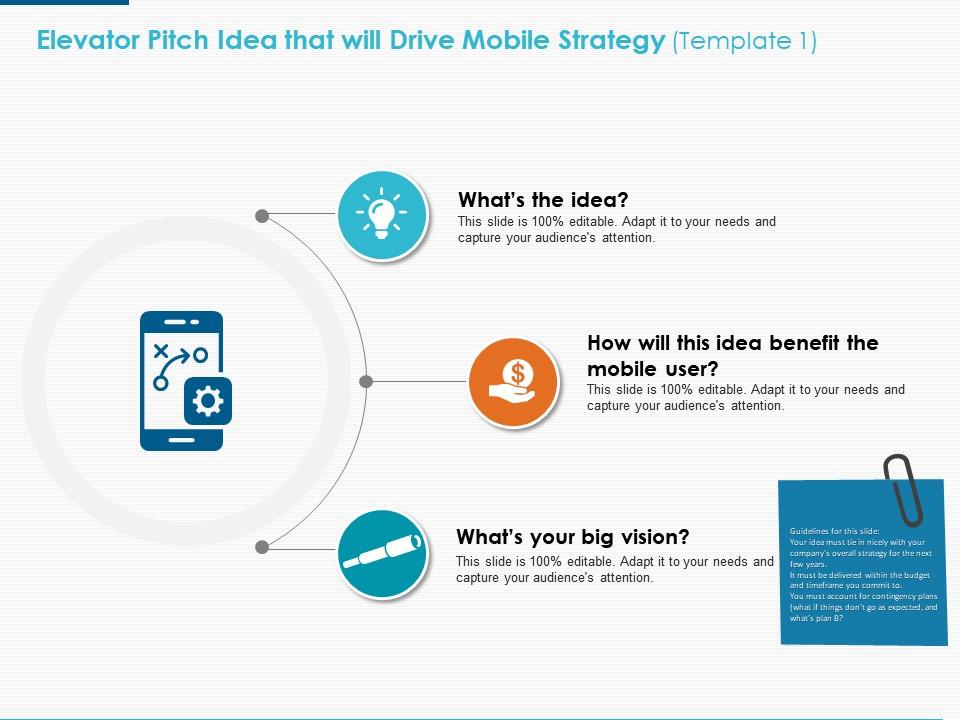
Elevator pitch idea that will drive mobile strategy planning ppt powerpoint presentation icon visual aids

Elevator pitch idea that will drive mobile strategy planning ppt powerpoint presentation icon visual aids
Slide 1 of 5
Favourites Favourites

Try Before you Buy Download Free Sample Product

Audience Impress Your
Audience
Editable 100%
Editable
Time Save Hours
of Time
The Biggest Sale is ending soon in
0
0
:
0
0
:
0
0
This is a three stage process. The stages in this process are Business, Planning, Strategy, Marketing, Management.

People who downloaded this PowerPoint presentation also viewed the following :

FAQs for Elevator pitch idea that will drive mobile strategy planning ppt powerpoint presentation

A compelling mobile strategy elevator pitch should include your target audience demographics, core mobile objectives, key performance metrics, competitive differentiation, and expected ROI timeline. These elements work together by clearly defining user needs, demonstrating strategic alignment with business goals, and showcasing measurable outcomes, with many organizations finding that concise, data-driven pitches ultimately secure stakeholder buy-in and accelerate mobile initiative approval.

Understanding the target audience improves mobile strategy pitch effectiveness by enabling tailored messaging, relevant use cases, and aligned business outcomes that resonate with specific stakeholder priorities. This approach allows presenters to emphasize cost savings for CFOs, user engagement metrics for marketing teams, and operational efficiency for operations leaders, while addressing industry-specific challenges like patient accessibility in healthcare or customer retention in retail, ultimately delivering more compelling and actionable mobile strategies.

Mobile strategy ROI metrics should highlight user acquisition costs, customer lifetime value, conversion rates, mobile revenue growth, and engagement metrics like session duration and retention rates. These indicators demonstrate tangible business outcomes, with retail companies finding that mobile optimization increases conversions by 20-30%, while financial services leverage mobile apps to reduce operational costs and enhance customer experiences, ultimately delivering competitive advantage and measurable revenue growth.

Current market trends significantly influence mobile strategy elevator pitches by emphasizing AI-powered personalization, 5G capabilities, voice commerce integration, and omnichannel experiences that drive customer engagement. These trends enable organizations to position their mobile strategies around faster load times, predictive analytics, and seamless cross-platform integration, with many companies finding that highlighting trend-responsive features delivers competitive advantage and demonstrates market awareness to stakeholders.

User experience serves as the cornerstone of compelling mobile strategy presentations, encompassing intuitive navigation, responsive design, personalization capabilities, accessibility features, and seamless cross-platform functionality. These UX elements demonstrate tangible business value by showcasing reduced bounce rates, increased user engagement, and higher conversion potential, with many organizations finding that UX-focused presentations resonate strongly with stakeholders concerned about competitive differentiation and customer retention.

Mobile strategy differentiation can be effectively communicated through highlighting unique value propositions, target audience specificity, competitive advantages, innovative features, and measurable business outcomes. These elements streamline pitch delivery by demonstrating clear market positioning, user experience enhancements, and revenue potential, with many organizations finding that focusing on specific use cases, scalability metrics, and customer pain point solutions ultimately delivers compelling investor interest and stakeholder buy-in.

Stakeholders' pain points in mobile strategy can be addressed through comprehensive user research, cross-platform compatibility solutions, robust security frameworks, and agile development methodologies that ensure rapid iteration. These approaches streamline implementation by identifying specific user needs, minimizing technical barriers, and delivering seamless experiences across devices, with many organizations finding that strategic mobile planning ultimately enhances customer engagement while reducing operational costs.

Effective storytelling techniques include using customer journey narratives, pain-point scenarios, success case studies, before-and-after transformations, and data-driven stories that demonstrate mobile ROI. These approaches enhance engagement by connecting mobile strategy concepts to real business outcomes, with many executives finding that compelling narratives around user experiences and competitive advantages resonate more effectively than technical specifications alone.

Visuals and templates enhance mobile strategy pitches by simplifying complex data, creating memorable storytelling frameworks, and maintaining audience focus through structured presentations. These tools streamline technical concepts like user journey mapping and performance metrics, while professional templates ensure consistent messaging and visual hierarchy, ultimately delivering clearer communication and stronger stakeholder buy-in for mobile initiatives.

Common mistakes include being too technical, lacking specific metrics, failing to address user pain points, ignoring competitive differentiation, and presenting unrealistic timelines or budgets. These pitfalls undermine credibility with stakeholders, with many mobile strategy presentations finding that focusing on clear business outcomes, user experience improvements, and measurable ROI projections delivers significantly stronger investor engagement and executive buy-in.

Competitive intelligence strengthens mobile strategy presentations by revealing market gaps, competitor weaknesses, and emerging opportunities that your mobile approach can capitalize on. Through comprehensive competitor analysis, businesses can demonstrate differentiation, justify strategic decisions, and showcase potential market share gains, while positioning their mobile initiatives as responses to competitive threats, ultimately delivering more compelling and data-driven presentations to stakeholders.

Best practices include using visual representations, avoiding technical jargon, focusing on business outcomes, creating analogies for complex concepts, and emphasizing user experience benefits. These approaches enhance understanding by translating technical elements into strategic value propositions, with many organizations finding that stakeholders respond better when mobile capabilities are framed around competitive advantage, cost efficiency, and customer satisfaction rather than underlying technologies.

Mobile strategy scalability can be articulated by emphasizing flexible architecture, cross-platform capabilities, user base expansion potential, and resource optimization frameworks that adapt to growing demands. Focus on demonstrating how the strategy seamlessly scales from pilot programs to enterprise-wide implementation, with many organizations finding that highlighting measurable growth metrics and infrastructure adaptability resonates most effectively with stakeholders.

Mobile strategy risks include security vulnerabilities, fragmented device compatibility, user adoption challenges, high development costs, and rapid technology obsolescence. While these present significant considerations, organizations increasingly find that strategic planning, robust testing protocols, and phased implementation approaches effectively mitigate these challenges, ultimately delivering competitive advantage and enhanced customer experiences.

Feedback integration involves systematically analyzing audience reactions, questions raised, and engagement levels to identify presentation strengths and improvement areas. Companies refine their mobile strategy pitches by documenting recurring concerns, adjusting technical depth based on audience expertise, and incorporating successful messaging elements from high-performing presentations, ultimately delivering more targeted and compelling pitches that resonate with stakeholders.

Ratings and Reviews

0% of 100
Write a review
Most Relevant Reviews

No Reviews