


Employee Code Of Conduct At Workplace Powerpoint Presentation Slides




Try Before you Buy Download Free Sample Product
 Impress Your
 Audience
 100%
100% Editable
 Save Hours
 of Time


Understanding and implementing organizational behaviour, or how people interact among groups, results in more effective business practices. Grab our Employee Code of Conduct at Workplace template. It focuses on enhancing productivity, and performance, boosting employee satisfaction, and improving motivation. Our deck also aims to ensure better leadership, managing decision making and facilitating improved cross-team collaboration. Additionally, our PPT covers slides about the scope of organizational behaviour, management and organizational behaviour model, etc. Further, it showcases the essential tools utilized in performance management, critical initiatives employed in behaviour-based safety, and crucial approaches in behaviour system analysis. Moreover, our module emphasizes the manager role in OB management, the organizational behaviour model, the significance of learning in corporate behaviour management, and different learning theories. It also depicts the importance of personality, motivation, and perception. Furthermore, our template exhibits the relevancy of groups in terms of formal and informal groups in OBM, the role of decision-making in OBM, the relevance of leadership, conflict management at the workplace, etc. Get access to this powerful template now.
People who downloaded this PowerPoint presentation also viewed the following :
Content of this Powerpoint Presentation
Slide 1: This slide introduces Employee Code of Conduct at Workplace. State your company name and begin.
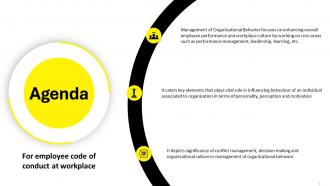
Slide 2: This slide states Agenda of the presentation.
Slide 3: This slide shows Table of Content for the presentation.
Slide 4: This slide highlights title for topics that are to be covered next in the template.
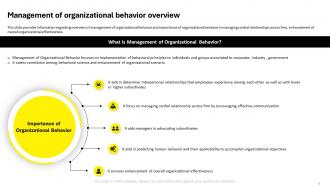
Slide 5: This slide presents Management of organizational behaviour overview.
Slide 6: This slide displays Association of organizational behaviour to applied behaviour analysis.
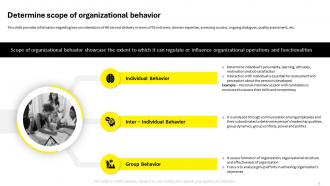
Slide 7: This slide represents Determine scope of organizational behaviour.
Slide 8: This slide showcases Determine management and organizational behaviour model.
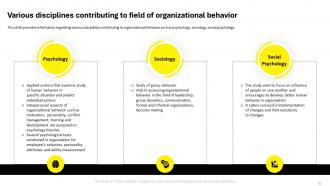
Slide 9: This slide shows Various disciplines contributing to field of organizational behaviour.
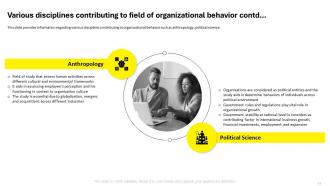
Slide 10: This is another slide continuing Various disciplines contributing to field of organizational behaviour.
Slide 11: This slide highlights title for topics that are to be covered next in the template.
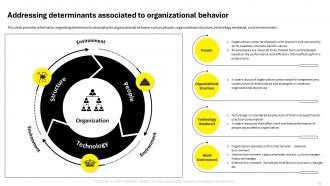
Slide 12: This slide presents Addressing determinants associated to organizational behaviour.
Slide 13: This slide displays Focus areas for management of organizational behaviour growth.
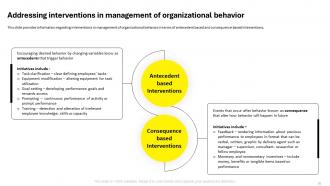
Slide 14: This slide represents Addressing interventions in management of organizational behaviour.
Slide 15: This slide showcases Nature of people as essential element associated to organizational behaviour.
Slide 16: This slide shows Nature of organization as essential element associated to organizational behaviour.
Slide 17: This slide highlights title for topics that are to be covered next in the template.
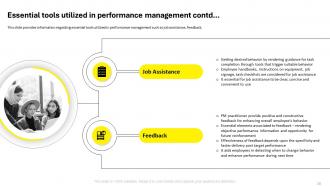
Slide 18: This slide presents Essential tools utilized in performance management.
Slide 19: This is another slide continuing Essential tools utilized in performance management.
Slide 20: This slide displays Key initiatives utilized in behaviour based safety.
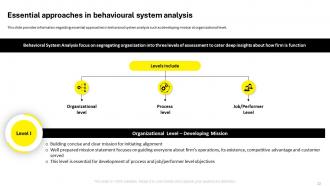
Slide 21: This slide represents Essential approaches in behavioural system analysis.
Slide 22: This is another slide continuing Essential approaches in behavioural system analysis.
Slide 23: This slide highlights title for topics that are to be covered next in the template.
Slide 24: This slide showcases Manager needs to ensure that everything should be under control in terms of budget, resource allocation, etc.
Slide 25: This slide shows How manager is capable in handling various challenges faced.
Slide 26: This slide highlights title for topics that are to be covered next in the template.
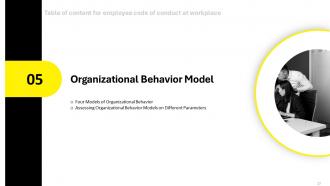
Slide 27: This slide presents Four models for organizational behaviour.
Slide 28: This slide displays Assessing organizational behaviour models on different parameters.
Slide 29: This slide highlights title for topics that are to be covered next in the template.
Slide 30: This slide represents Addressing factors affecting learning of individual associated to organization.
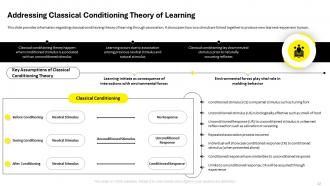
Slide 31: This slide showcases Addressing classical conditioning theory of learning.
Slide 32: This slide shows Key principles associated classical conditioning theory of learning.
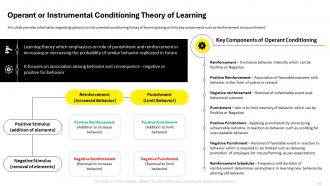
Slide 33: This slide presents Operant or instrumental conditioning theory of learning.
Slide 34: This slide displays Key essentials of social learning theory.
Slide 35: This slide represents Addressing cognitive learning theory.
Slide 36: This slide shows Table of Content for the presentation.
Slide 37: This slide presents Determine major personality attributes managing organizational behaviour.
Slide 38: This is another slide continuing Determine major personality attributes managing organizational behaviour.
Slide 39: This slide displays Determine importance of motivation & perception in organizational behaviour.
Slide 40: This slide highlights title for topics that are to be covered next in the template.
Slide 41: This slide represents Determine role of different groups in organization.
Slide 42: This slide showcases Addressing various types of group roles existing across organization.
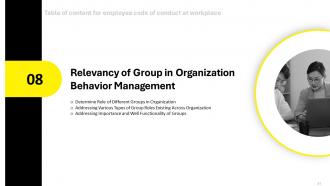
Slide 43: This slide shows Addressing importance and well functionality of groups.
Slide 44: This slide highlights title for topics that are to be covered next in the template.
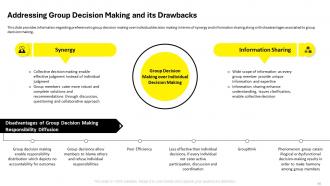
Slide 45: This slide presents Group Decision Making over Individual Decision Making.
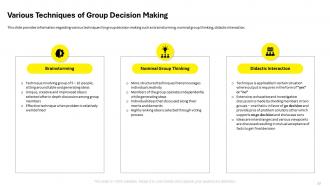
Slide 46: This slide displays Various techniques of group decision making.
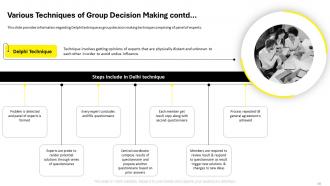
Slide 47: This is another slide continuing Various techniques of group decision making.
Slide 48: This slide highlights title for topics that are to be covered next in the template.
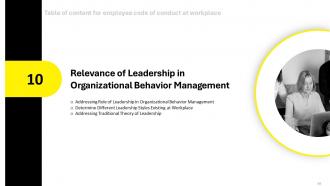
Slide 49: This slide represents Addressing role of leadership in organizational behaviour management.
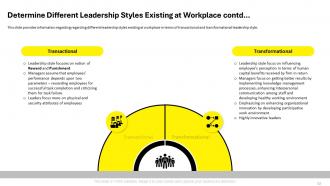
Slide 50: This slide showcases Determine different leadership styles existing at workplace.
Slide 51: This is another slide continuing Determine different leadership styles existing at workplace.
Slide 52: This slide shows Addressing traditional theory of leadership.
Slide 53: This slide highlights title for topics that are to be covered next in the template.
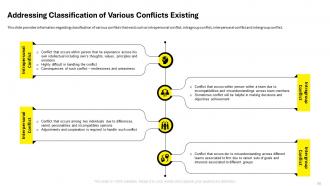
Slide 54: This slide presents Addressing classification of various conflicts existing.
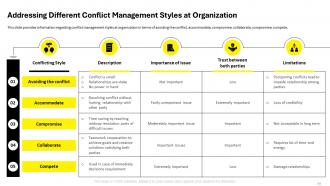
Slide 55: This slide displays Addressing different conflict management styles at organization.
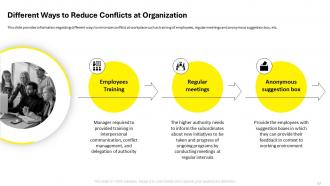
Slide 56: This slide represents Different ways to reduce conflicts at organization.
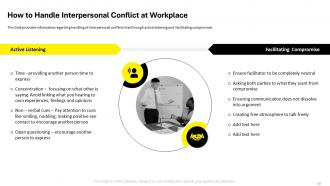
Slide 57: This slide showcases How to handle interpersonal conflict at workplace.
Slide 58: This slide highlights title for topics that are to be covered next in the template.
Slide 59: This slide shows Addressing culture in managing organizational culture.
Slide 60: This slide presents Addressing classification of different organizational culture.
Slide 61: This slide displays Addressing classification of different organizational culture.
Slide 62: This slide highlights title for topics that are to be covered next in the template.
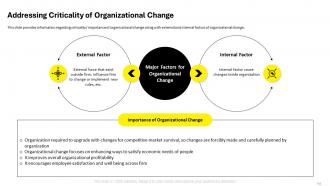
Slide 63: This slide represents Addressing criticality of organizational change.
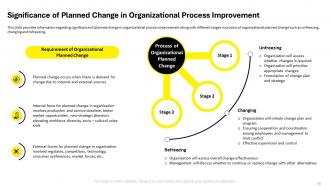
Slide 64: This slide showcases Significance of planned change in organizational process improvement.
Slide 65: This slide shows Addressing different kinds of organizational planned change.
Slide 66: This slide highlights title for topics that are to be covered next in the template.
Slide 67: This slide presents Determine essential organization development techniques.
Slide 68: This slide contains all the icons used in this presentation.
Slide 69: This slide is titled as Additional Slides for moving forward.
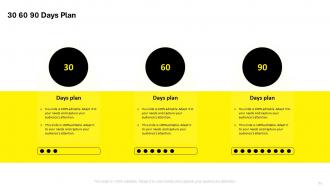
Slide 70: This slide provides 30 60 90 Days Plan with text boxes.
Slide 71: This is About Us slide to show company specifications etc.
Slide 72: This slide presents Bar chart with two products comparison.
Slide 73: This slide depicts Area chart with two products comparison.
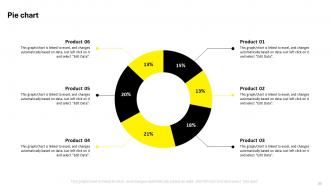
Slide 74: This slide shows Pie Chart with data in percentage.
Slide 75: This is a Comparison slide to state comparison between commodities, entities etc.
Slide 76: This slide shows Funnel with related icons and text.
Slide 77: This slide contains Puzzle with related icons and text.
Slide 78: This is a Timeline slide. Show data related to time intervals here.
Slide 79: This slide depicts Venn diagram with text boxes.
Slide 80: This is a Thank You slide with address, contact numbers and email address.
Employee Code Of Conduct At Workplace Powerpoint Presentation Slides with all 89 slides:
Use our Employee Code Of Conduct At Workplace Powerpoint Presentation Slides to effectively help you save your valuable time. They are readymade to fit into any presentation structure.









































FAQs for Employee Code Of Conduct At Workplace
Look, you'll want to hit the big ones: integrity, respect, keeping things confidential, and following laws plus company rules. Cover conflicts of interest too - that one trips people up more than you'd think. Don't forget proper use of company stuff and how to report violations. I mean, most of this feels obvious, but writing it down stops those awkward "nobody told me" moments later. Just make sure it's specific enough to actually help people make decisions. Generic fluff that sounds nice but gives zero guidance? Total waste of everyone's time.
Honestly, don't just email a PDF and call it done. Interactive training sessions work way better - people can actually ask questions about real situations they'll face. I'd follow up with bite-sized refresher emails highlighting specific sections because let's face it, nobody's memorizing 50 pages. Put it on your intranet with good search functionality so they can find answers fast when needed. The whole thing is about repetition through different formats and making it feel relevant to their daily work. Oh, and quarterly team discussions are great for talking through those tricky gray areas.
Your Employee Code of Conduct basically sets the tone for how people act every day at work. It's like having an unspoken rulebook that everyone actually follows - covers everything from meeting etiquette to handling disagreements. When everyone knows what's expected, you get way more consistency across different teams. Plus it creates this sense of safety because people understand the boundaries, you know? I've seen workplaces where the code was just corporate fluff and others where it actually matched their values - huge difference. If you want to shape your culture, make sure yours reflects what you actually want happening, not just nice-sounding words.
Define exactly what counts as discrimination and harassment - give real examples because people miss the subtle stuff. Zero tolerance has to mean actual consequences, not just empty threats. Set up multiple ways to report since going to your boss isn't always realistic. Retaliation protection is huge too, that's what stops most people from speaking up. Oh and don't make the policy some confusing 20-page document nobody reads. Keep reporting simple and safe, then follow through when someone comes forward. I've watched companies mess this up by being all talk, no action.
Honestly, you want to give people a bunch of different ways to report stuff. Anonymous hotline is pretty standard, plus maybe an online portal thing. Having a designated ethics person or HR contact helps too. Train your managers to handle reports the right way - though between you and me, lots of employees would rather skip their direct boss anyway. Make sure everyone knows about these options during onboarding. Post them on your intranet or whatever internal site you use. The whole point is choice - people need to feel safe reporting however works best for them.
Okay so you'll want to add stuff about digital communication standards, home office security, and video call etiquette. The weirdest part honestly? Setting work-life boundaries when your bedroom is also your office. Include guidelines for appropriate video backgrounds, what to wear on calls, keeping company info confidential when your roommate's right there, and handling work data on your home wifi. Also nail down availability hours and response times - otherwise people think you're available 24/7 just because you're home. Oh, and start by going through your current code to see what doesn't work for remote situations.
Focus on stuff your people actually deal with every day. Conflicts of interest are huge - personal relationships affecting business calls, side hustles that compete with you. Whistleblowing gets complicated quick, but you need solid protections plus fair investigations. Don't forget social media rules and the whole confidentiality vs transparency mess. Oh, and what happens when company policy clashes with someone's personal beliefs? That one's tricky. Get different departments involved early - they'll catch obvious problems you totally missed. Trust me, outside perspectives save you from looking stupid later.
Honestly, do it every year minimum. Most companies do major overhauls every 2-3 years unless regulations change or something goes sideways. I swear I've seen handbooks still talking about fax machine etiquette - like what century are we in? Anyway, you'll need updates whenever new laws drop, workplace drama happens, or your company pivots its values. Don't wait for problems to hit. Better to catch stuff early than scramble later. Set a reminder right now and make someone actually responsible for it, or it'll never happen.
Honestly, a good Code of Conduct actually makes people MORE engaged, not less. It creates that psychological safety thing where everyone knows the rules and feels protected from workplace BS. Clear guidelines = less anxiety and more trust in leadership. Your company shows it genuinely cares about a positive environment instead of just lip service about "values" (ugh, those meetings). The trick is making it supportive, not like you're all in trouble. Oh, and definitely ask employees what they want covered when you're writing it - their input makes it way better.
Honestly, you've got to actually follow the same rules you're asking everyone else to follow. Show up on time, admit when you mess up, treat people right - the basics. People can smell hypocrisy from a mile away, and once they catch you being inconsistent, you're done. When you make decisions, explain your reasoning so they can see how you're applying company values in real scenarios. Oh, and call out violations fairly - doesn't matter if it's your star performer or the new guy. At the end of the day, your team will copy whatever behavior you're modeling, so make sure it's the right stuff.
Honestly, mixing it up is everything here. Interactive workshops are your best bet - people can actually ask questions and bounce ideas off each other. Online modules handle the boring basics pretty well, and employees can work through them whenever. Role-playing feels super awkward but it actually works? Case studies make those abstract policies feel real too. I'd skip the one-and-done approach though. Quarterly check-ins or even random email reminders when stuff comes up keeps it fresh. Oh, and tracking completion online saves you a headache later.
So your employee code of conduct? It's basically how your company takes all the confusing legal stuff and breaks it down into normal language you can actually understand. Covers things like harassment, discrimination, data privacy, financial reporting - all the areas that could seriously mess up the company if someone screws up. I mean, nobody wants to accidentally break labor laws or securities regulations, right? Think of it as your legal safety net, honestly. Following it keeps both you and the company out of trouble. Pretty much just stick to it religiously and you'll be fine.
Look, the codes that actually work are short and visual - nobody reads walls of text. Survey your people first about what ethical stuff they deal with day-to-day, then build around that instead of generic fluff. Interactive case studies work way better than lectures. Leadership has to be all-in from the start or it's pointless. Build it into onboarding but don't forget refreshers because people zone out. Oh, and you need anonymous reporting that actually leads somewhere - empty suggestion boxes are worse than nothing. The companies I've seen nail this? They made consequences real and consistent.
Start with surveys or focus groups before you write anything - way better than guessing what people want. Anonymous suggestion boxes are clutch because honestly, who wants to complain about their boss with their name attached? Ask about specific situations they deal with daily, not vague "what policies should we have" questions. Here's the thing though - you absolutely have to show them how their feedback actually changed the final code. Otherwise next time you ask for input, crickets. People remember when their time gets wasted. Circle back and tell them what you incorporated from their suggestions.
Start with verbal warnings, then move to written ones, suspension, and finally termination. That's your basic progression. But honestly, some stuff like harassment or stealing? Fire them immediately - don't mess around with that. Be super clear about which violations get which consequences so nobody can claim they didn't know. Oh, and if you've got an appeal process, mention that too. The whole point is spelling everything out ahead of time. Trust me, you'll thank yourself later when you don't have to deal with "but I didn't realize" drama.
-
SlideTeam never fails to surprise me with its amazing PPT designs. Thanks team for providing me with your constant support!
-
The presentations are very helpful. I am always able to get appropriate templates for the different topics related to my profession.