


Employee Counselling For Enhancing Productivity At Workplace Complete Deck




Try Before you Buy Download Free Sample Product
 Impress Your
 Audience
 100%
100% Editable
 Save Hours
 of Time


Check out our professionally designed Employee Counselling for Enhancing Productivity at Workplace PowerPoint Presentation. Employee counseling involves a comprehensive support service employers offer to aid employees in managing personal and work-related challenges. The primary objective is assessing employees emotional state and organizing practical counseling sessions accordingly. Firstly, the Employee Therapy PPT Templates outlines stages of employee counseling for various employee categories. Additionally, it illustrates counseling strategies to enhance workforce performance and attain organizational goals. A detailed procedure is provided for implementing each counseling step within the organization. Furthermore, the Directive counseling strategies for employee retention and performance optimization ultimately boost profits. The presentation concludes with informative dashboards displaying collective employee wellness and mental health status. Download our fully editable module, compatible with Google Slides, to tailor the content to your specific needs. Get access now.
People who downloaded this PowerPoint presentation also viewed the following :
Content of this Powerpoint Presentation
Slide 1: This slide introduces Employee Counselling for Enhancing Productivity at Workplace. State your company name and begin.
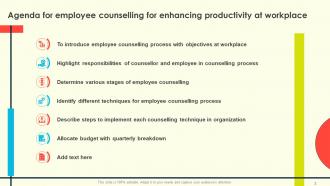
Slide 2: This is an Agenda slide. State your agendas here.
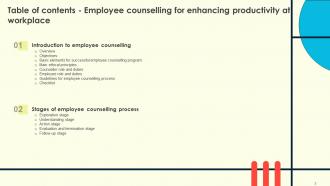
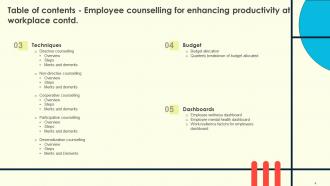
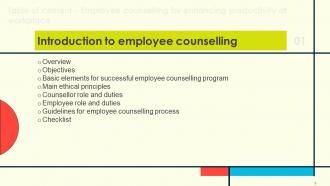
Slide 3: This slide shows Table of Content for the presentation.
Slide 4: This slide continues showing Table of Content for the presentation.
Slide 5: This slide shows title for topics that are to be covered next in the template.
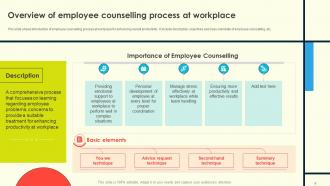
Slide 6: This slide displays introduction of employee counselling process at workplace for enhancing overall productivity.
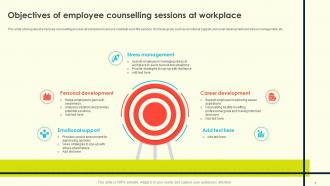
Slide 7: This slide presents goals of employee counselling process at workplace to ensure maintain work life balance.
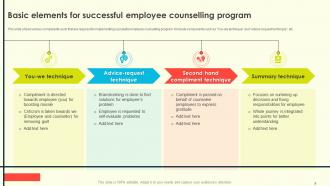
Slide 8: This slide shows various components such that are required for implementing successful employee counselling program.
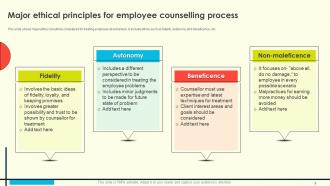
Slide 9: This slide displays major ethics should be considered for treating employee at workplace. It include ethics such as fidelity, autonomy and beneficence, etc.
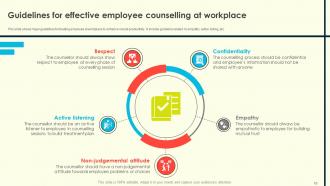
Slide 10: This slide shows major guidelines for treating employee at workplace to enhance overall productivity. It include guideline related to empathy, active listing, etc.
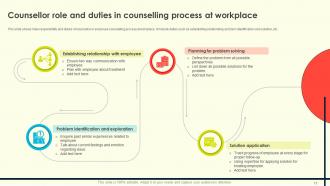
Slide 11: This slide presents main responsibility and duties of counsellor in employee counselling process at workplace.
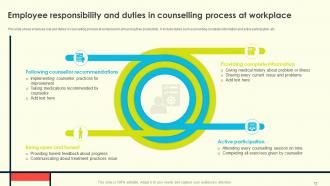
Slide 12: This slide shows employee role and duties in counselling process at workplace for enhancing their productivity.
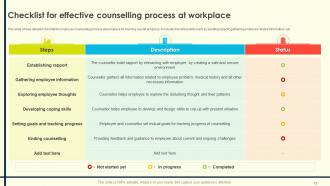
Slide 13: This slide displays detailed checklist for employee counselling process at workplace for tracking overall progress.
Slide 14: This slide presents title for topics that are to be covered next in the template.
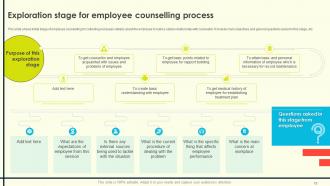
Slide 15: This slide shows initial stage of employee counselling for collecting necessary details about the employee to build a stable relationship with counsellor.
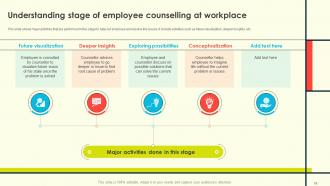
Slide 16: This slide presents major activities that are performed in this stage to help out employee and resolve the issues. It include activities such as future visualization etc.
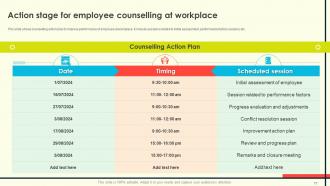
Slide 17: This slide displays a counselling action plan to improve performance of employee at workplace.
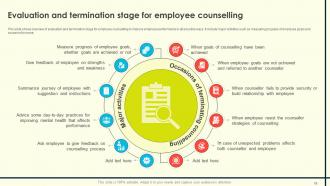
Slide 18: This slide shows overview of evaluation and termination stage for employee counselling to improve employee performance in all possible ways.
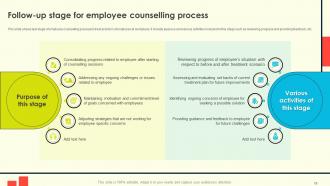
Slide 19: This slide displays last stage of employee counselling process to treat problem of employee at workplace. It include purpose and various activities.
Slide 20: This slide shows title for topics that are to be covered next in the template.
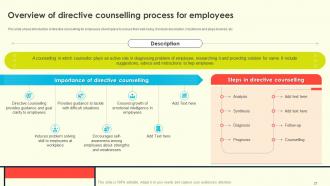
Slide 21: This slide displays introduction of directive counselling for employees at workplace to ensure their well-being. It include description, importance and steps involved, etc.
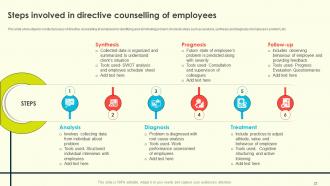
Slide 22: This slide show steps to conduct process of directive counselling at workplace for identifying and eliminating problem.
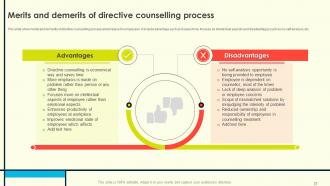
Slide 23: This slide displays merits and demerits of directive counselling process at workplace for employees. It include advantage such as it saves time etc.
Slide 24: This slide shows title for topics that are to be covered next in the template.
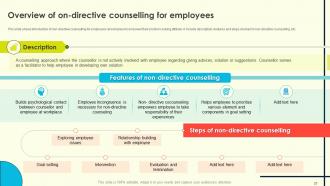
Slide 25: This slide presents introduction of non-directive counselling for employees at workplace to empower their problem solving attitude.
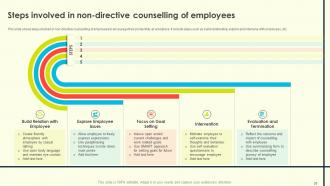
Slide 26: This slide shows steps involved in non-directive counselling of employees to encourage their productivity at workplace.
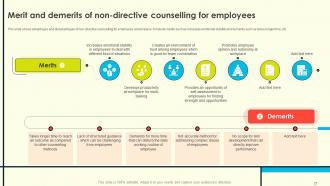
Slide 27: This slide displays advantages and disadvantages of non-directive counselling for employees at workplace.
Slide 28: This slide shows title for topics that are to be covered next in the template.
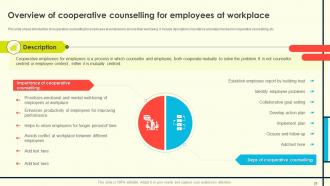
Slide 29: This slide presents introduction of cooperative counselling for employees at workplace to ensure their well being.
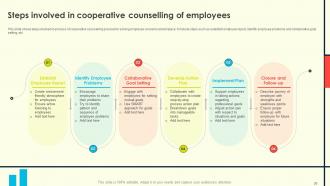
Slide 30: This slide displays steps involved in process of cooperative counselling process for solving employee concerns at workplace.
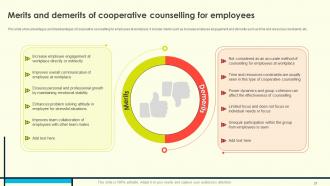
Slide 31: This slide presents advantages and disadvantages of cooperative counselling for employees at workplace.
Slide 32: This slide shows title for topics that are to be covered next in the template.
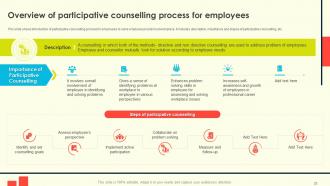
Slide 33: This slide displays introduction of participative counselling process for employees to solve employee problems at workplace.
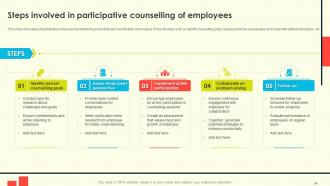
Slide 34: This slide shows steps of participative employees for enhancing productivity and coordination at workplace. It include steps such as identify counselling goals etc.
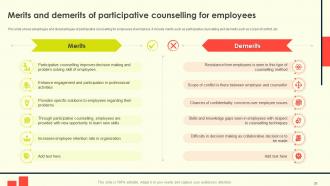
Slide 35: This slide presents advantages and disadvantages of participative counselling for employees at workplace. It include merits such as participative counselling etc.
Slide 36: This slide shows title for topics that are to be covered next in the template.
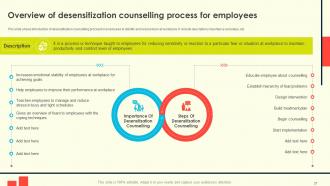
Slide 37: This slide presents introduction of desensitization counselling process for employees to identify and reduce fears at workplace.
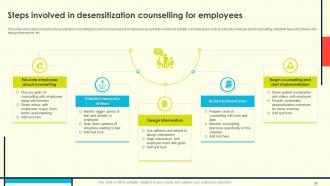
Slide 38: This slide shows steps involved in desensitization counselling process for employees at workplace to ensure their emotional stability.
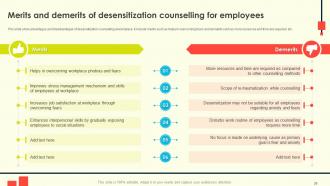
Slide 39: This slide displays advantages and disadvantages of desensitization counselling at workplace. It include merits such as helps in overcoming fears and demerits etc.
Slide 40: This slide shows title for topics that are to be covered next in the template.
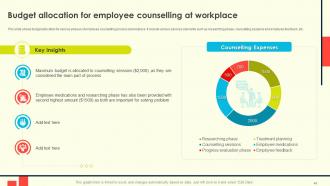
Slide 41: This slide presents budget allocation for various phases of employee counselling process at workplace.
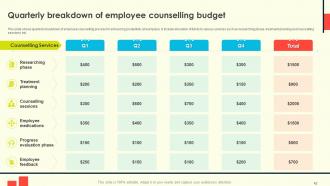
Slide 42: This slide displays quarterly breakdown of employee counselling process for enhancing productivity at workplace.
Slide 43: This slide shows title for topics that are to be covered next in the template.
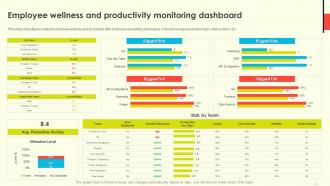
Slide 44: This slide presents figures related to employee wellness and productivity after employee counselling at workplace. It include average productive hours, stats by team, etc.
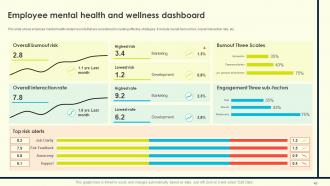
Slide 45: This slide shows employee mental health related records that are considered in creating effective strategies.
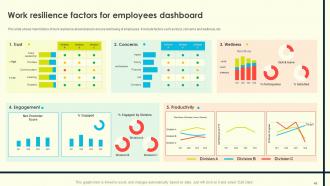
Slide 46: This slide displays main factors of work resilience at workplace to ensure well being of employees. It include factors such as trust, concerns and wellness, etc.
Slide 47: This slide shows all the icons included in the presentation.
Slide 48: This slide is titled as Additional Slides for moving forward.
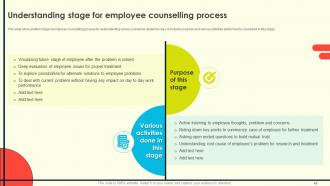
Slide 49: This slide show another stage of employee counselling process for understanding various scenarios related to case.
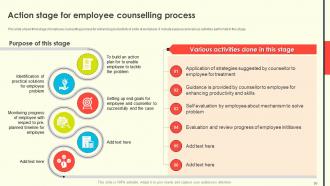
Slide 50: This slide presents third stage of employee counselling process for enhancing productivity of skills at workplace.
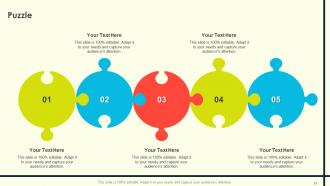
Slide 51: This slide contains Puzzle with related icons and text.
Slide 52: This is Our Target slide. State your targets here.
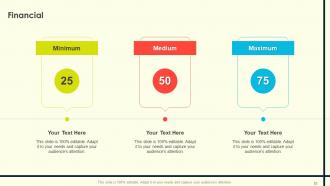
Slide 53: This is a financial slide. Show your finance related stuff here.
Slide 54: This slide depicts Venn diagram with text boxes.
Slide 55: This slide displays Mind Map with related imagery. Adapt it to your needs and capture your audience's attention.
Slide 56: This slide presents displays Types and metrics of performance metrics with additional textboxes and related imagery.
Slide 57: This slide displays Lego timeline with additional textboxes and related imagery.
Slide 58: This slide displays silhouettes with additional textboxes and related imagery.
Slide 59: This slide showcases Magnifying Glass to highlight, minute details, information, specifications etc.
Slide 60: This is an Idea Generation slide to state a new idea or highlight information, specifications etc.
Slide 61: This is a Funnel slide. Showcase how the data moves through the process.
Slide 62: This slide displays Hierarchy with additional textboxes and related imagery.
Slide 63: This is a Thank You slide with address, contact numbers and email address.
Employee Counselling For Enhancing Productivity At Workplace Complete Deck with all 71 slides:
Use our Employee Counselling For Enhancing Productivity At Workplace Complete Deck to effectively help you save your valuable time. They are readymade to fit into any presentation structure.








FAQs for Employee Counselling For Enhancing Productivity At
Honestly, employee counseling is a game-changer for catching problems early. Your team's mental health improves, job satisfaction goes up, and people actually stay instead of constantly quitting. It prevents so much workplace drama - trust me on this one. Plus you'll see better productivity, less people calling in sick, and way fewer conflicts. Communication gets smoother too since everyone has somewhere safe to hash things out. Oh, and check if your company already has an Employee Assistance Program first. Most places do but they're terrible at promoting it.
Honestly, trust your gut - if someone seems "off," they probably are. Performance drops are obvious signs, but I notice the subtle stuff first. Maybe they're calling out more or missing deadlines they'd usually nail. Sometimes people get snappy or just... distant? Like they stop joining conversations or seem totally overwhelmed. Oh, and don't overlook physical changes - when someone's constantly exhausted or looks rough, that's telling you something. The trick is actually knowing your people well enough to spot when their normal shifts. Regular one-on-ones help with that, but really it comes down to paying attention.
Honestly, three main things matter here. Find somewhere private first - people won't open up if Karen from accounting might walk by, you know? Then just listen. Don't interrupt or immediately jump into fix-it mode (even though you'll want to). Ask open questions instead of assuming what's wrong. Oh, and tell them upfront what stuff you'd have to report - better they know the limits now than get blindsided later. Short sentences work. Longer ones help you really connect with what they're saying. The whole point is making them feel supported, not like they're being grilled.
Honestly, culture plays a huge role in counseling sessions. People from hierarchical backgrounds might clam up around their boss, you know? Meanwhile, someone who's used to direct communication will actually prefer you being blunt with them. Mental health attitudes vary wildly too - I've watched this mess up so many well-intentioned conversations. What feels caring to you could totally overwhelm someone else. My advice? Ditch the generic approach and just ask people straight up how they like to communicate. Sounds obvious but most managers skip this step entirely. Adapt to each person instead of assuming.
Honestly, confidentiality is everything here - without it, people won't open up at all. You've got to spell out what stays private right from the start. Most things are confidential, but there are some legal exceptions around safety stuff or illegal activities that you can't avoid mentioning upfront. I've watched programs completely bomb because employees were terrified their boss would hear about their personal problems. Write down exactly who sees what info and when those rare exceptions kick in. Oh, and make sure the counselors go over this again during those first meetings - people forget or didn't really listen the first time around.
Performance stuff comes up constantly - attendance, workplace drama, people clashing with coworkers. Personal issues bleeding into work too, like divorces or sick family members. Stress management is huge. Oh, and honestly? Interpersonal conflicts eat up maybe 40% of my time because some people just can't communicate to save their lives. Substance abuse pops up more than you'd think. The trick is spotting red flags early instead of waiting for everything to blow up. I always tell managers to do regular check-ins with anyone who seems off.
Definitely track the hard numbers first - retention rates, sick days, productivity stuff. But here's the thing, those metrics don't tell you everything. Anonymous surveys are where you'll get the real dirt on whether people actually find it helpful. Check utilization rates too because what's the point if nobody's using it? I'd do quarterly surveys asking about stress levels and job satisfaction. Oh, and measure everything now before you start so you have something to compare it to later. Otherwise you're just guessing if it's working.
Focus on active listening and basic counseling techniques first. Your team needs to know how to create safe spaces, ask open-ended questions, and document everything properly. The legal stuff is critical - confidentiality rules, what topics are off-limits, when to refer people to EAP. Role-playing different scenarios helps a ton. But honestly? The trickiest part is teaching people when to step back and not try fixing everything themselves. I've seen too many well-meaning managers get in over their heads. Schedule annual refreshers because these skills definitely get rusty without practice.
Honestly, tech can be a game-changer for employee mental health stuff. Your people get 24/7 chat support and video sessions from literally anywhere - way better than trying to sneak out for appointments. Apps give them instant coping tools when they're spiraling. AI screening helps match folks with the right support faster too. The anonymity thing is clutch though - tons of employees won't set foot in a therapist's office but they'll totally use confidential online platforms. Data helps you see patterns across your whole team. Oh, and definitely survey people first about what digital tools they'd actually bother using. No point rolling out something nobody wants.
So first off, put that info everywhere - onboarding stuff, employee handbook, intranet, you know the drill. People totally forget these resources exist unless they're actively drowning, so send reminders through email or meetings. Train managers to spot when someone's struggling and how to bring it up without being weird about it. Honestly, posters in break rooms work too - sounds old school but whatever. The trick is making it feel normal, not like some big dramatic thing. Oh, and don't bombard people with it constantly or they'll tune out completely.
Dude, counselling programs are seriously underrated for keeping people around. When employees know they can get help with work stress or personal stuff, they don't just bail when things get tough. I honestly think it's one of those things that separates good companies from shitty ones. People want to feel valued as actual humans, not just productivity machines. The trick is making it super easy to access and actually confidential - otherwise it's just another useless perk nobody touches. Happy employees stick around longer. Pretty simple math really.
Okay so the main things are confidentiality, boundaries, and knowing your limits. Don't share what people tell you without permission - that's like rule
-
The content is very helpful from business point of view.
-
Design layout is very impressive.