Employee Health And Safety Key Performance Indicator Dashboard

Rating:
90%
Employee Health And Safety Key Performance Indicator Dashboard
Slide 1 of 6
Favourites Favourites

Try Before you Buy Download Free Sample Product

Audience Impress Your
Audience
Editable 100%
Editable
Time Save Hours
of Time
The Biggest Sale is ending soon in
0
0
:
0
0
:
0
0
Rating:
90%
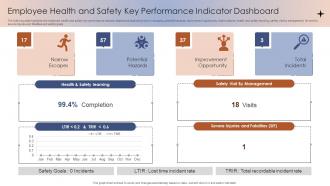
The following slide highlights the employee health and safety key performance indicator dashboard illustrating narrow escapes, potential hazards, improvement opportunity, total incidents, health and safety learning, safety visit by management, ltir and trir, severe injuries and fatalities and safety goals Presenting our set of slides with name Employee Health And Safety Key Performance Indicator Dashboard. This exhibits information on four stages of the process. This is an easy-to-edit and innovatively designed PowerPoint template. So download immediately and highlight information on Narrow Escapes, Potential Hazards, Improvement Opportunity, Total Incidents.

FAQs for Employee Health And Safety Key

Key employee health and safety KPIs include incident rates, near-miss reporting frequency, safety training completion rates, workplace inspections scores, and employee safety perception surveys. These metrics enable organizations to proactively identify risks, reduce workplace injuries, and enhance overall safety culture, with many companies finding that comprehensive KPI tracking ultimately delivers lower insurance costs, improved productivity, and stronger employee retention across manufacturing, healthcare, and construction sectors.

Businesses can effectively track workplace accidents through incident rate calculations, near-miss reporting systems, severity classifications, trend analysis across departments, and real-time safety dashboards. These measurement approaches enable organizations to identify patterns, implement targeted interventions, and benchmark performance against industry standards, while many companies finding that comprehensive tracking ultimately reduces insurance costs, improves employee morale, and strengthens regulatory compliance.

Employee training serves as the foundation for achieving health and safety KPIs by developing hazard recognition skills, ensuring regulatory compliance, and building safety-first culture across organizations. Through comprehensive training programs, companies significantly reduce workplace incidents, minimize compliance violations, and enhance employee engagement, with manufacturing and construction sectors finding that well-trained teams deliver measurable improvements in safety performance metrics.

Organizations ensure KPI alignment with regulations and standards by conducting regular compliance audits, benchmarking against industry frameworks like OSHA guidelines, and integrating regulatory requirements directly into their measurement systems. Through automated monitoring tools and cross-functional teams, companies streamline compliance tracking, reduce violation risks, and enhance workplace safety standards, ultimately delivering stronger regulatory adherence and competitive operational advantage.

Setting realistic health and safety KPIs involves establishing baseline measurements, consulting industry benchmarks, engaging frontline employees in target-setting, and ensuring metrics align with organizational capabilities and regulatory requirements. These practices enable organizations to create achievable yet challenging goals by incorporating historical data, sector-specific standards, and employee insights, ultimately delivering measurable safety improvements and sustainable compliance across operations.

Employee feedback can be incorporated through regular safety surveys, incident reporting systems, focus groups, and suggestion platforms that capture frontline insights about workplace hazards and safety concerns. This input enables organizations to develop more relevant and actionable KPIs, with many companies finding that employee-driven metrics significantly enhance safety awareness and compliance.

Tools for monitoring health and safety KPIs include wearable devices, IoT sensors, mobile safety apps, digital dashboards, and predictive analytics platforms. These technologies streamline data collection, automate incident reporting, and enhance real-time monitoring across manufacturing, construction, and healthcare organizations, ultimately delivering improved compliance, reduced workplace accidents, and better employee wellbeing outcomes.

Health and safety KPIs should be reviewed monthly for trending analysis and updated quarterly to reflect regulatory changes, incident patterns, and organizational priorities. Many organizations find that this balanced approach enables proactive risk management while maintaining operational efficiency, with industries like manufacturing and construction often implementing real-time dashboards for critical metrics, ultimately delivering enhanced workplace safety and regulatory compliance.

Benchmarking health and safety KPIs presents challenges including inconsistent data collection methodologies, varying industry definitions, limited access to competitor metrics, different organizational sizes, and regulatory compliance variations across regions. These obstacles often result in incomplete comparisons, with many organizations finding that establishing internal baseline trends and partnering with industry associations delivers more meaningful insights for strategic safety improvements.

Organizations use KPI data to foster safety culture by establishing transparent reporting systems, recognizing departments with strong safety performance, and involving employees in goal-setting processes. Through regular safety dashboards and team meetings, companies like manufacturing plants and construction firms create accountability while celebrating improvements, ultimately transforming safety from compliance requirement into shared organizational value.

Employee wellness programs significantly improve health and safety KPIs by reducing workplace injuries, lowering absenteeism rates, decreasing workers' compensation claims, and enhancing overall employee engagement scores. These programs deliver measurable outcomes through preventive health screenings, ergonomic training, and stress management initiatives, with many organizations finding that comprehensive wellness strategies ultimately reduce healthcare costs while boosting productivity and employee retention.

Near-miss incidents can be quantified through near-miss reporting rates, severity classification systems, trending analysis over time periods, and root cause categorization methods. These metrics enable organizations to identify potential hazards before accidents occur, with manufacturing plants, construction sites, and chemical facilities finding that proactive near-miss tracking significantly reduces actual incidents and enhances overall workplace safety performance.

Leadership drives health and safety KPIs by establishing clear policies, allocating adequate resources, and demonstrating visible commitment to safety protocols across all organizational levels. Through regular communication, strategic investment in safety technologies, and accountability frameworks, executives enable enhanced compliance rates, reduced incident frequencies, and improved employee engagement, with many organizations finding that leadership involvement ultimately delivers stronger safety cultures and measurable competitive advantages.

Data analytics enhances health and safety KPI tracking by identifying patterns in incident data, predicting potential risks through predictive modeling, and automating real-time monitoring across multiple workplace locations. Through advanced analytics platforms, organizations streamline compliance reporting, accelerate incident response times, and deliver more targeted safety interventions, with many manufacturing and construction companies finding that data-driven approaches significantly reduce workplace accidents while optimizing resource allocation.

Not meeting health and safety KPIs presents significant operational, financial, and legal risks, including increased workplace accidents, regulatory penalties, higher insurance premiums, and potential litigation exposure. These deficiencies ultimately impact employee morale, productivity, and retention while damaging organizational reputation, with many companies finding that proactive safety investments deliver substantially lower costs than reactive compliance measures.

Ratings and Reviews

90% of 100
Review Form
Write a review
Most Relevant Reviews
  1. 80%

    by Joe Thomas

    “Detailed and great to save your time.”
  2. 100%

    by Murphy Green

    The design is very attractive, informative, and eye-catching, with bold colors that stand out against all the basic presentation templates. 

2 Item(s)

per page: