Employee Productivity Improvement Action Plan Key Initiatives To Enhance

Rating:
90%
Employee Productivity Improvement Action Plan Key Initiatives To Enhance
Slide 1 of 6
Favourites Favourites

Try Before you Buy Download Free Sample Product

Audience Impress Your
Audience
Editable 100%
Editable
Time Save Hours
of Time
The Biggest Sale is ending soon in
0
0
:
0
0
:
0
0
Rating:
90%
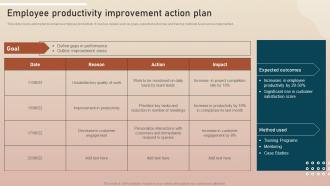
This slide covers action plan to enhance employee productivity. It involves details such as goals, expected outcomes and training methods resources implemented.Deliver an outstanding presentation on the topic using this Employee Productivity Improvement Action Plan Key Initiatives To Enhance. Dispense information and present a thorough explanation of Improvement Productivity, Unsatisfactory Quality, Satisfaction Score using the slides given. This template can be altered and personalized to fit your needs. It is also available for immediate download. So grab it now.

FAQs for Employee Productivity Improvement Action Plan Key

Primary factors influencing remote employee productivity include reliable technology infrastructure, clear communication protocols, structured work schedules, dedicated workspace setup, and strong managerial support systems. These elements work together by minimizing technical disruptions, enhancing collaboration efficiency, and maintaining accountability standards, with many organizations finding that strategic investment in digital tools and flexible policies ultimately delivers higher engagement levels and competitive operational advantage.

Companies can measure employee productivity through goal achievement rates, quality metrics, revenue per employee, project completion times, and customer satisfaction scores. These performance indicators enable organizations to assess actual output and impact rather than time spent, with many finding that outcome-based measurements drive better results, enhance accountability, and ultimately deliver more strategic insights into workforce effectiveness.

Workplace culture significantly influences employee productivity through trust-building, communication patterns, recognition systems, collaborative environments, and clear value alignment. A positive culture enhances productivity by fostering engagement, reducing turnover, and encouraging innovation, while toxic environments create stress, disengagement, and inefficiencies, with many organizations finding that cultural transformation delivers measurable improvements in performance and retention.

Employee engagement directly correlates with productivity through increased motivation, reduced absenteeism, higher quality output, and enhanced collaboration among team members. Engaged employees demonstrate significantly better performance metrics, with studies showing 23% higher profitability in organizations prioritizing engagement, ultimately delivering improved customer satisfaction, reduced turnover costs, and sustainable competitive advantage in today's talent-driven market.

Managers can boost productivity during peak periods through strategic workforce allocation, flexible scheduling, temporary resource augmentation, streamlined communication protocols, and priority-based task management. These approaches enable teams to handle increased demands by redistributing workloads efficiently, extending operational hours when needed, and maintaining clear focus on critical deliverables, ultimately sustaining performance while minimizing employee burnout.

Technology improves workplace productivity by automating routine tasks, streamlining communication through collaborative platforms, and providing real-time analytics for better decision-making. Through AI-powered tools, cloud-based systems, and project management software, organizations enhance efficiency, reduce manual errors, and enable remote collaboration, with many companies finding that these integrated solutions ultimately deliver faster project completion and significantly improved operational performance.

Employee training and development significantly enhances overall productivity by improving skills, increasing efficiency, reducing errors, and boosting employee engagement and retention. These programs enable organizations to streamline operations, accelerate task completion, and minimize costly mistakes, with many companies finding that well-trained employees deliver higher quality work and contribute more strategically to business objectives.

Breaks and work-life balance enhance sustained productivity by preventing burnout, maintaining cognitive performance, and reducing turnover rates. Through strategic rest periods and flexible arrangements, organizations streamline operations while employees deliver higher quality output, increased creativity, and better decision-making, with many companies finding that these practices ultimately boost both retention and competitive advantage.

Feedback and recognition enhance motivation by providing clear performance direction, acknowledging achievements, building confidence, fostering growth mindsets, and creating emotional connections to work. These approaches streamline talent development by reducing uncertainty, accelerating skill improvement, and strengthening employee engagement, with many organizations finding that regular recognition programs ultimately deliver higher retention rates and competitive advantage.

Organizations can tailor productivity strategies by implementing personality assessments, creating flexible work environments, and offering diverse communication channels that match individual preferences and strengths. Through adaptive management approaches, teams benefit from personalized goal-setting methods, varied collaboration styles, and customized feedback mechanisms, with many companies finding that personality-driven strategies enhance both individual performance and overall team effectiveness.

Common remote team productivity pitfalls include communication gaps, collaboration inefficiencies, time zone coordination challenges, digital distraction management, and accountability tracking difficulties. These obstacles can be minimized through structured communication protocols, collaborative technology platforms, and regular check-in systems, with many organizations finding that clear expectations, dedicated workspaces, and strategic use of productivity tools ultimately enhance remote team performance and deliver sustainable competitive advantages.

Organizational policies like flexible hours significantly enhance employee productivity by improving work-life balance, reducing commute stress, and enabling peak performance scheduling. Companies across sectors, from tech firms to financial services, find that flexible arrangements increase output, reduce turnover, and attract top talent, ultimately delivering competitive advantage through higher engagement and operational efficiency.

Physical workspace design significantly impacts employee productivity through ergonomic furniture, natural lighting, noise management, collaborative zones, and technology integration. These elements enhance focus, reduce fatigue, and streamline workflows, with many organizations finding that well-designed offices increase output by 20-25% while improving employee satisfaction and retention rates.

Employees can enhance their productivity by setting clear daily priorities, eliminating distractions, leveraging productivity tools like time-tracking apps, and developing consistent routines that optimize their energy levels. Through proactive skill development, regular self-assessment, and strategic task batching, professionals across industries streamline their workflows, ultimately delivering higher-quality work while reducing stress and enhancing career advancement opportunities.

Key metrics include output quality, project completion rates, innovation contributions, client satisfaction scores, and goal achievement percentages rather than traditional time-based measurements. Knowledge workers in consulting, research, and technology sectors require qualitative assessments that capture creative problem-solving, strategic thinking, and collaborative impact, with organizations increasingly finding that outcome-focused metrics deliver better performance insights and employee engagement.

Ratings and Reviews

90% of 100
Review Form
Write a review
Most Relevant Reviews
  1. 80%

    by Chung Bennett

    “Excellent information with easy access.”
  2. 100%

    by Charlie Jones

    I’ve been your client for a few years now. Couldn’t be more than happy after using your templates. Thank you!

2 Item(s)

per page: