Employee Relations Management Case Study Of Google Inc Employee Relations Management To Develop Positive

Rating:
90%
Employee Relations Management Case Study Of Google Inc Employee Relations Management To Develop Positive Employee Relations Management Case Study Of Google Inc Employee Relations Management To Develop Positive
Slide 1 of 9

or

Favourites Favourites

Try Before you Buy Download Free Sample Product

Audience Impress Your
Audience
Editable 100%
Editable
Time Save Hours
of Time
The Biggest Sale is ending soon in
0
0
:
0
0
:
0
0
Rating:
90%
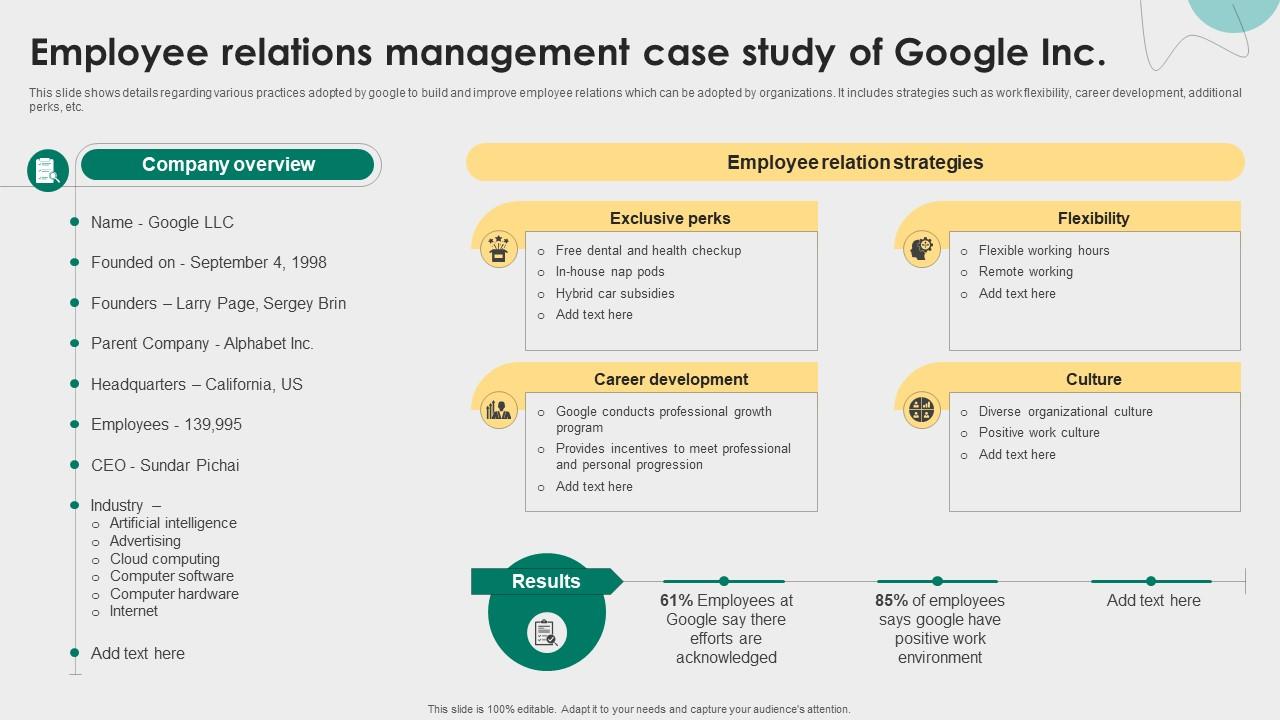
This slide shows details regarding various practices adopted by google to build and improve employee relations which can be adopted by organizations. It includes strategies such as work flexibility, career development, additional perks, etc. Increase audience engagement and knowledge by dispensing information using Employee Relations Management Case Study Of Google Inc Employee Relations Management To Develop Positive. This template helps you present information on Four stages. You can also present information on Exclusive Perks, Career Development, Flexibility, Culture using this PPT design. This layout is completely editable so personaize it now to meet your audiences expectations.

FAQs for Employee Relations Management Case Study Of Google Inc Employee Relations Management

Key components of a successful employee relations management strategy include clear communication channels, conflict resolution protocols, performance management systems, employee feedback mechanisms, and comprehensive policy frameworks. These elements work together by fostering transparency, addressing workplace issues proactively, and maintaining positive organizational culture, with many companies finding that strategic employee relations ultimately delivers higher retention rates, improved productivity, and enhanced workplace satisfaction.

Organizations foster transparent communication through regular town halls, open-door policies, anonymous feedback systems, digital collaboration platforms, and clear communication protocols. These approaches streamline information flow by eliminating hierarchical barriers, encouraging two-way dialogue, and providing multiple channels for employee input, with many companies finding that transparent communication ultimately enhances trust, engagement, and operational efficiency.

Conflict resolution serves as a cornerstone of employee relations management by maintaining workplace harmony, preventing productivity disruptions, and preserving team cohesion through structured mediation processes. Effective resolution strategies enable organizations to transform disputes into learning opportunities, reduce turnover costs, and strengthen communication channels, with many companies finding that proactive conflict management ultimately enhances employee satisfaction and organizational performance.

Employee feedback can be effectively integrated through structured collection methods, regular review cycles, transparent communication channels, and cross-departmental collaboration committees. Organizations increasingly find that systematic feedback integration, especially in retail, healthcare, and manufacturing sectors, enhances operational efficiency, reduces turnover, and delivers stronger employee engagement while ultimately creating more responsive, competitive workplace cultures.

Workplace culture significantly impacts employee relations by shaping communication patterns, trust levels, collaboration effectiveness, and conflict resolution approaches. A positive culture fosters open dialogue, mutual respect, and shared accountability, while toxic environments create tension and disengagement, with many organizations finding that strategic culture initiatives ultimately enhance retention, productivity, and overall workplace harmony.

Technology improves employee relations management by automating HR processes, enabling real-time feedback collection, and providing data-driven insights into workforce dynamics. Through AI-powered analytics and digital communication platforms, organizations streamline conflict resolution, enhance transparency in decision-making, and deliver personalized employee experiences, ultimately reducing turnover while strengthening workplace culture and operational efficiency.

Best practices for handling workplace grievances include establishing clear reporting procedures, ensuring confidential investigation processes, implementing fair hearing mechanisms, maintaining detailed documentation, and providing timely resolutions with follow-up support. These approaches streamline conflict resolution by promoting transparency, reducing legal risks, and preserving employee trust, with many organizations finding that structured grievance systems ultimately enhance workplace culture and minimize costly disputes.

Managers can be trained through comprehensive programs covering conflict resolution, communication skills, legal compliance, emotional intelligence, and early warning sign recognition. These training initiatives typically include role-playing scenarios, case studies from various industries like healthcare and retail, and ongoing coaching support, ultimately enabling faster issue resolution, improved workplace culture, and reduced legal risks.

Employee engagement is significant because it directly impacts productivity, retention, and workplace culture, creating stronger communication channels, increased job satisfaction, and reduced turnover costs. Engaged employees demonstrate higher performance levels, contribute more innovative solutions, and serve as brand ambassadors, with many organizations finding that strategic engagement initiatives ultimately deliver competitive advantage and enhanced operational efficiency.

Labor laws significantly influence employee relations management by establishing compliance requirements for wages, working conditions, discrimination prevention, and dispute resolution procedures. These regulations shape organizational policies around hiring, termination, workplace safety, and collective bargaining, with many companies finding that proactive legal compliance ultimately streamlines operations, reduces litigation risks, and enhances employee trust and engagement.

Employee relations focuses specifically on workplace relationships, conflict resolution, communication channels, union negotiations, and maintaining positive staff interactions. Human resource management encompasses broader organizational functions including recruitment, performance management, compensation planning, training programs, and strategic workforce development, with employee relations serving as one specialized component within the comprehensive HR framework that ultimately delivers enhanced organizational efficiency and competitive advantage.

Organizations can measure employee relations effectiveness through engagement surveys, retention rates, grievance resolution times, productivity metrics, and exit interview feedback. These measurement tools enable companies to track workplace satisfaction, identify improvement areas, and demonstrate ROI on HR investments, with many finding that comprehensive analytics ultimately deliver stronger employee loyalty and competitive talent advantages.

Effective diversity and inclusion strategies include comprehensive bias training, diverse recruitment practices, inclusive leadership development, employee resource groups, and equitable performance evaluation systems. These approaches streamline organizational culture by fostering belonging, enhancing innovation, and improving retention rates, with many companies finding that diverse teams deliver superior problem-solving capabilities and competitive market advantages.

Regular performance reviews enhance employee relations by establishing clear communication channels, providing structured feedback opportunities, and creating transparent career development pathways. Through consistent evaluation processes, organizations strengthen manager-employee trust, address concerns proactively, and align individual goals with company objectives, ultimately delivering improved job satisfaction and reduced workplace conflicts.

Leadership fundamentally shapes employee relations by establishing organizational culture, communication standards, and conflict resolution frameworks that define workplace dynamics. Effective leaders foster trust through transparent decision-making, consistent policy application, and open dialogue channels, with many organizations finding that strong leadership reduces turnover, enhances productivity, and ultimately delivers competitive advantage through engaged workforces.

Ratings and Reviews

90% of 100
Review Form
Write a review
Most Relevant Reviews
  1. 80%

    by Danilo Woods

    Great product with highly impressive and engaging designs.
  2. 100%

    by Dan Marshall

    Very well designed and informative templates.

2 Item(s)

per page: