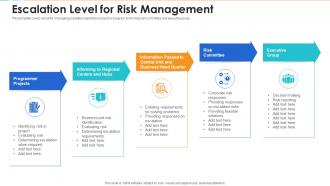
Escalation level for risk management
Try Before you Buy Download Free Sample Product
Audience
Editable
of Time
This template covers about for managing escalation reported in project or program by forming risk committee and executive group.
People who downloaded this PowerPoint presentation also viewed the following :
Escalation level for risk management with all 6 slides:
Use our Escalation Level For Risk Management to effectively help you save your valuable time. They are readymade to fit into any presentation structure.
FAQs for Escalation level
Primary factors contributing to risk escalation include inadequate risk identification, poor communication channels, insufficient monitoring systems, delayed response protocols, and lack of stakeholder engagement. These factors compound by creating information gaps, reducing response time, and limiting mitigation options, with many organizations finding that proactive risk frameworks and clear escalation pathways ultimately deliver better project outcomes and operational control.
Organizations effectively identify early warning signs of risk escalation through continuous monitoring systems, predictive analytics, stakeholder feedback mechanisms, and regular risk assessment reviews. These approaches enable proactive detection by tracking key performance indicators, analyzing historical patterns, and establishing clear escalation thresholds, with many institutions finding that automated alerts and cross-departmental communication ultimately prevent minor issues from becoming major operational disruptions.
Communication serves as the foundation for effective risk escalation management, enabling early warning systems, clear escalation pathways, standardized reporting protocols, and cross-functional collaboration within teams. Through structured communication frameworks, organizations streamline decision-making processes, minimize response delays, and ensure critical information reaches appropriate stakeholders quickly, with many finding that transparent communication channels ultimately reduce operational disruptions and enhance overall risk mitigation effectiveness.
Cultural differences significantly influence risk escalation perceptions through varying communication styles, hierarchy respect levels, uncertainty tolerance, and decision-making approaches within teams. While some cultures encourage direct escalation and open dialogue about potential issues, others prioritize consensus-building or defer to authority, with many international organizations finding that establishing clear escalation protocols and cultural awareness training ultimately delivers more effective risk management and stronger team collaboration.
Risk escalation assessment methodologies include risk scoring matrices, probability-impact analysis, Monte Carlo simulations, scenario planning, and threshold-based categorization systems. These approaches enable organizations to systematically evaluate threats by severity, likelihood, and potential business impact, with many financial institutions and healthcare systems finding that structured escalation frameworks significantly enhance decision-making speed and resource allocation efficiency.
Leadership can intervene through immediate risk assessment protocols, cross-functional crisis teams, resource reallocation, communication cascades, and decision acceleration frameworks. These strategic responses enable organizations to contain escalating risks by implementing rapid containment measures, mobilizing expert resources, and maintaining stakeholder confidence, with many finding that proactive intervention significantly minimizes operational disruption and financial impact.
Common pitfalls include inadequate risk monitoring frameworks, siloed communication between teams, over-reliance on initial assessments without regular updates, and lack of clear escalation triggers or thresholds. These gaps often emerge in complex projects where teams focus on immediate deliverables rather than broader risk patterns, with many organizations finding that poor stakeholder communication and insufficient cross-functional visibility ultimately amplify minor risks into major project threats.
A risk management framework mitigates risk escalation effects by establishing clear escalation protocols, defining risk thresholds, implementing early warning systems, and creating structured response procedures. Through systematic risk assessment and monitoring, organizations streamline decision-making processes, enhance communication across departments, and ultimately deliver faster containment of emerging threats, with many financial institutions finding that structured frameworks significantly reduce operational disruptions.
**INPUT**: What tools are available to help visualize and track risk escalation over time? **OUTPUT**: Risk visualization and tracking tools include dashboards, heat maps, trend analysis software, automated monitoring systems, and integrated risk management platforms. These technologies streamline risk assessment by providing real-time alerts, predictive analytics, and comprehensive reporting capabilities, with many financial institutions and healthcare organizations finding that enhanced visibility ultimately delivers faster response times and improved regulatory compliance. *[Word count: 56 words]*
Lessons learned from previous projects inform future risk escalation strategies by identifying trigger patterns, refining communication protocols, and establishing clearer decision-making hierarchies. Through systematic documentation and analysis, organizations streamline response times, enhance stakeholder coordination, and minimize project disruptions, with many finding that structured knowledge transfer ultimately delivers more proactive risk management and improved project outcomes.
Strong stakeholder engagement significantly reduces risk escalation by ensuring early identification, transparent communication, and collaborative problem-solving throughout project lifecycles. When stakeholders actively participate in risk assessment and mitigation planning, organizations experience faster issue resolution, improved resource allocation, and enhanced decision-making, ultimately delivering better project outcomes and stronger stakeholder relationships.
Organizations should adjust risk management by implementing phase-specific monitoring frequencies, stakeholder communication protocols, and mitigation thresholds that evolve with project complexity. During initiation phases, companies establish baseline risk registers and governance structures, while execution phases require real-time monitoring and rapid response mechanisms, ultimately delivering proactive risk prevention rather than reactive crisis management.
Effective risk escalation metrics include frequency of occurrence, severity impact scores, time-to-resolution patterns, stakeholder exposure levels, and cascading effect indicators. These measurements enable organizations to predict escalation potential by analyzing historical patterns, cross-functional dependencies, and threshold breaches, with many financial services and healthcare institutions finding that combined scoring models ultimately deliver faster intervention and minimized operational disruption.
Training and development strengthen team resilience by building proactive risk identification skills, enhancing communication protocols, and developing rapid response capabilities. Through simulation exercises and cross-functional workshops, organizations enable teams to recognize early warning signs, coordinate effectively during crises, and implement containment strategies swiftly, ultimately minimizing escalation impact and maintaining operational continuity.
Creating a proactive risk management culture requires establishing clear risk ownership, regular training programs, open communication channels, performance incentives tied to risk awareness, and cross-functional collaboration frameworks. These practices enable organizations to identify potential issues early, streamline decision-making processes, and enhance operational resilience, with many financial services and healthcare institutions finding that proactive approaches ultimately deliver competitive advantages and reduced incident costs.
-
Helpful product design for delivering presentation.
-
Great designs, really helpful.