Essential Tips To Improve Employer Brand Plan
Try Before you Buy Download Free Sample Product
Audience
Editable
of Time
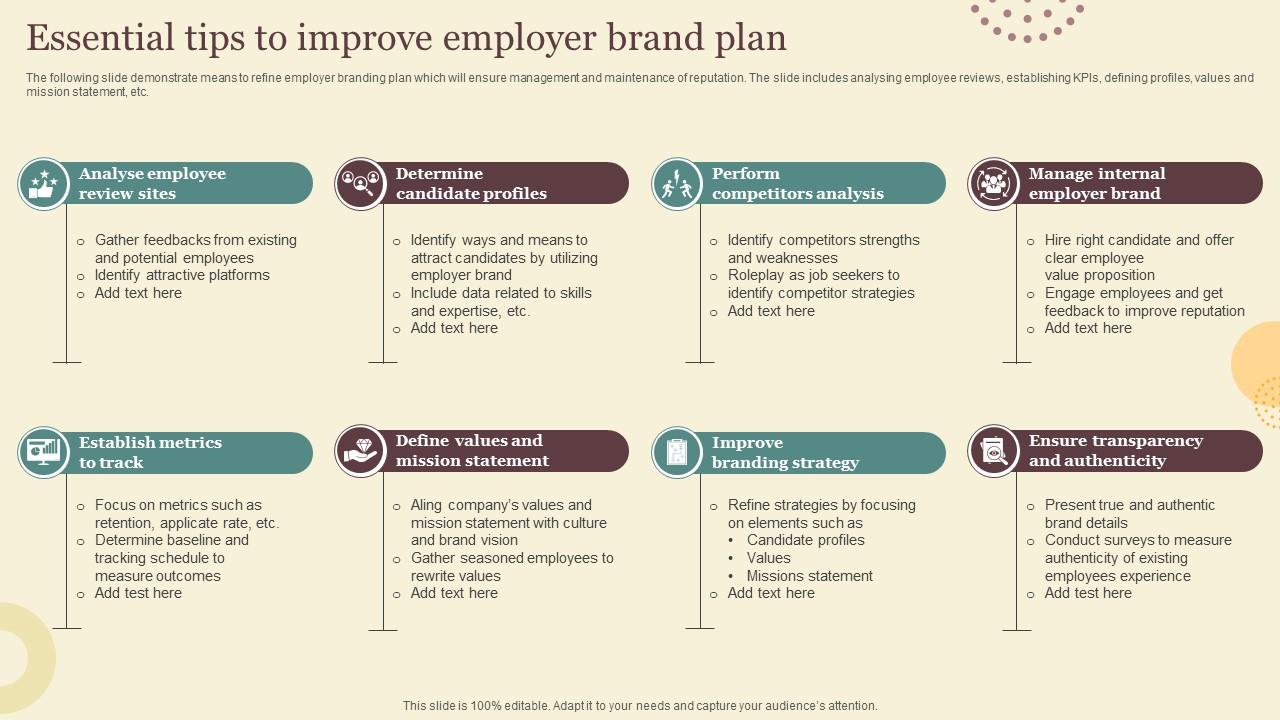
The following slide demonstrate means to refine employer branding plan which will ensure management and maintenance of reputation. The slide includes analysing employee reviews, establishing KPIs, defining profiles, values and mission statement, etc.
People who downloaded this PowerPoint presentation also viewed the following :
Essential Tips To Improve Employer Brand Plan with all 6 slides:
Use our Essential Tips To Improve Employer Brand Plan to effectively help you save your valuable time. They are readymade to fit into any presentation structure.
FAQs for Essential Tips To Improve
A strong employer brand includes compelling company culture, clear career development opportunities, competitive compensation and benefits, authentic leadership communication, and consistent employee experiences across all touchpoints. These elements work together by attracting top talent, reducing recruitment costs, and improving retention rates, with many organizations finding that strategic employer branding delivers significant competitive advantage in increasingly tight labor markets.
Companies effectively communicate their employer brand through authentic storytelling across multiple touchpoints, including compelling career pages, employee testimonials, social media presence, and transparent recruitment processes. These strategies work by showcasing real workplace culture, highlighting growth opportunities, and demonstrating company values in action, with many organizations finding that consistent messaging across platforms significantly enhances candidate attraction and quality.
Employee experience directly shapes employer branding by influencing how current employees perceive, discuss, and represent the organization to potential candidates, customers, and industry peers. Positive experiences with workplace culture, professional development, and leadership translate into authentic advocacy, while negative experiences can damage reputation through social media, review platforms, and professional networks, ultimately impacting talent acquisition and competitive positioning.
Companies leverage social media for employer branding through showcasing company culture, highlighting employee achievements, sharing behind-the-scenes content, posting authentic testimonials, and engaging with industry conversations. These strategies enable organizations to reach broader talent pools, demonstrate workplace values authentically, and build meaningful connections with potential candidates, ultimately creating competitive recruitment advantages.
Key employer branding metrics include employee Net Promoter Score, time-to-fill positions, cost-per-hire, retention rates, and glassdoor ratings. These measurements enable organizations to track recruitment efficiency, employee satisfaction, and brand perception across industries, with many companies finding that strong employer brands reduce hiring costs by up to 50% while attracting higher-quality candidates.
An authentic employer brand improves retention by fostering genuine cultural alignment, increasing employee engagement through transparent values, and creating stronger emotional connections between workers and organizational mission. When companies authentically represent their workplace culture, employees experience reduced cognitive dissonance, enhanced job satisfaction, and deeper sense of belonging, with many organizations finding that authentic branding decreases turnover by establishing realistic expectations and meaningful purpose.
Companies tailor employer branding by segmenting messaging across generational preferences, career stages, and cultural backgrounds, utilizing targeted social media platforms, customized benefits packages, and demographic-specific recruitment channels. Through personalized content strategies, organizations enhance their appeal to millennials seeking purpose, Gen Z prioritizing flexibility, and experienced professionals valuing stability, ultimately attracting diverse talent pools.
Corporate culture significantly impacts employer branding by shaping employee experiences, retention rates, and external reputation through authentic workplace values, leadership practices, and organizational behaviors. Companies with strong, positive cultures attract top talent more effectively, reduce recruitment costs, and enhance their market positioning, with many organizations finding that genuine cultural alignment delivers measurable competitive advantages.
Organizations align their employer brand with business strategy by integrating workforce messaging with core company values, mission statements, and competitive positioning across all recruitment touchpoints. This strategic alignment enables companies to attract talent that directly supports business objectives, with tech firms emphasizing innovation culture and financial services highlighting stability and growth opportunities, ultimately delivering stronger employee retention and enhanced market positioning.
Common employer branding pitfalls include misaligned messaging between marketing promises and actual employee experiences, neglecting current employee voices in brand development, inconsistent communication across recruitment channels, and failing to showcase authentic workplace culture. Organizations often struggle by overpromising benefits without delivering genuine value, while successful companies increasingly focus on transparency and employee advocacy to build credible, sustainable brands.
Employee feedback enhances employer branding by identifying authentic strengths, addressing workplace concerns, and revealing what truly attracts talent retention. This input enables organizations to craft genuine brand messages, improve recruitment materials, and showcase real employee experiences through testimonials and case studies, ultimately creating more credible and compelling employer value propositions.
Companies can showcase their employer brand through virtual office tours, employee-generated social media content, interactive career websites with day-in-the-life videos, gamified recruitment experiences, and transparent salary transparency initiatives. These approaches enable organizations to demonstrate authentic workplace culture, streamline candidate engagement, and ultimately attract top talent while building competitive advantage in increasingly tight labor markets.
Diversity and inclusion can be integrated into employer branding through authentic storytelling, transparent hiring practices, inclusive leadership representation, and genuine community engagement initiatives. Organizations like Microsoft and Johnson & Johnson showcase diverse employee experiences, implement bias-free recruitment processes, and partner with underrepresented communities, ultimately enhancing talent attraction while building stronger, more innovative workplace cultures.
Recruitment marketing and employer branding create compelling narratives that showcase company culture, values, career growth opportunities, competitive benefits, and meaningful work environments. Through strategic social media campaigns, employee testimonials, and targeted content, organizations attract high-caliber candidates who align with their mission, ultimately reducing hiring costs while building stronger, more engaged teams.
Storytelling enhances employer branding by showcasing authentic employee experiences, company culture evolution, and career growth journeys through compelling narratives that resonate with potential talent. These story-driven campaigns enable organizations to humanize their workplace, differentiate from competitors, and build emotional connections, with companies like Google and Salesforce finding that personal employee stories significantly boost recruitment engagement and talent acquisition success.
-
My presentations were a bit amateur before I found SlideTeam’s designs. I’ve been able to find slides for nearly every topic I’ve had to present. Thanks, Slideteam!
-
They had the topic I was looking for in a readymade presentation…helped me meet my deadline.Â