


Ethical Hacking And Network Security Powerpoint Presentation Slides




Try Before you Buy Download Free Sample Product
 Impress Your
 Audience
 100%
100% Editable
 Save Hours
 of Time


This PowerPoint presentation gives a brief idea about the ethical hacking training provider company, problems that ethical hackers can solve, and reasons to choose ethical hacking as a profession. Here is an efficiently designed Ethical Hacking and Network Security template. We have covered skills required to become an ethical hacker, including roles, responsibilities, description, and an overview of hacking and ethical hacking by including the need, purpose, types, and legality of ethical hacking. Moreover, in this Ethical Hacking and Network Security slides, we have included fundamental concepts of ethical hacking, benefits, limitation of ethical hacking, different types of ethical hackers, and critical vulnerabilities found by them. In addition, this Ethical Hacking PPT contains other ethical hacking techniques, various phases of ethical hacking such as surveillance, scanning, gaining access, maintaining access, clearing tracks, and best ethical hacking tools and software. Furthermore, this Ethical Hacking and Network Security template compares white and black hat hackers and ethical hacking and penetration testing. Lastly, this deck comprises a timeline, a roadmap, and a dashboard for ethical hacking. Download our 100 percent editable and customizable template now.
People who downloaded this PowerPoint presentation also viewed the following :
Content of this Powerpoint Presentation
Slide 1: This slide introduces Ethical Hacking and Network Security. State Your Company Name and begin.
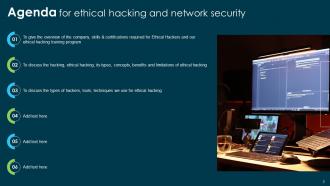
Slide 2: This slide presents Agenda for Ethical Hacking.
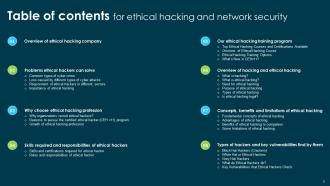
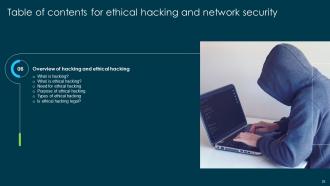
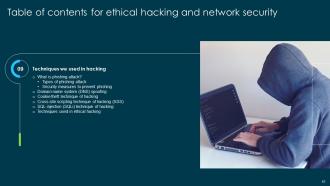
Slide 3: This slide displays Table of Contents for Ethical Hacking.
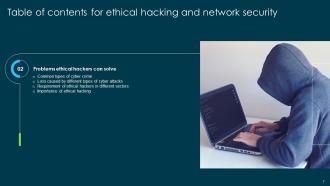
Slide 4: This is another slide continuing Table of Contents for Ethical Hacking.
Slide 5: This slide highlights title for topics that are to be covered next in the template.
Slide 6: This slide describes the overview of the company including the number of countries in which services are provided.
Slide 7: This slide highlights title for topics that are to be covered next in the template.
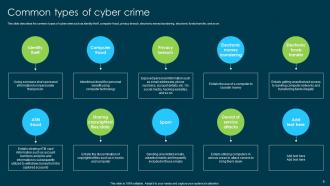
Slide 8: This slide presents common types of cybercrime such as identity theft, computer fraud, privacy breach, etc.
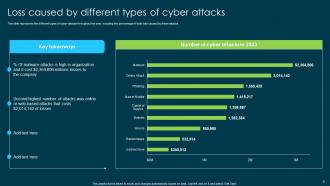
Slide 9: This slide displays Loss Caused by Different Types of Cyber Attacks.
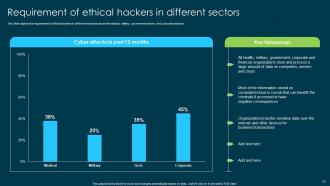
Slide 10: This slide represents Requirement of Ethical Hackers in Different Sectors.
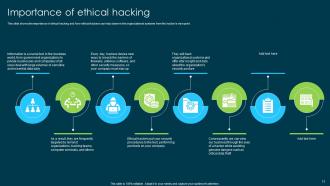
Slide 11: This slide shows the importance of ethical hacking and how ethical hackers can help observe the organizational systems from the hacker’s viewpoint.
Slide 12: This slide highlights title for topics that are to be covered next in the template.
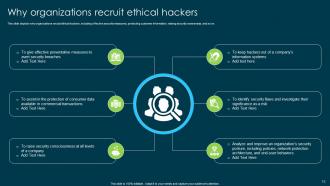
Slide 13: This slide depicts why organizations recruit ethical hackers, including effective security measures, protecting customer information, raising security awareness, etc.
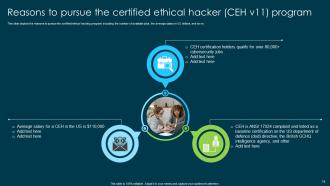
Slide 14: This slide showcases Reasons to Pursue the Certified Ethical Hacker (CEH v11) Program.
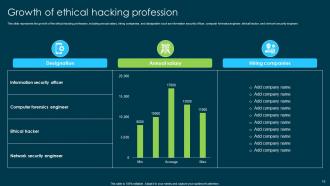
Slide 15: This slide represents the growth of the ethical hacking profession, including annual salary, hiring companies, and designation.
Slide 16: This slide highlights title for topics that are to be covered next in the template.
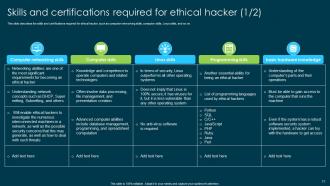
Slide 17: This slide presents Skills and Certifications Required for Ethical Hacker.
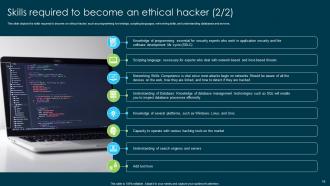
Slide 18: This is another slide continuing Skills Required to Become an Ethical Hacker.
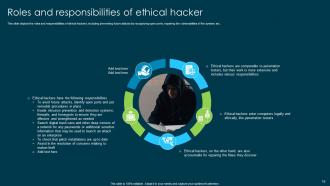
Slide 19: This slide depicts the roles and responsibilities of ethical hackers, including preventing future attacks by recognizing open ports.
Slide 20: This slide highlights title for topics that are to be covered next in the template.
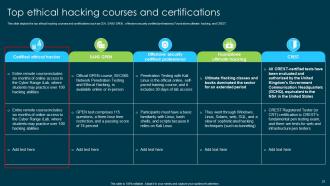
Slide 21: This slide presents top ethical hacking courses and certifications such as CEH, SANS GPEN, offensive security certified professional, etc.
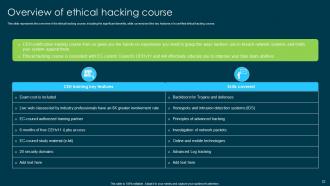
Slide 22: This slide represents the overview of the ethical hacking course, including the significant benefits, skills covered and the key features.
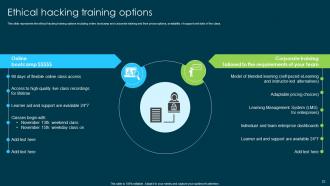
Slide 23: This slide showcases ethical hacking training options including online bootcamp and corporate training.
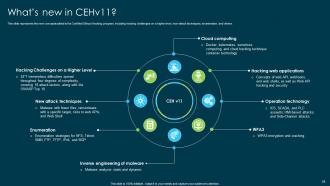
Slide 24: This slide represents the new concepts added to the Certified Ethical Hacking program.
Slide 25: This slide highlights title for topics that are to be covered next in the template.
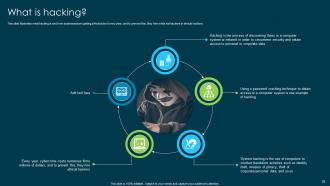
Slide 26: This slide illustrates what hacking is and how businesses are getting affected by it every year.
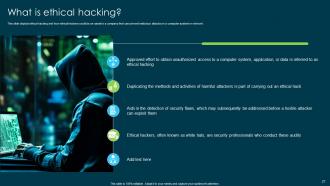
Slide 27: This slide depicts ethical hacking and how ethical hackers could be an asset to a company.
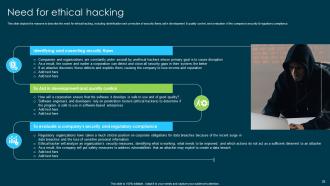
Slide 28: This slide represents reasons to describe the need for ethical hacking, including identification and correction of security flaws.
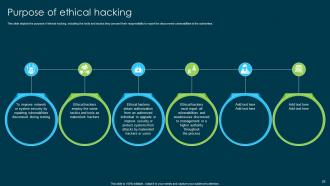
Slide 29: This slide depicts the purpose of ethical hacking, including the tools and tactics they use and their responsibility to report.
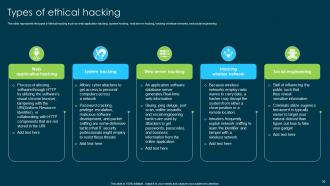
Slide 30: This slide represents the types of ethical hacking such as web application hacking, system hacking, web server hacking, etc.
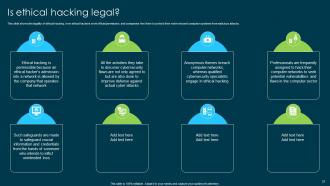
Slide 31: This slide shows the legality of ethical hacking, how ethical hackers work official permission, and companies hire them to protect their networks.
Slide 32: This slide highlights title for topics that are to be covered next in the template.
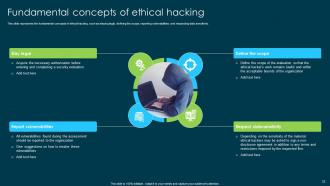
Slide 33: This slide represents the fundamental concepts of ethical hacking, such as staying legal, defining the scope, reporting vulnerabilities, etc.
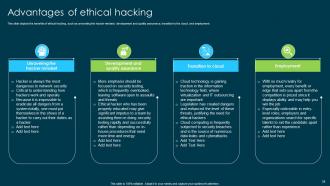
Slide 34: This slide depicts the benefits of ethical hacking, such as unraveling the hacker mindset, development and quality assurance.
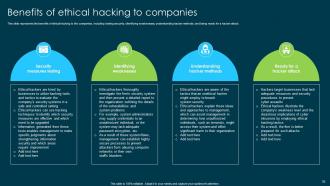
Slide 35: This slide showcases benefits of ethical hacking to the companies, including testing security, identifying weaknesses, understanding hacker methods, etc.
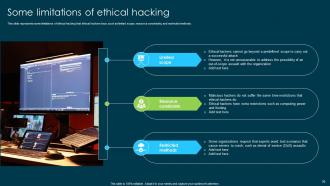
Slide 36: This slide represents some limitations of ethical hacking that ethical hackers face, such as limited scope, resource constraints, and restricted methods.
Slide 37: This slide highlights title for topics that are to be covered next in the template.
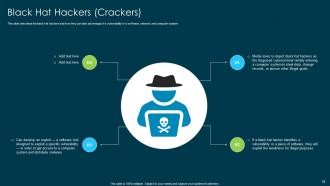
Slide 38: This slide describes the black hat hackers and how they can take advantage of a vulnerability in a software, network, and computer system.
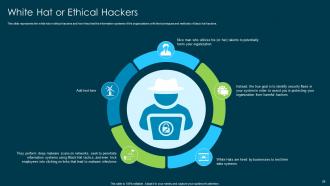
Slide 39: This slide represents the white hat or ethical hackers and how they test the information systems of the organizations.
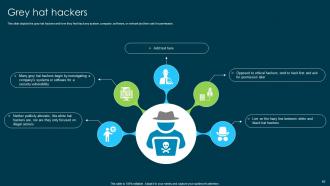
Slide 40: This slide depicts the grey hat hackers and how they first hack any system, computer, software, or network and then ask for permission.
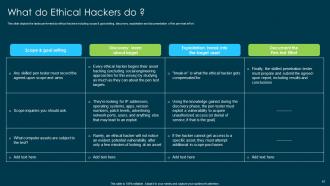
Slide 41: This slide presents tasks performed by ethical hackers including scope & goal setting, discovery, exploitation, etc.
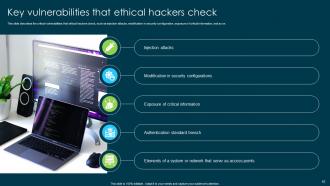
Slide 42: This slide represents Key Vulnerabilities that Ethical Hackers Check.
Slide 43: This slide highlights title for topics that are to be covered next in the template.
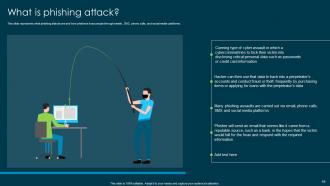
Slide 44: This slide represents what phishing attacks are and how phishers hoax people through emails, SMS, phone calls, and social media platforms.
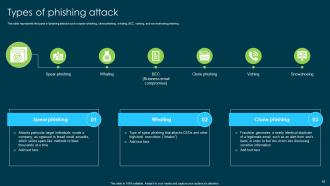
Slide 45: This slide showcases types of phishing attacks such a spear-phishing, clone phishing, whaling, BEC, vishing, and snowshoeing phishing.
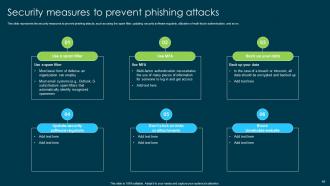
Slide 46: This slide shows Security Measures to Prevent Phishing Attacks.
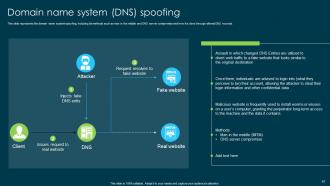
Slide 47: This slide displays domain name system spoofing, including its methods such as man in the middle and DNS server compromise.
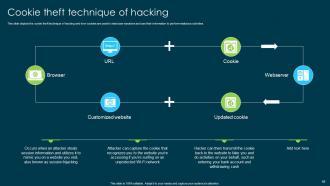
Slide 48: This slide depicts the cookie theft technique of hacking and how cookies are used to steal user sessions.
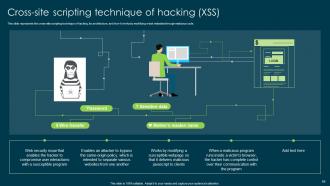
Slide 49: This slide represents the cross-site scripting technique of hacking, its architecture, and how it works by modifying weak websites through malicious code.
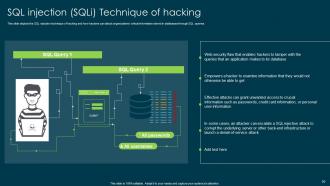
Slide 50: This slide depicts the SQL injection technique of hacking and how hackers can attack organizations’ critical information.
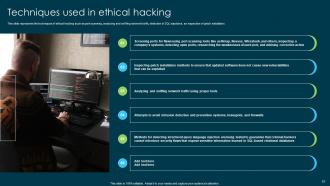
Slide 51: This slide represents techniques of ethical hacking such as port scanning, analyzing and sniffing network traffic.
Slide 52: This slide highlights title for topics that are to be covered next in the template.
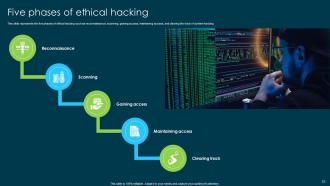
Slide 53: This slide showcases five phases of ethical hacking such as reconnaissance, scanning, gaining access, etc.
Slide 54: This slide illustrates the reconnaissance phase of ethical hacking and how attackers use the foot printing technique.
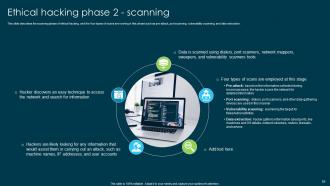
Slide 55: This slide describes the scanning phase of ethical hacking, and the four types of scans are running in this phase.
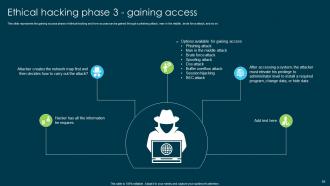
Slide 56: This slide represents the gaining access phase of ethical hacking and how access can be gained through a phishing attack.
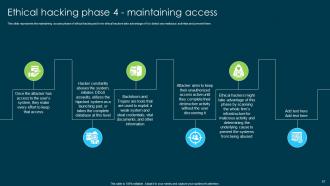
Slide 57: This slide showcases maintaining access phase of ethical hacking and how ethical hackers take advantage of it.
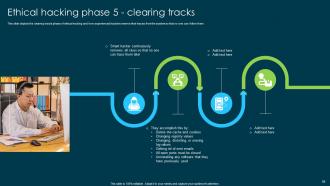
Slide 58: This slide depicts the clearing tracks phase of ethical hacking and how experienced hackers remove their traces.
Slide 59: This slide highlights title for topics that are to be covered next in the template.
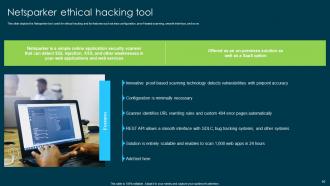
Slide 60: This slide depicts the Net sparker tool used for ethical hacking and its features such as less configuration, proof-based scanning, smooth interface, and so on.
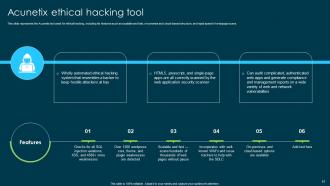
Slide 61: This slide represents the Acunetix tool used for ethical hacking, including its features such as scalable and fast, on-premise and cloud-based structure.
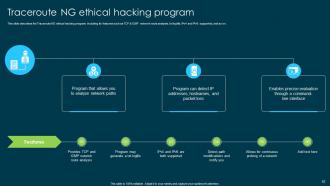
Slide 62: This slide describes the Traceroute NG ethical hacking program, including its features such as TCP & ICMP network route analysis.
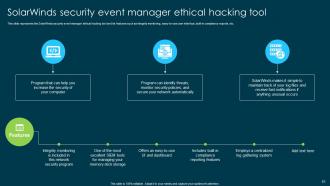
Slide 63: This slide represents SolarWinds Security Event Manager Ethical Hacking Tool.
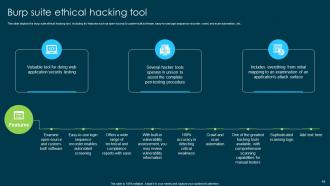
Slide 64: This slide depicts the burp suite ethical hacking tool, including its features such as open-source & custom-built software.
Slide 65: This slide highlights title for topics that are to be covered next in the template.
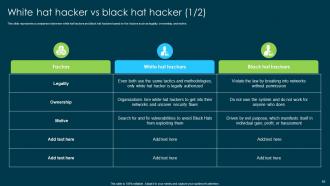
Slide 66: This slide represents a comparison between white hat hackers and black hat hackers based on the factors such as legality, ownership, and motive.
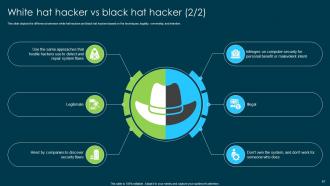
Slide 67: This slide depicts the difference between white hat hackers and black hat hackers based on the techniques, legality, ownership, and intention.
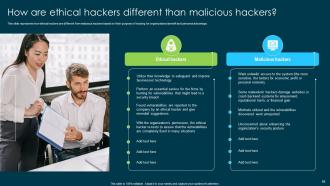
Slide 68: This slide showcases how ethical hackers are different from malicious hackers based on their purpose of hacking.
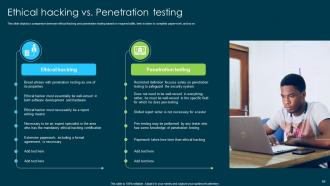
Slide 69: This slide depicts a comparison between ethical hacking and penetration testing based on required skills.
Slide 70: This slide highlights title for topics that are to be covered next in the template.
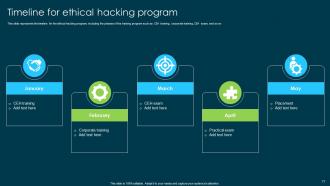
Slide 71: This slide represents the timeline for the ethical hacking program, including the phases of the training program.
Slide 72: This slide highlights title for topics that are to be covered next in the template.
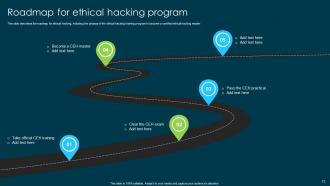
Slide 73: This slide showcases Roadmap for Ethical Hacking Program.
Slide 74: This slide highlights title for topics that are to be covered next in the template.
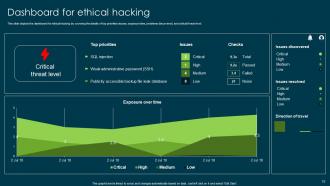
Slide 75: This slide depicts the dashboard for ethical hacking by covering the details of top priorities issues.
Slide 76: This slide displays Icons for Ethical Hacking (IT).
Slide 77: This slide is titled as Additional Slides for moving forward.
Slide 78: This slide provides Clustered Column chart with two products comparison.
Slide 79: This slide displays Stacked Line with Markers.
Slide 80: This is an Idea Generation slide to state a new idea or highlight information, specifications etc.
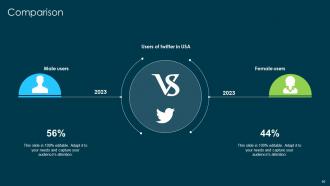
Slide 81: This is a Comparison slide to state comparison between commodities, entities etc.
Slide 82: This is a Financial slide. Show your finance related stuff here.
Slide 83: This slide contains Puzzle with related icons and text.
Slide 84: This is Our Target slide. State your targets here.
Slide 85: This slide shows Post It Notes. Post your important notes here.
Slide 86: This is a Timeline slide. Show data related to time intervals here.
Slide 87: This is a Thank You slide with address, contact numbers and email address.
Ethical Hacking And Network Security Powerpoint Presentation Slides with all 94 slides:
Use our Ethical Hacking And Network Security Powerpoint Presentation Slides to effectively help you save your valuable time. They are readymade to fit into any presentation structure.















FAQs for Ethical Hacking And Network Security
Basically, ethical hackers get permission first - that's the huge difference. You're authorized to test systems and document what you find to help companies fix vulnerabilities. Regular hackers? They're just breaking in for personal gain or to cause damage. Though grey hat hackers kinda muddy the waters there. Ethical hackers follow responsible disclosure too, plus they usually have certs like CEH or OSCP. Honestly, the field's pretty solid if you're thinking about it. Just make sure you always get proper authorization before testing anything - that permission slip is literally what keeps you out of jail.
First thing - set clear boundaries so your ethical hackers don't accidentally crash anything important. Bug bounty programs are solid for finding vulnerabilities, and you'll want partnerships with good pen testing companies too. Legal agreements are crucial (learned that one the hard way). Build a process that actually fixes bugs instead of just collecting them in some forgotten spreadsheet. Don't treat this like a one-and-done thing either. Regular testing cycles work best, and definitely track how fast you're patching stuff up.
CEH and OSCP are the big two everyone recognizes - those actually open doors. Security+ is decent for beginners but kinda basic tbh. CISSP's good if you want the management angle, shows you get the bigger picture. OSCP will absolutely wreck you but damn, it proves you can actually break into stuff instead of just cramming theory. Start with CEH to dip your toes in. Then go for OSCP when you're feeling masochistic enough for the real hands-on nightmare. Worth it though - that cert carries serious weight.
Get written permission first - seriously can't stress this enough. Stay within whatever scope you agreed to, don't go poking around extra systems just because you can. Never profit off vulnerabilities you find or leak sensitive data (wild that people still do this). Document your work properly and only report to the right people. Once you step outside those boundaries, you're basically breaking the law. Always ask if you're unsure about limits - better to look overly cautious than end up in legal trouble over something stupid.
Dude, ethical hacking isn't just poking at websites anymore. Now you're dealing with IoT gadgets, cloud setups, AI systems - the whole digital mess. Attack surfaces are everywhere since everything's connected (my fridge probably has more vulnerabilities than some corporate networks lol). You've gotta know containerization, API security, blockchain flaws, even ML bias issues. It's moved way past finding basic SQL injections. Think like an attacker across entire ecosystems now. Honestly? Start learning cloud security and DevSecOps if you haven't already. That's where all the jobs are.
Honestly, just grab Kali Linux first - it's got everything bundled together which saves tons of time. Start with Nmap for network scanning and Burp Suite for web apps. Those two will handle most of what you need initially. Metasploit's great for exploits, Wireshark for packet stuff. Nessus costs money but it's solid for vulnerability scans, though OpenVAS works fine too if you're broke lol. Aircrack-ng if you're doing wireless testing. Oh and Hashcat for cracking passwords - that thing's a beast. Really though, master Nmap and Burp first before diving into the fancy stuff.
So ethical hackers have pretty strict protocols they follow. They work in sandboxed environments and encrypt everything when communicating. Before touching any sensitive stuff, they sign NDAs - the works. They only grab data that's absolutely needed to prove vulnerabilities exist, not just downloading everything they can get their hands on. Though honestly, I bet some do get tempted to poke around more than necessary! After testing's done, there's a clear policy for securely deleting everything. If you're hiring them, definitely ask them to explain their data protection process upfront.
Dude, this stuff is tricky legally. The Computer Fraud and Abuse Act in the US doesn't care about your good intentions - you can still get screwed without written permission. EU has harsh cybersecurity laws too, though some countries are more chill about security research. Even white hat stuff can backfire without proper authorization. I learned this the hard way when a buddy almost got in trouble despite helping a company. Always get written consent first, follow responsible disclosure, and honestly? Talk to a cybersecurity lawyer in your area. It's worth the peace of mind.
Look, ethical hackers are basically the good guys who break into your stuff before the actual criminals do. They use all the same tricks real attackers would - scanning networks, finding weak passwords, that whole deal. Pretty smart when you think about it. You get reports showing exactly what's broken and how to patch it up. The tricky part? Actually doing something about it instead of just filing the report away somewhere. It helps you figure out where your security actually sucks and what's worth spending money on first.
So the main stuff ethical hackers go after? SQL injection and XSS are huge - those pop up everywhere. Broken authentication is another big one. They'll also look for insecure object references, misconfigurations, and anywhere sensitive data's getting exposed. CSRF attacks are sneaky as hell, people underestimate those. Oh, and using outdated components with known vulns - that's low-hanging fruit for attackers. Automated scans are good to start with, but honestly they only catch surface-level issues. Manual testing's where you find the stuff that actually matters. That's when things get interesting.
So your ethical hackers will give you detailed reports showing exactly what's broken and how to fix it. Most companies do regular meetings where the hackers walk through everything with your dev team - fair warning, these get super technical but they're worth it. You'll want clear timelines for when stuff needs to be patched. They rank everything by how bad it could be, so you know what to tackle first. Oh, and make sure you set up retesting after you've fixed things - sometimes the "fix" doesn't actually work. Just create a formal process with regular check-ins and you'll be good.
So here's the deal - ethical hacking is like your insurance policy for GDPR and HIPAA compliance. Both regulations require you to actively protect data, and pen testing proves you're actually doing it, not just talking about it. GDPR wants "appropriate technical measures" and HIPAA needs regular security assessments. Honestly, the documentation alone is worth it when auditors come knocking. I'd start scheduling these tests regularly because scrambling after a breach or during an audit? That's when costs go through the roof and everyone's panicking.
Track stuff like how fast you fix vulnerabilities and what percentage of critical issues your pentesters catch that automated scans miss. That's honestly where you'll see if it's worth the money. Also watch for repeat findings - if the same SQL injection keeps showing up, your dev team isn't learning from previous tests which is frustrating. Set up baseline metrics now, then check quarterly to see if incidents are actually dropping. Compare your security posture year-over-year too. The vulnerability discovery rates will tell you a lot about whether you're getting better at this whole thing.
Dude, the worst myth is that ethical hackers are just criminals who got busted and flipped sides. Total BS - most of us have legit certifications and formal training. Oh, and people think we're constantly trying to hack random stuff for kicks. We only test what we're authorized to mess with, obviously. Another thing that bugs me? Everyone assumes it's just running some automated scripts. Actually takes real technical skills and creativity - you gotta understand the business side too. If you're thinking about getting into it, definitely focus on certs first and set up your own practice labs. Way safer than... other methods.
Honestly, just make it a daily thing. I follow a bunch of security researchers on Twitter and check SANS or Krebs when I'm drinking my morning coffee. Bug bounty platforms are where it's at though – you see actual vulns getting found in real time, which is pretty cool. Reddit's r/netsec is solid, and local OWASP meetups are worth it if you can swing it. Google alerts work great for specific stuff you care about. YouTube has some decent security channels too, though you gotta wade through some garbage. Don't go crazy trying to read everything – 30 minutes most mornings works for me. Pick two good sources first, then add more later.
-
The content is very helpful from business point of view.
-
Editable templates with innovative design and color combination.