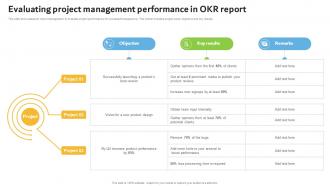
Evaluating Project Management Performance In Okr Report
Try Before you Buy Download Free Sample Product
Audience
Editable
of Time
This slide showcases okr report management to evaluate project performance for increased transparency. This further includes project name, objective and key results.
People who downloaded this PowerPoint presentation also viewed the following :
Evaluating Project Management Performance In Okr Report with all 9 slides:
Use our Evaluating Project Management Performance In Okr Report to effectively help you save your valuable time. They are readymade to fit into any presentation structure.
FAQs for Evaluating Project Management Performance
Key performance indicators for project management success include schedule variance, budget performance, scope adherence, quality metrics, and stakeholder satisfaction scores. These KPIs enable organizations to streamline project oversight by tracking deliverable completion rates, resource utilization efficiency, and risk mitigation effectiveness, with many companies finding that consistent KPI monitoring ultimately delivers improved project outcomes and enhanced competitive advantage.
Qualitative metrics assess subjective aspects like team satisfaction, stakeholder engagement, and communication effectiveness, while quantitative metrics measure numerical data such as budget variance, schedule adherence, and resource utilization rates. Through balanced evaluation approaches, organizations streamline performance reviews, enhance project outcomes, and deliver strategic insights, with many project managers finding that combining both metrics ultimately provides comprehensive assessment and competitive advantage.
Stakeholder satisfaction can be measured through surveys and feedback forms, regular check-ins and interviews, performance metrics against agreed expectations, communication effectiveness assessments, and post-project evaluations. These methods enable project managers to gauge engagement levels, identify areas for improvement, and ensure deliverables meet stakeholder needs, ultimately enhancing project success rates and building stronger long-term partnerships across organizations.
Project management tools facilitate performance evaluations by providing real-time tracking of deliverables, automated progress reporting, and comprehensive analytics that measure individual and team contributions against project milestones. These platforms enable managers to assess productivity through data-driven insights, streamline feedback processes, and identify performance gaps early, ultimately delivering more objective evaluations and enhanced team accountability.
Risk management serves as a critical performance indicator, measuring how effectively teams identify, assess, mitigate, and monitor potential threats throughout project lifecycles. Through proactive risk strategies, organizations enhance project predictability, reduce costly delays, and maintain stakeholder confidence, with many finding that robust risk frameworks ultimately deliver higher success rates and competitive advantage in increasingly complex business environments.
Lessons learned can be systematically integrated into performance evaluations through structured documentation processes, cross-functional review sessions, and competency-based assessment frameworks that capture both successes and improvement areas. These approaches enable organizations to enhance individual development, refine team dynamics, and strengthen project methodologies, with many companies finding that systematic integration ultimately delivers improved project outcomes and competitive advantage.
Common project audit methodologies include post-implementation reviews, milestone assessments, earned value management, risk audits, and stakeholder feedback analysis. These approaches streamline evaluation processes by examining scope adherence, budget variance, timeline performance, and deliverable quality, with many organizations finding that systematic auditing enhances future project success rates and operational efficiency.
Project scope changes impact performance evaluations by altering original baselines for budget, timeline, and deliverables, making accurate assessment challenging and potentially unfair to project teams. Effective mitigation strategies include implementing robust change control processes, updating performance metrics to reflect approved modifications, and establishing clear documentation protocols that distinguish between controllable performance issues and scope-driven variances, ultimately ensuring fair evaluation while maintaining project accountability.
**INPUT**: What are the best practices for aligning project performance evaluations with organizational goals? **OUTPUT**: Best practices include establishing clear KPIs tied to strategic objectives, implementing balanced scorecards, conducting regular milestone reviews, integrating stakeholder feedback loops, and utilizing data-driven assessment frameworks. These approaches streamline evaluation processes by connecting project outcomes to business priorities, enabling organizations to optimize resource allocation and strategic focus, ultimately delivering enhanced operational efficiency and competitive advantage.
Gantt charts and visual aids enhance project evaluation by providing clear timeline visibility, progress tracking, resource allocation insights, and milestone identification at a glance. These tools streamline performance assessment by enabling project managers to quickly identify bottlenecks, compare planned versus actual progress, and communicate status updates effectively, ultimately delivering improved project transparency and faster decision-making capabilities.
Communication metrics are significant because they directly impact project success rates, team alignment, and stakeholder satisfaction through measurable indicators like response times, meeting effectiveness, and information clarity. These metrics enable project managers to identify bottlenecks, enhance collaboration, and streamline decision-making processes, with many organizations finding that improved communication tracking ultimately delivers faster project completion and reduced costs.
Project managers ensure transparency by establishing clear evaluation criteria, sharing performance data openly with stakeholders, conducting regular check-ins, and documenting all assessments comprehensively. Through consistent communication protocols and standardized reporting frameworks, organizations streamline accountability processes, enhance team trust, and deliver more accurate project outcomes, with many finding that transparent evaluation practices ultimately strengthen stakeholder relationships and improve future project success rates.
Team dynamics significantly influence project performance evaluation through communication patterns, collaboration effectiveness, conflict resolution capabilities, decision-making processes, and individual accountability levels. Poor team cohesion can mask individual contributions and skew performance metrics, while strong dynamics enhance transparency and accurate assessment, with many organizations finding that teams with clear roles and open communication deliver more reliable evaluation data and improved project outcomes.
Post-project reviews foster continuous improvement by incorporating structured feedback collection, root cause analysis of successes and failures, and standardized documentation processes that capture actionable insights. Through systematic evaluation frameworks, organizations streamline future project planning, enhance resource allocation, and accelerate delivery timelines, with many companies finding that regular retrospectives ultimately deliver measurable performance gains and competitive advantage.
Common pitfalls include focusing solely on schedule adherence, ignoring stakeholder satisfaction, overlooking team development metrics, relying on incomplete data, and evaluating performance too late in project cycles. These evaluation gaps can mislead decision-making and compromise future project success, with many organizations finding that balanced scorecards incorporating quality, budget, timeline, and stakeholder feedback deliver more comprehensive insights.
-
The pricing page of this website is very sorted. I felt no pain while buying the PPTs.
-
Innovative and Colorful designs.