

F591 Key Features Of Predictive Data Analytics Software Data Science And Analytics Transformation Toolkit




Try Before you Buy Download Free Sample Product
 Impress Your
 Audience
 100%
100% Editable
 Save Hours
 of Time


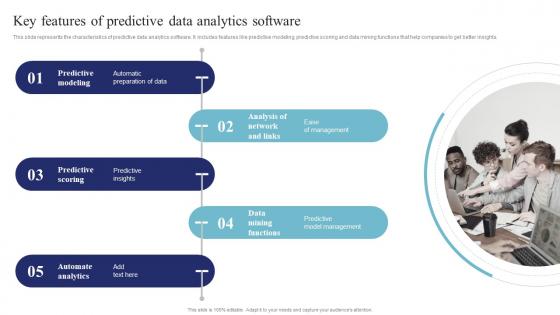
This slide represents the characteristics of predictive data analytics software. It includes features like predictive modeling, predictive scoring and data mining functions that help companies to get better insights.
People who downloaded this PowerPoint presentation also viewed the following :
F591 Key Features Of Predictive Data Analytics Software Data Science And Analytics Transformation Toolkit with all 6 slides:
Use our F591 Key Features Of Predictive Data Analytics Software Data Science And Analytics Transformation Toolkit to effectively help you save your valuable time. They are readymade to fit into any presentation structure.





FAQs for F591 Key Features Of Predictive Data Analytics Software Data Science And
**INPUT**: What are the key components of a successful predictive data analytics strategy? **OUTPUT**: Key components include quality data collection, advanced statistical modeling, machine learning algorithms, real-time processing capabilities, and skilled analytical teams. These elements work together by enabling accurate forecasting, identifying market trends, and optimizing resource allocation, with many organizations finding that strategic integration ultimately delivers competitive advantage and enhanced decision-making across operations.
Businesses leverage predictive analytics to enhance customer experience by personalizing recommendations, anticipating service needs, optimizing pricing strategies, and predicting customer behavior patterns across touchpoints. Through machine learning algorithms, companies like Netflix, Amazon, and financial institutions deliver targeted content, proactive support, and customized offerings, ultimately reducing churn while increasing satisfaction and loyalty.
Machine learning enhances predictive data analytics by automating pattern recognition, processing vast datasets, and continuously improving accuracy through algorithmic learning. These technologies streamline forecasting by identifying complex correlations, adapting to new data patterns, and minimizing human intervention, with many organizations finding that ML-driven analytics deliver significantly faster insights and more reliable predictions.
Data quality and sourcing significantly impact predictive analytics accuracy by determining model reliability, forecast precision, and decision-making effectiveness. Poor data sources or inconsistent quality can produce misleading predictions, while clean, comprehensive datasets enable financial institutions, healthcare systems, and retailers to achieve reliable forecasting, ultimately delivering competitive advantage and strategic insights.
Common implementation challenges include data quality issues, insufficient technical expertise, integration complexities, resistance to change, and high initial costs. Organizations often struggle with siloed data systems, lack of skilled analysts, and cultural barriers where teams resist data-driven decision making, though companies investing in proper training and change management typically see significant improvements in forecasting accuracy and operational efficiency.
Predictive analytics optimizes supply chain management by forecasting demand patterns, identifying potential disruptions, and streamlining inventory levels across multiple touchpoints. Through machine learning algorithms, manufacturers and retailers can anticipate seasonal fluctuations, minimize stockouts, and reduce carrying costs, while enabling proactive supplier management, ultimately delivering enhanced operational efficiency and improved customer satisfaction in an increasingly complex logistics environment.
Ethical considerations include data privacy, algorithmic bias, transparency, informed consent, and data security. These safeguards ensure responsible analytics by protecting personal information, preventing discriminatory outcomes, and maintaining stakeholder trust, with many organizations finding that ethical frameworks ultimately deliver sustainable competitive advantage while minimizing regulatory risks.
Industries apply predictive analytics through sector-specific approaches, with healthcare using patient outcome modeling and treatment optimization, retail leveraging demand forecasting and inventory management, manufacturing implementing predictive maintenance and quality control, and financial services employing fraud detection and risk assessment. These applications streamline operations, reduce costs, and enhance decision-making, ultimately delivering competitive advantages and improved customer experiences across diverse business environments.
Popular predictive analytics tools include Python, R, SAS, IBM SPSS, Tableau, Microsoft Power BI, and cloud platforms like AWS SageMaker and Google Analytics Intelligence. These technologies streamline model development, data visualization, and automated insights, with many financial services firms and healthcare organizations finding that integrated platforms significantly enhance forecasting accuracy while reducing analysis time.
Organizations measure predictive analytics ROI by tracking cost savings from improved decision-making, revenue increases from better forecasting, and efficiency gains through automated processes. Financial services firms calculate reduced fraud losses, while retailers measure inventory optimization benefits and healthcare systems quantify improved patient outcomes, ultimately demonstrating measurable business value and competitive advantage.
Best practices for visualizing predictive analytics results include interactive dashboards, scenario modeling displays, confidence interval charts, trend forecasting graphs, and real-time performance indicators. These visualization methods enhance decision-making by presenting complex predictions through intuitive interfaces, enabling stakeholders to quickly interpret forecasts and adjust strategies, with many organizations finding that clear visual storytelling significantly improves analytical adoption and business outcomes.
Predictive analytics forecasts future outcomes using historical data and statistical models, while descriptive analytics examines past performance and prescriptive analytics recommends specific actions. These three approaches work strategically together, with financial services using descriptive reporting for quarterly reviews, predictive models for risk assessment, and prescriptive algorithms for investment recommendations, ultimately delivering comprehensive business intelligence.
Essential data governance frameworks for predictive analytics include data quality management, privacy compliance protocols, access control systems, metadata management, and audit trail mechanisms. These frameworks work together by ensuring data accuracy, maintaining regulatory compliance, and establishing clear ownership structures, with organizations in healthcare, finance, and retail finding that robust governance ultimately delivers more reliable predictions and competitive advantage.
Predictive analytics enhances risk management and fraud detection by analyzing historical patterns, identifying anomalies in real-time, and scoring potential threats before they materialize. Through machine learning algorithms, banks streamline loan approvals while minimizing defaults, insurance companies detect fraudulent claims faster, and financial institutions reduce operational losses, ultimately delivering stronger security and competitive advantage.
Future trends in predictive analytics include real-time streaming analytics, edge computing integration, automated machine learning, explainable AI models, and augmented analytics platforms. These advances enable organizations to make faster decisions, reduce infrastructure costs, and democratize data science capabilities, with many enterprises finding that combining these technologies delivers enhanced customer experiences and competitive advantage in increasingly data-driven markets.
-
Great work on designing the presentation. I just loved it!
-
The designs by SlideTeam are honestly the best I have seen so far. Will be definitely coming back for more.