
Feed forward neural networks ppt powerpoint presentation inspiration rules
Try Before you Buy Download Free Sample Product
Audience
Editable
of Time
Our Feed Forward Neural Networks Ppt Powerpoint Presentation Inspiration Rules are explicit and effective. They combine clarity and concise expression.
People who downloaded this PowerPoint presentation also viewed the following :
Feed forward neural networks ppt powerpoint presentation inspiration rules with all 2 slides:
Give your audience a fulfilling experience. They will find our Feed Forward Neural Networks Ppt Powerpoint Presentation Inspiration Rules elevating.
FAQs for Feed forward neural networks ppt powerpoint
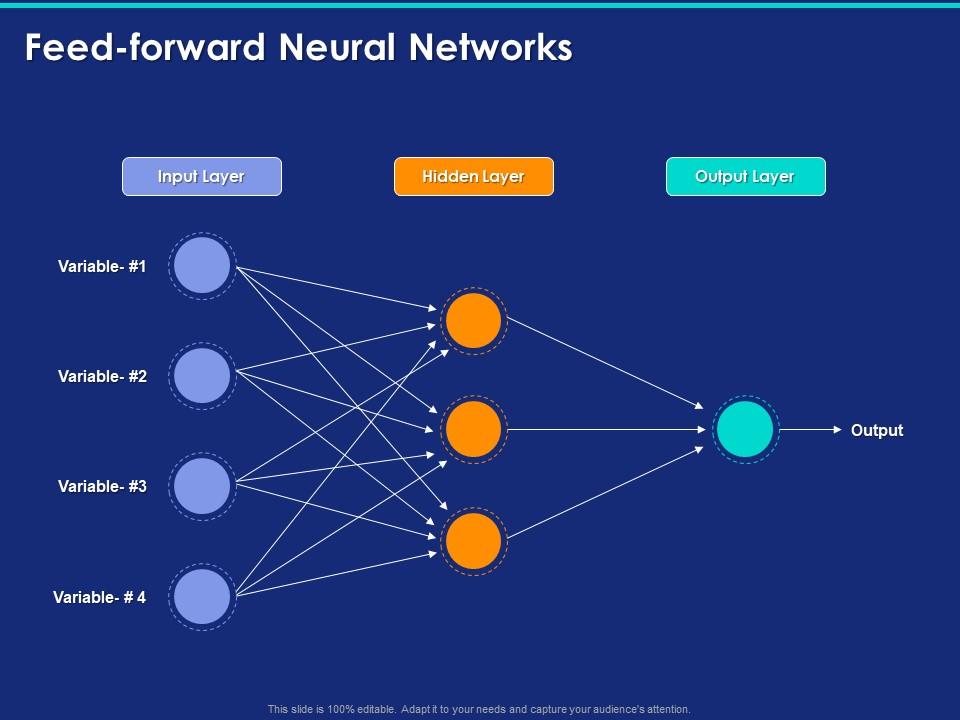
So you've got three main parts: input layer, hidden layers (one or more), and output layer. Weights and biases connect everything. Each neuron uses activation functions like ReLU or sigmoid to process data as it moves through. Feed forward just means data goes one way - input to output, no crazy loops like RNNs have. Training's where it gets interesting though - backpropagation tweaks all those weights and biases. I'd sketch your architecture first, figure out how many hidden layers you need. More complex problems need more neurons, but don't go overboard or you'll overfit.
Look, your network's architecture basically controls everything it can learn. Deep networks capture complex stuff, but go overboard and you'll get vanishing gradients or overfitting - classic rookie mistakes. Width gives you more power too, though you need way more data to make it work. Honestly? Finding the right balance is more art than science. I always tell people to start with like 2-3 hidden layers, then slowly add complexity while watching your validation loss. Skip connections and good regularization help tons. Each problem's different though, so don't get too attached to any single approach.
So neural networks need activation functions to learn anything interesting - without them you're just doing linear math no matter how many layers you stack. Pretty pointless for real problems! They add the non-linearity that lets networks figure out complex patterns. ReLU is your best bet to start with since it's straightforward and doesn't run into those annoying vanishing gradient issues. Sigmoid and tanh work too but have their own quirks. Honestly, just go with ReLU first and switch later if you're having problems.
So basically, feedforward networks just push data straight through - input goes to output, no looking back. RNNs though? They've got memory loops that let them remember stuff from before. Picture an assembly line versus someone who actually pays attention to what happened earlier. Feedforward is great for image recognition since each photo stands alone. But RNNs shine with sequences - like predicting text or stock prices where yesterday's data matters for today's guess. Honestly, I used to think all neural networks were the same until I realized how different they actually are. Short version: use RNNs when order matters, feedforward when it doesn't.
Honestly, feedforward networks are everywhere - total workhorses. Classification stuff is huge: spam detection, image recognition, banking fraud. Regression too, like house prices or stock predictions (though good luck with stocks lol). Medical diagnosis is probably the coolest application - analyzing X-rays, predicting patient outcomes from symptoms and labs. Pretty much any structured input data where you need to predict something. Just remember they work best when your data doesn't have those sequential dependencies. That's actually the key thing when you're picking between different architectures.
Dropout is probably your best starting point - it randomly shuts off neurons so your model can't get too dependent on specific patterns. Early stopping works great too, just watch your validation loss and stop before things get ugly. L1/L2 regularization is solid but honestly dropout's easier to mess around with first. You could also try reducing your model size or adding more data if you've got it. Batch normalization helps sometimes too, though I've had mixed results with that one. Start simple with dropout and early stopping - they'll give you the biggest bang for your buck.
For ReLU networks, He initialization is your best bet - it's specifically designed for those activations since ReLU zeroes out half the neurons. Xavier/Glorot works great with sigmoid and tanh instead. Both scale weights based on your layer sizes to keep gradients flowing properly. Random normal/uniform initialization exists but honestly it's pretty meh compared to the other two. Never use zero initialization though, it completely breaks symmetry and your network won't learn anything. Most frameworks pick decent defaults automatically, but if you're being picky about convergence speed, just go with He for ReLU layers.
So backpropagation is basically the network figuring out which weights screwed up the prediction. You start at the output layer and trace the error backwards through each hidden layer - it's like following breadcrumbs but in reverse. The chain rule helps calculate gradients as you go. Each weight gets adjusted based on how much it contributed to the mess. Honestly, the math looks scarier than it actually is. Going layer by layer in the opposite direction of your forward pass is the key part. I'd definitely recommend coding a tiny example by hand at least once, even though it's tedious. That's when the whole process finally clicked for me.
Honestly, feedforward networks are perfect when you just need something that works without the headache. Quick to train, solid results for basic classification stuff. But here's the thing - they're pretty dumb about sequences or images since they only see flat data. I always start with these for tabular datasets though. They're like the Honda Civic comparison you mentioned, which is spot-on. Overfitting can be annoying with small datasets. For anything involving time series or spatial patterns? Skip them. You'll need RNNs or CNNs instead.
So basically dropout randomly kills off neurons during training - like 20-50% of them just get set to zero. It's kinda genius actually because your network can't get lazy and rely on the same neuron combos every time. Forces it to learn better, more general patterns instead of memorizing stuff. When you're actually using the model though, all neurons come back and get scaled properly. I'd start with around 0.2 or 0.3 for the dropout rate and see how your validation looks. Works really well for deeper networks that love to overfit everything.
Okay so it totally depends on what you're building. Classification problems? Go with accuracy, precision, recall, F1-score, ROC-AUC. Regression stuff uses MSE, RMSE, MAE, R-squared instead. Cross-entropy loss works great for multi-class things. I usually just pick something basic first - accuracy for classification or MSE for regression. Gets you a quick baseline. You can always add fancier metrics later if you need them. The real trick is choosing metrics that actually make sense for your problem. Don't just pick whatever sounds cool. Maybe 2-3 solid ones that match what you're trying to achieve business-wise.
So learning rate is how big steps your model takes when updating weights. Too high? It'll overshoot and bounce around like crazy - imagine trying to walk downstairs in the dark but taking huge jumps. Set it too low and training becomes painfully slow or gets stuck. You want that goldilocks zone where it moves steadily without going nuts. I usually start with 0.001 or 0.01, then watch the loss curve and tweak from there. Honestly, it's one of those things you get a feel for after messing around with it enough.
Yeah so more layers definitely help you catch complex stuff that simpler networks totally miss. But you can easily go overboard - too many parameters and you'll overfit hard, especially if your dataset isn't huge. Training gets painfully slow too. Honestly I've made this mistake way too many times lol. Start basic and add complexity bit by bit while watching your validation scores. The right amount really depends on what you're working with. Don't just pile on layers hoping it'll magically work better.
Yeah totally! So you grab a pre-trained model and freeze most of the early layers - they've already learned useful stuff. Then just retrain the final layers on your data. Swap out the output layer to match however many classes you need. Honestly works way better than starting from scratch, especially when your dataset isn't huge. I usually start super conservative and only train the top layer or two. You can always unfreeze more layers later if you're not getting good results. Oh and throw in some task-specific layers if your problem is weird enough to need them.
Honestly, backpropagation in the 80s was the game-changer - suddenly you could actually train these things properly. Then around 2010, ReLU activations basically saved everyone from the vanishing gradient nightmare. Before that, we were all stuck with sigmoids and training took forever (so frustrating looking back). The universal approximation theorem was pretty mind-blowing too - proved that feedforward networks can approximate any continuous function, which is wild when you think about it. These days you've also got Xavier/He initialization, dropout, batch normalization... but if you're just getting started? ReLU + proper weight initialization will solve like 90% of your problems right off the bat.
No Reviews