


Finance Portfolio Powerpoint Ppt Template Bundles





Try Before you Buy Download Free Sample Product
 Impress Your
 Audience
 100%
100% Editable
 Save Hours
 of Time


Explore the art of strategic wealth management with our comprehensive PPT on Finance Portfolio. Dive into the world of investments, learning the nuances of asset allocation, diversification, and risk management. Uncover the power of portfolio management in optimizing returns and achieving financial goals. Delve into the realm of financial assets, securities, and the dynamic capital market landscape. Tailored for investors, financial professionals, and enthusiasts alike, this presentation equips you with the insights to construct, manage, and evaluate portfolios effectively. Elevate your financial acumen, make informed decisions, and navigate the complexities of the investment landscape with confidence.
People who downloaded this PowerPoint presentation also viewed the following :
Finance Portfolio Powerpoint Ppt Template Bundles with all 29 slides:
Use our Finance Portfolio Powerpoint Ppt Template Bundles to effectively help you save your valuable time. They are readymade to fit into any presentation structure.









FAQs for Finance Portfolio Powerpoint
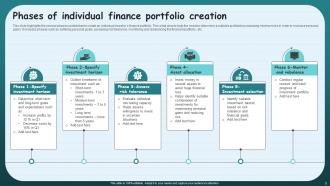
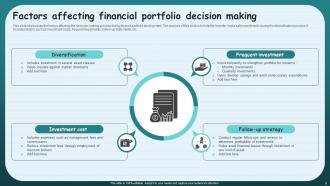
Key factors include risk tolerance, investment timeline, diversification across asset classes, liquidity needs, and return objectives. These considerations enable investors to balance growth potential with capital preservation, while aligning portfolio composition with specific financial goals, with many financial advisors finding that strategic asset allocation ultimately delivers more consistent long-term performance than market timing approaches.
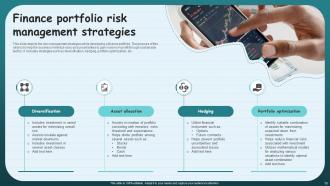
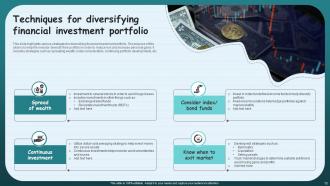
Diversification minimizes risk by spreading investments across different asset classes, sectors, geographic regions, and investment styles, reducing exposure to any single investment's poor performance. Through strategic allocation across stocks, bonds, real estate, and international markets, investors can achieve more stable returns while maintaining growth potential, ultimately delivering enhanced risk-adjusted performance in volatile market conditions.
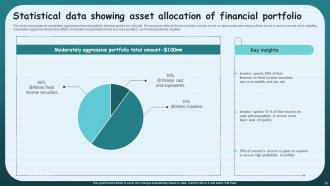
Asset allocation strategies serve as the foundation of portfolio management, determining how investments are distributed across stocks, bonds, real estate, commodities, and alternative assets based on risk tolerance and objectives. These strategies enable investors to optimize returns while managing volatility, with many financial advisors finding that strategic allocation typically accounts for 80-90% of portfolio performance outcomes.
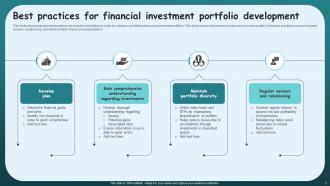
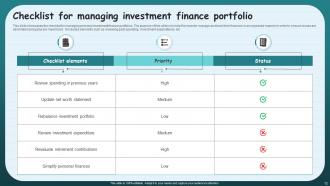
Finance portfolios should typically be rebalanced quarterly or semi-annually, though this varies based on market volatility, risk tolerance, and investment goals. Regular rebalancing enables investors to maintain target asset allocations, capitalize on market fluctuations through strategic buying and selling, and minimize risk exposure, with many financial institutions finding that disciplined rebalancing enhances long-term returns while controlling portfolio drift.
Active portfolio management involves frequent trading, market timing, and security selection to outperform benchmarks, while passive management tracks market indices with minimal trading. Active strategies deliver potentially higher returns through professional analysis and tactical adjustments, though they incur higher fees, whereas passive approaches offer lower costs and consistent market performance, with many financial institutions finding that strategic combinations of both approaches optimize risk-adjusted returns.
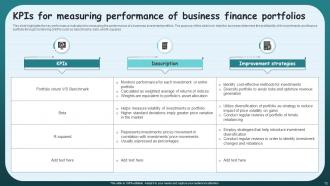
Investors can assess portfolio performance through return analysis, risk-adjusted metrics like Sharpe ratios, benchmark comparisons, and diversification evaluation across asset classes. These assessment methods enable tracking of dividend yields, capital appreciation, and volatility patterns, with many financial advisors finding that regular quarterly reviews ultimately deliver better risk management and strategic rebalancing opportunities.
Economic indicators significantly influence portfolio decisions by providing insights into market trends, inflation rates, interest rate movements, employment levels, and GDP growth patterns. These metrics enable investors to adjust asset allocation, sector exposure, and risk management strategies, with many financial advisors finding that proactive indicator analysis delivers enhanced returns and improved portfolio resilience.
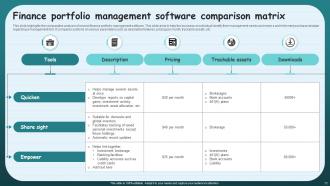
Technology enhances portfolio management through automated rebalancing, real-time analytics, risk assessment algorithms, and AI-driven market analysis tools. These solutions streamline decision-making by providing instant performance insights, predictive modeling, and comprehensive risk evaluation, with many investment firms finding that automated systems deliver faster responses to market changes and ultimately improved returns.
Key portfolio risk metrics include Value at Risk (VaR), beta coefficient, standard deviation, Sharpe ratio, maximum drawdown, and correlation coefficients. These measurements enable financial institutions and investment firms to assess volatility, downside exposure, and risk-adjusted returns across different asset classes, ultimately delivering better portfolio optimization and more informed investment decisions for sustained growth.
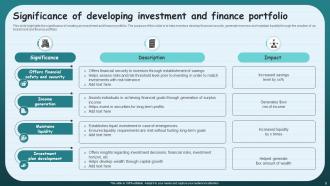
Personal financial goals fundamentally shape portfolio construction by determining asset allocation, risk tolerance, investment timeline, and diversification strategies. Different objectives, such as retirement planning, home purchases, or education funding, require distinct approaches, with younger investors typically embracing higher-risk growth investments while those nearing retirement prioritize capital preservation, ultimately delivering personalized investment strategies aligned with individual circumstances.
Alternative investments offer portfolio diversification, inflation protection, potentially higher returns, and reduced correlation with traditional markets, while providing access to unique asset classes like real estate and commodities. However, they also present challenges including higher fees, limited liquidity, complex valuations, and increased due diligence requirements, with many institutional investors finding that strategic allocation ultimately delivers enhanced risk-adjusted returns despite operational complexities.
Tax implications significantly influence portfolio strategy through asset location decisions, timing of gains and losses, and investment vehicle selection, ultimately affecting after-tax returns and long-term wealth accumulation. Strategic tax planning enables investors to minimize drag through tax-efficient funds, harvesting losses to offset gains, and utilizing tax-advantaged accounts, with many financial advisors finding that coordinated tax-aware strategies can enhance portfolio performance by 1-2% annually.
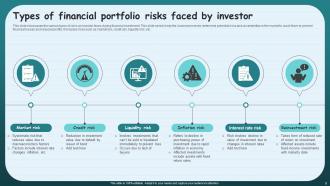
Risk management strategies for finance portfolios include diversification across asset classes, hedging through derivatives, setting stop-loss limits, regular rebalancing, and stress testing scenarios. These approaches streamline portfolio protection by minimizing concentration risk, reducing volatility exposure, and maintaining optimal asset allocation, with many financial institutions finding that systematic risk assessment ultimately delivers more stable returns and enhanced investor confidence.
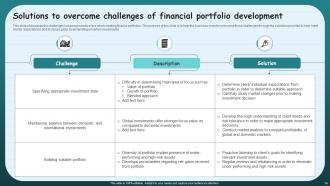
Common portfolio pitfalls include lack of diversification, emotional decision-making, market timing attempts, inadequate risk assessment, and neglecting regular rebalancing. These mistakes often lead to concentrated exposure in single sectors, panic selling during downturns, and missed opportunities, with many institutional investors finding that systematic approaches and disciplined strategies ultimately deliver more consistent returns and reduced volatility.
Emotional decision-making significantly undermines portfolio performance by driving investors to buy high during market euphoria and sell low during panic, contradicting fundamental investment principles. These psychological biases lead to frequent trading, increased transaction costs, and poorly timed market entries and exits, with many financial advisors finding that disciplined, data-driven strategies consistently outperform emotion-based decisions.
-
Love how there are no boring templates here! The design is fresh and creative, just the way I like it. Can't wait to edit and use them for my extended projects!
-
Loved the fact that SlideTeam provides clean, high-definition, and professional PowerPoint products.