


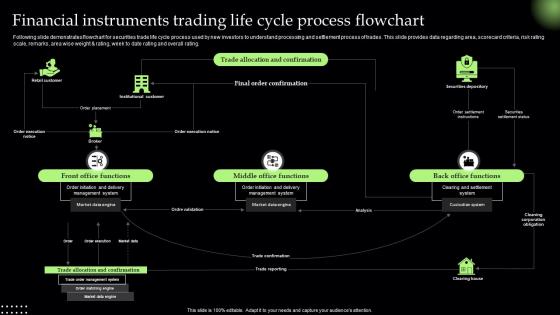
Financial Instruments Trading Life Cycle Process Flowchart




Try Before you Buy Download Free Sample Product
 Impress Your
 Audience
 100%
100% Editable
 Save Hours
 of Time


Following slide demonstrates flowchart for securities trade life cycle process used by new investors to understand processing and settlement process of trades. This slide provides data regarding area, scorecard criteria, risk rating scale, remarks, area wise weight and rating, week to date rating and overall rating.
People who downloaded this PowerPoint presentation also viewed the following :
Financial Instruments Trading Life Cycle Process Flowchart with all 6 slides:
Use our Financial Instruments Trading Life Cycle Process Flowchart to effectively help you save your valuable time. They are readymade to fit into any presentation structure.





FAQs for Financial Instruments Trading Life
Primary financial instruments for trading include equities, fixed-income securities, derivatives, foreign exchange, commodities, and structured products. These instruments enable portfolio diversification, risk management, and capital appreciation across global markets, with institutional investors and trading firms increasingly leveraging advanced analytics and algorithmic strategies to optimize returns and minimize exposure risks.
Derivatives derive their value from underlying assets like stocks or commodities, while traditional instruments like stocks and bonds represent direct ownership or debt obligations. Unlike stocks offering company ownership or bonds providing fixed income, derivatives enable speculation, hedging, and risk management through contracts, with financial institutions and investment firms leveraging these instruments for portfolio optimization and enhanced returns.
Financial instrument prices are influenced by market supply and demand, economic indicators, geopolitical events, company earnings reports, and interest rate changes. These factors create volatility patterns that traders analyze through technical and fundamental analysis, with many financial institutions finding that algorithmic trading systems help capitalize on price movements while managing risk exposure effectively.
Financial instruments enable investors to manage risk through diversification, hedging strategies, portfolio balancing, and exposure control across different asset classes and market conditions. Through derivatives, bonds, insurance products, and structured securities, investors can minimize potential losses, protect against market volatility, and optimize returns, while maintaining strategic flexibility in an increasingly complex financial landscape.
Traders assess liquidity through bid-ask spreads, trading volume, market depth, price impact analysis, and time-to-execution metrics. These indicators help evaluate how quickly positions can be entered or exited without significant price movement, with forex and major equity markets typically offering superior liquidity compared to emerging market bonds or small-cap stocks, ultimately enabling more efficient trading strategies.
Interest rates significantly impact fixed-income securities trading by creating inverse price relationships, where rising rates decrease bond values while falling rates increase them. This dynamic drives active trading strategies, with institutional investors, pension funds, and portfolio managers constantly repositioning portfolios to capitalize on rate movements, ultimately seeking to optimize yields and manage duration risk in an increasingly volatile interest rate environment.
Leverage amplifies both potential profits and losses in financial instruments trading by allowing traders to control larger positions with smaller capital investments. While leverage can significantly enhance returns during favorable market movements, it also increases risk exposure, with many institutional traders finding that proper risk management and position sizing become critical for maintaining long-term profitability and competitive advantage.
Technological advancements transforming financial instruments trading include algorithmic trading systems, artificial intelligence, high-frequency trading platforms, blockchain technology, and real-time analytics tools. These technologies streamline operations by automating trade execution, minimizing human error, and accelerating transaction speeds, with many financial institutions finding that enhanced data processing ultimately delivers competitive advantages and improved market responsiveness.
Macroeconomic indicators significantly influence financial instrument valuations by affecting interest rates, inflation expectations, currency strength, and economic growth projections. Key indicators like GDP growth, employment data, and central bank policies drive investor sentiment and risk assessment, with bond prices typically inversely correlating with interest rate changes, while equity valuations respond to growth and inflation dynamics, ultimately creating trading opportunities across asset classes.
Key regulatory considerations include compliance with securities laws, margin requirements, anti-money laundering protocols, disclosure obligations, and risk management standards. These frameworks enhance market transparency by establishing clear trading boundaries, protecting investor interests, and ensuring institutional accountability, with many financial services firms finding that robust compliance ultimately delivers competitive advantage and operational efficiency.
Traders utilize technical analysis by examining price charts, identifying support and resistance levels, applying moving averages, analyzing volume patterns, and using momentum indicators like RSI or MACD. These analytical tools enable more informed entry and exit decisions across stocks, forex, and commodities, with many professional traders finding that systematic technical approaches enhance risk management and ultimately deliver more consistent trading performance.
ETFs offer diversification, lower fees, reduced research requirements, instant portfolio exposure, and built-in risk management compared to individual stocks. While individual stocks provide higher growth potential and direct company ownership, ETFs streamline investment decisions by delivering broad market access with minimized volatility, making them increasingly attractive for investors seeking balanced exposure without extensive stock analysis.
Geopolitical events significantly impact financial instrument trading by creating market volatility, shifting investor sentiment, and altering risk assessments across currencies, commodities, and equities. Through uncertainty and policy changes, traders navigate fluctuating oil prices, currency devaluations, and sector rotations, with many financial institutions finding that diversified portfolios and real-time analysis ultimately deliver competitive advantages during turbulent periods.
Market sentiment significantly influences financial instruments trading by driving price movements, creating volatility patterns, and shaping investor behavior across asset classes. This psychological factor affects everything from stock valuations to currency fluctuations, with traders increasingly leveraging sentiment analysis tools, social media monitoring, and behavioral indicators to anticipate market shifts, ultimately delivering enhanced timing strategies and competitive positioning advantages.
Algorithmic trading strategies operate by using pre-programmed rules and mathematical models to automatically execute trades across stocks, bonds, derivatives, and currencies at optimal speeds and prices. These systems analyze market data, identify patterns, and execute thousands of transactions per second, enabling financial institutions to minimize human error, reduce transaction costs, and capitalize on market opportunities that manual trading cannot capture.
-
SlideTeam is my go-to resource for professional PPT templates. They have an exhaustive library, giving you the option to download the best slide!
-
Easy to use and customize templates. Helped me give a last minute presentation.