


Financial value creation strategy





Try Before you Buy Download Free Sample Product
 Impress Your
 Audience
 100%
100% Editable
 Save Hours
 of Time


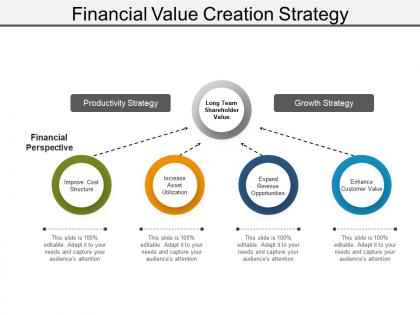
Incorporate this Financial Value Creation Strategy PowerPoint presentation to determine the health and well-being of the organization in the long run. The value-creating strategy for your firm can be discussed with your colleagues using this monetary evaluation PowerPoint layout. The productive and growth procedure can be illustrated efficiently with this business value PPT theme. The various financial measures such as long term shareholder value can be tracked by taking the assistance of this financial management PowerPoint layout. You can analyze the financial measures of the performance of your institution for better management by employing this economic measure PPT layout. Key elements like improving the cost structure, increasing asset utilization, expanding revenue opportunities and enhancing customer value can be showcased by utilizing this financial value PowerPoint slideshow. The significance of monetary value creation can be highlighted with this corporate finance PowerPoint theme. Download this profitability enhancement PPT theme for attaining business plans efficiently.
People who downloaded this PowerPoint presentation also viewed the following :
Financial value creation strategy with all 5 slides:
Get in the glare with our Financial Value Creation Strategy. Be the focus of their attention.




FAQs for Financial
Key metrics for measuring financial value creation include return on invested capital (ROIC), economic value added (EVA), free cash flow generation, revenue growth rates, and profit margin expansion. These financial indicators work together to provide comprehensive visibility into organizational performance, with many companies finding that tracking ROIC alongside EVA delivers clearer insights into capital efficiency and long-term competitive positioning.
Companies can effectively align financial objectives with business strategy through integrated planning processes, performance measurement systems, capital allocation frameworks, and cross-functional collaboration between finance and operations teams. This strategic alignment enables organizations to optimize resource allocation, enhance operational efficiency, and drive sustainable growth, with many finding that synchronized financial planning ultimately delivers improved profitability and competitive advantage.
Innovation drives financial value creation by introducing new products, optimizing operations, reducing costs, and opening untapped market opportunities. Companies leveraging strategic innovation, like tech firms developing AI solutions or manufacturers implementing automation, enhance competitive positioning, accelerate revenue growth, and deliver superior returns to stakeholders in increasingly dynamic markets.
Organizations leverage data analytics to identify value creation opportunities by analyzing customer behavior patterns, operational inefficiencies, market trends, revenue optimization potential, and cost reduction areas. Through predictive modeling and real-time insights, companies in retail, manufacturing, and financial services streamline operations, enhance customer experiences, and uncover new revenue streams, ultimately delivering competitive advantage and measurable ROI improvements.
Common challenges include insufficient cash flow management, ineffective cost control strategies, limited revenue diversification, inadequate market positioning, and poor resource allocation decisions. These obstacles often stem from disconnected planning processes and reactive decision-making, with many organizations finding that strategic financial frameworks enable better forecasting, streamlined operations, and ultimately sustainable competitive advantage.
Sustainable practices contribute to long-term financial value by reducing operational costs, enhancing brand reputation, and attracting ESG-focused investors. Companies implementing renewable energy, waste reduction, and ethical sourcing strategies often experience lower utility expenses, increased customer loyalty, and access to green financing options, while many organizations find that sustainability initiatives ultimately deliver competitive differentiation and improved market positioning.
Startups can implement revenue diversification, lean operational models, strategic partnerships, data-driven decision making, and scalable technology infrastructure from the outset. These approaches streamline resource allocation, minimize unnecessary costs, and accelerate market penetration, with many early-stage companies finding that combining multiple revenue streams with efficient operations ultimately delivers sustainable growth and competitive positioning in increasingly dynamic markets.
Stakeholder expectations significantly influence financial value creation by shaping strategic priorities, resource allocation decisions, and performance metrics that guide organizational focus. While investor demands for returns drive efficiency initiatives, employee expectations for growth opportunities and customer demands for enhanced experiences often align with long-term value creation, ultimately delivering sustainable competitive advantage.
Employee engagement directly correlates with financial value creation through increased productivity, reduced turnover costs, enhanced customer satisfaction, and improved operational efficiency. Engaged employees drive revenue growth by delivering superior customer experiences, fostering innovation, and maintaining higher performance standards, with many organizations finding that highly engaged workforces achieve significantly better financial outcomes and competitive advantage.
Mergers and acquisitions maximize financial value creation through strategic synergy identification, optimal deal structuring with appropriate debt-equity ratios, comprehensive due diligence processes, and efficient integration planning that preserves key talent and systems. Through careful valuation methodologies and post-merger integration strategies, companies achieve cost reductions, revenue enhancements, and market expansion opportunities, ultimately delivering sustainable competitive advantages.
**INPUT**: What financial frameworks are most effective in guiding value creation initiatives? **OUTPUT**: Effective financial frameworks for value creation include Economic Value Added (EVA), Return on Invested Capital (ROIC), discounted cash flow analysis, balanced scorecards, and activity-based costing models. These frameworks enable organizations to measure performance, optimize resource allocation, and identify profitable growth opportunities, with many companies finding that strategic combinations deliver enhanced operational efficiency and competitive advantage. [Word count: 56 words]
Companies can assess branding impact on financial value creation through brand valuation methodologies, customer lifetime value analysis, market share tracking, and revenue attribution models. These approaches enable organizations to measure brand equity changes, customer acquisition costs, and pricing premium capabilities, with many financial services and retail companies finding that strong branding correlates directly with improved profit margins and sustainable competitive advantage.
Cash flow management is fundamental to financial value creation because it ensures liquidity for operations, investments, and growth opportunities while minimizing financial risk. Effective cash flow optimization enables companies to reinvest in strategic initiatives, maintain operational flexibility during market fluctuations, and deliver consistent shareholder returns, with many organizations finding that disciplined cash management ultimately drives sustainable competitive advantage and long-term value appreciation.
Technology adoption improves operational efficiency by automating repetitive tasks, streamlining workflows, and optimizing resource allocation across departments. Through AI-powered analytics and cloud-based systems, organizations reduce processing times, minimize human error, and enhance decision-making speed, with many financial services and manufacturing companies finding that strategic technology integration delivers cost savings and competitive advantage.
Risk management serves as a fundamental pillar of financial value creation by protecting existing assets, enabling strategic growth opportunities, and optimizing capital allocation decisions. Through comprehensive risk assessment frameworks, organizations can pursue higher-return investments while maintaining operational stability, with many financial institutions finding that effective risk management ultimately enhances investor confidence and sustainable profitability.
-
Helpful product design for delivering presentation.
-
Out of the box and creative design.