Five days kaizen blitz agenda facilitating company

Five days kaizen blitz agenda facilitating company
Slide 1 of 2
Favourites Favourites

Try Before you Buy Download Free Sample Product

Audience Impress Your
Audience
Editable 100%
Editable
Time Save Hours
of Time
The Biggest Sale is ending soon in
0
0
:
0
0
:
0
0
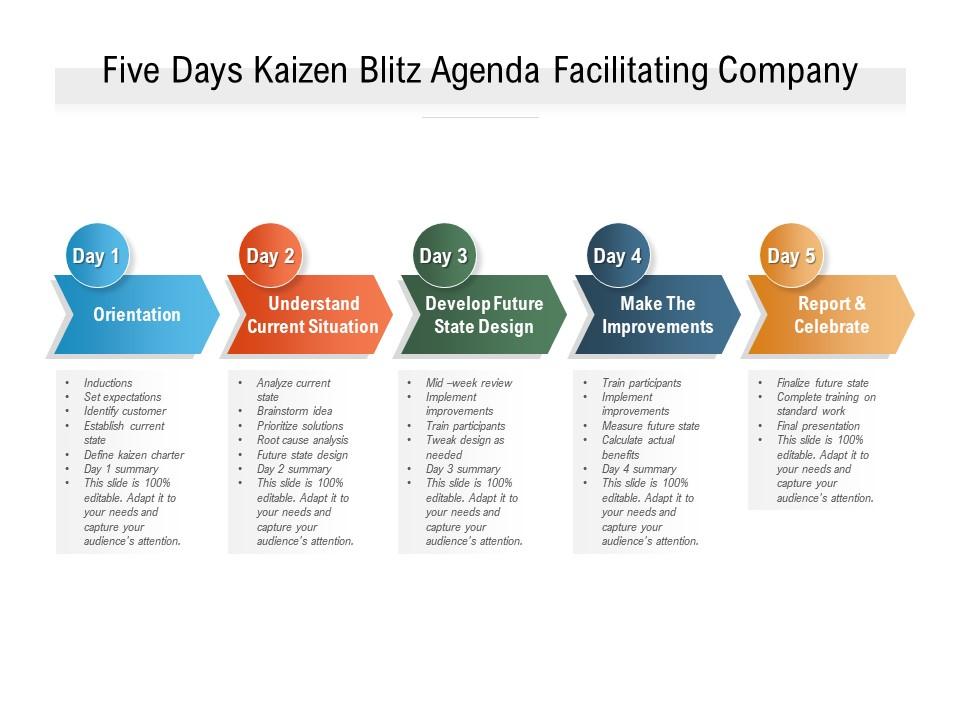
Presenting this set of slides with name Five Days Kaizen Blitz Agenda Facilitating Company. This is a five stage process. The stages in this process are Orientation, Improvements, Develop Future, Understand Current Situation, Report Celebrate. This is a completely editable PowerPoint presentation and is available for immediate download. Download now and impress your audience.

People who downloaded this PowerPoint presentation also viewed the following :

FAQs for Five days kaizen blitz

So Kaizen Blitz is basically regular kaizen on fast-forward. You pull a team together for like 3-5 days and hammer out improvements super intensively. Regular kaizen happens gradually over months as people make small tweaks to their daily work. Blitz events are exhausting but you get those breakthrough moments that feel amazing. The whole point is speed and getting people from different departments working together on one specific problem. I'd say pick something that's been driving your team crazy - like a bottleneck everyone complains about. Those work best for your first blitz since people are already motivated to fix it.

Pick 6-8 people who actually understand the process you're fixing - that's your team right there. Get your baseline data sorted beforehand: metrics, process maps, customer complaints, whatever you've got. Trust me, clean data saves you so much headache later. Leadership needs to promise they'll act on your recommendations within 30 days, otherwise everyone just rolls their eyes. Block out those 3-5 days completely - no "I'll just pop in for five minutes" nonsense. Set up a proper war room with whiteboards and sticky notes everywhere. Oh, and define your scope super tight upfront. You don't want to end up trying to fix the entire company in a week!

For a solid Kaizen Blitz, give everyone clear roles beforehand. Get a facilitator to run things and a timekeeper - seriously, these can drag on forever without one. Someone needs to be the scribe (rotate this so nobody gets stuck with it all day). Grab your process experts who actually know the work, but also bring in outsiders with fresh perspectives. Oh, and make sure you've got a leader there who can actually make decisions and kill roadblocks on the spot. The "fresh eyes" people often catch the obvious stuff everyone else misses.

Honestly, getting the right team together is everything. You want people who actually do the job every day, plus someone with real authority to approve changes immediately. Keep it small though - 5-7 people tops or you'll waste time herding cats. Mix of front-line workers and managers works best; I've watched so many fail when it's all one or the other. Different skill sets matter too. Oh, and include at least one skeptic - they're annoying but they'll catch issues everyone else misses. Those problem-spotters actually end up making your solutions way stronger.

Ugh, you're gonna hit three main roadblocks: people hating change, scope creep, and everyone wanting to debate solutions to death instead of just trying stuff. Analysis paralysis is seriously the worst! Set super clear boundaries upfront - what's in, what's not. Focus your team on quick wins over perfect solutions since you can fix things later anyway. Get leadership backing you before you start so they can shut down pushback. Oh, and stick to your timeline like your life depends on it. Celebrate the small stuff too - keeps everyone motivated when things get crazy.

You need solid numbers to prove your Kaizen Blitz actually moved the needle - otherwise you're just hoping things got better. Grab baseline data like cycle times or defect rates at least a week before the event starts. During the blitz itself, keep measuring because honestly, watching those numbers improve in real-time gets everyone fired up and motivated. Then measure again afterward to see your actual wins and figure out what still needs fixing. The whole point is having concrete proof of improvement, not just gut feelings that things are better now.

Start with gemba walks - go see what's actually happening on the floor. Value stream mapping is amazing for catching waste and bottlenecks. Use the 5 Whys to dig past surface issues (though honestly, most people quit after like 3). Pareto analysis shows which problems are worth your time. Simple observation sheets work great too. Oh, and fishbone diagrams help with root cause stuff. I'd definitely do the gemba walk first thing - you can't fix what you don't really get, you know?

Honestly, assign roles upfront or you'll get the same 2 people talking the whole time. I always mix up teams for different activities - keeps people from hiding in their little cliques, you know? Create smaller breakout groups where the quiet ones actually speak up. Sticky notes are your friend here since people can contribute without putting themselves on the spot immediately. Oh, and definitely set ground rules that everyone's input counts. Time-box everything too - nothing kills momentum like letting discussions drag on forever. Trust me, I've sat through way too many painful sessions where only the loud folks participated.

Track your main metrics at 30, 60, and 90 days after the event - basically whatever you were trying to fix (cycle time, defects, productivity, etc.). The real challenge is keeping momentum after everyone's initial excitement dies down. Someone needs to actually own the follow-up measurements or they'll disappear into the void. Document your baseline vs current state consistently. I'd also watch team engagement and how well people stick to the new processes - those usually predict if your improvements will last. Monthly check-ins work well for reviewing data and fixing what's not working.

Hey! So the trick is baking those changes right into your daily routine immediately. Document everything and give specific people ownership - someone's gotta watch these new processes. Weekly check-ins at first, then monthly ones work well to catch backsliding early. Honestly, I've watched so many solid improvements just... disappear when teams get swamped with other priorities. Train people properly and remove anything that'd tempt them to go back to old habits. The new way should feel easier than before. Do a real review at 90 days to see what's actually working.

Okay so communication is literally everything here. Send everyone clear objectives before you even start - like, way before. I learned this the hard way once. During the actual event, do quick daily check-ins and use visual boards so people can see what's happening. Leadership needs to be around and visible, not hiding in meetings somewhere. Document everything as you go because you'll forget half of it otherwise. After it's done, share the results with real numbers and celebrate publicly. Honestly, it's way better to over-communicate than have people wondering what's going on.

Start by pulling actual customer data - surveys, complaints, support tickets, whatever you've got. That becomes your roadmap for the whole Kaizen event. I've watched teams go down rabbit holes fixing stuff customers don't even care about, which is honestly painful to see. Keep measuring against what matters to customers, not just your internal metrics. Oh, and if you can swing it, bring someone from customer support into the room. They hear all the real complaints daily and can keep you honest when you're tempted to focus on the wrong problems.

Oh absolutely! Just figure out what's driving everyone nuts first - like survey people about their biggest headaches. Manufacturing places usually go hard on safety stuff and lean workflows. Healthcare focuses more on patient wait times and infection control (makes sense). Tech teams? They're obsessed with deployment issues and bug fixes. Honestly the best part is you can shape the whole thing around whatever industry-specific regulations or pain points you're dealing with. I'd probably start by asking your team what their top three daily frustrations are, then build from there.

Get everything down while it's still fresh in your head - problems you solved, what you actually did, and the real numbers. Make a quick one-page thing with before/after stats and photos of the changes. I'm obsessed with taking tons of photos during these events, but seriously you'll thank yourself later. Don't forget the stuff that went wrong or when people pushed back - that's honestly the most valuable intel for next time. Oh and do this within like 48 hours max because after that everyone's memory gets fuzzy and you lose that momentum.

Dude, try a Kaizen Blitz for that workflow mess you mentioned. Basically you get everyone together for like 3-4 days to tackle one specific problem. People from different departments actually start talking instead of staying in their bubbles. The tight deadline forces quick decisions - no more committee meetings that drag on forever. You'd be surprised how much people don't know about what other teams actually do day-to-day. Everyone implements changes on the spot rather than waiting months for approval. Pick something that's been annoying the whole office and watch magic happen. Plus team dynamics get way better afterward.

Ratings and Reviews

0% of 100
Write a review
Most Relevant Reviews

No Reviews