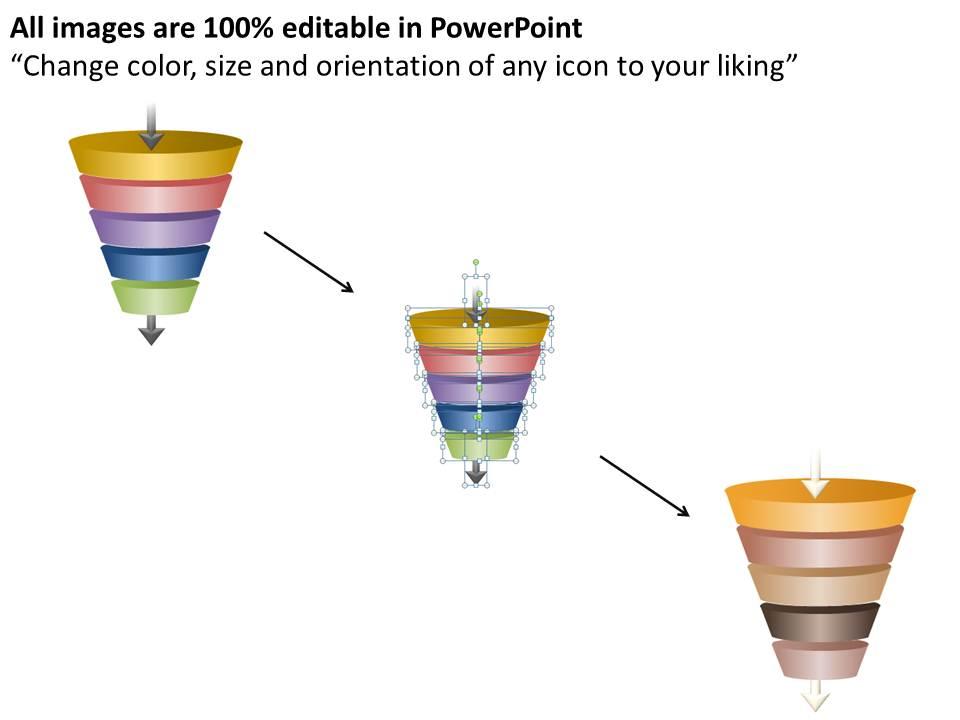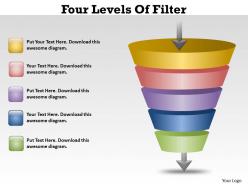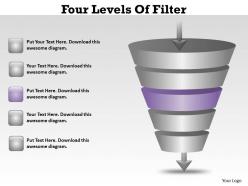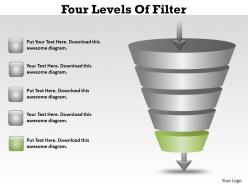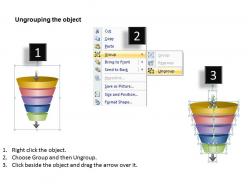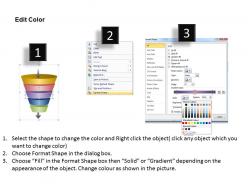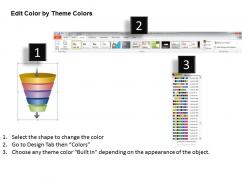
Five level fliter process funnel diagram
Try Before you Buy Download Free Sample Product
Audience
Editable
of Time
Our Five Level Fliter Process Funnel Diagram will brook no nonsense. Like you they are straight and direct.
People who downloaded this PowerPoint presentation also viewed the following :
Five level fliter process funnel diagram with all 10 slides:
Our Five Level Fliter Process Funnel Diagram are like designer labels. They will put a stamp on your brand of thought.
FAQs for Five level fliter
The key components of a five-level filter process funnel diagram include progressive screening stages, defined criteria at each level, volume reduction metrics, decision checkpoints, and outcome tracking mechanisms. These components streamline complex filtering processes by eliminating unsuitable candidates or options systematically, enhancing operational efficiency across recruitment, sales qualification, and quality control applications, ultimately delivering faster decision-making and improved resource allocation.
The five-level filter process enhances decision-making by systematically eliminating unsuitable options, reducing cognitive overload, ensuring comprehensive evaluation, standardizing criteria application, and maintaining objective assessment throughout complex scenarios. Through structured filtering stages, organizations in sectors like financial services, healthcare, and manufacturing streamline strategic choices, minimize decision fatigue, and ultimately deliver faster, more reliable outcomes while reducing costly errors in high-stakes business environments.
The five-level filter process proves most effective in financial services, healthcare, manufacturing, retail, and technology sectors where systematic evaluation is critical. Banks use it for loan approvals and risk assessment, hospitals for patient triage and treatment protocols, while manufacturers apply it for quality control and supplier selection, ultimately delivering improved decision-making accuracy and operational efficiency.
Each level in a five-level filter process represents a progressive refinement stage, typically moving from broad screening to detailed evaluation, with criteria becoming increasingly specific and stringent at each subsequent level. These sequential filters enable organizations to systematically eliminate unsuitable candidates, prospects, or options while preserving resources, with many businesses finding that this structured approach delivers faster decision-making, improved quality outcomes, and enhanced operational efficiency.
The five-level filter process diagram helps visualize customer journey mapping by breaking down complex customer interactions into distinct, manageable stages that show progression from initial awareness to final conversion. This structured approach enables businesses to identify specific touchpoints, pain points, and optimization opportunities at each level, while tracking customer behavior patterns and drop-off rates, ultimately delivering clearer insights for improving conversion strategies and enhancing overall customer experiences.
Several organizations have successfully implemented five-level filter processes, including banks using staged risk assessment for loan approvals, hospitals employing multi-tier patient screening protocols, and manufacturing companies utilizing progressive quality control checkpoints. These systematic approaches streamline decision-making by eliminating unsuitable options early, reducing processing costs, and improving final outcomes, with many institutions finding that structured filtering enhances operational efficiency while maintaining rigorous standards.
Tools best suited for creating five-level filter process funnel diagrams include Microsoft Visio, Lucidchart, Draw.io, Canva, and PowerPoint's SmartArt features. These platforms streamline diagram creation by offering customizable templates, drag-and-drop functionality, and collaborative editing capabilities, with many organizations finding that cloud-based solutions like Lucidchart ultimately deliver enhanced team coordination and real-time updates.
The five-level filter process adapts to digital marketing through audience segmentation, content filtering, channel optimization, engagement scoring, and conversion tracking stages. This systematic approach enables marketers to streamline campaign targeting, enhance lead qualification across social media and email platforms, and ultimately deliver higher ROI, with many organizations finding significantly improved customer acquisition costs.
Common mistakes include skipping stakeholder input, creating overly complex criteria, inadequate testing phases, poor documentation, and insufficient feedback loops between levels. These oversights can lead to bottlenecks, inconsistent filtering, and reduced process effectiveness, with many organizations finding that thorough planning and iterative refinement ultimately deliver smoother operations and better outcomes.
The five-level filter process facilitates prioritization by systematically evaluating tasks through strategic alignment, resource requirements, risk assessment, timeline feasibility, and expected outcomes. This structured approach enables organizations to streamline decision-making, eliminate low-value activities, and focus resources on high-impact projects, with many companies finding that it significantly enhances operational efficiency and strategic execution.
Yes, the five-level filter process effectively supports risk assessment and management by systematically categorizing, prioritizing, and filtering risks through progressive evaluation stages. Organizations use this approach to streamline risk identification, assessment, mitigation planning, monitoring, and response protocols, with many financial institutions and healthcare systems finding that it enhances decision-making accuracy while reducing operational vulnerabilities.
Data analysis plays a crucial role in refining each filter level by identifying bottlenecks, measuring conversion rates, analyzing drop-off patterns, and evaluating criteria effectiveness at every stage. Through systematic data review, organizations can optimize filtering parameters, adjust threshold requirements, and streamline decision workflows, with many businesses finding that data-driven refinements significantly enhance process efficiency and improve overall outcomes.
Effectiveness of five-level filter process funnels can be measured through conversion rates at each stage, lead quality scores, time-to-decision metrics, cost per acquisition, and overall throughput efficiency. These measurements enable organizations to identify bottlenecks, optimize filtering criteria, and enhance resource allocation, with many sales and recruitment teams finding that systematic tracking ultimately delivers higher conversion rates and improved candidate or customer experiences.
Potential limitations include oversimplification of complex processes, rigid structure that may not accommodate unique workflows, difficulty visualizing non-linear or cyclical processes, and potential information overload across five distinct levels. While this diagram format enhances clarity and stakeholder communication, organizations in dynamic sectors like technology or healthcare often find that complex decision-making processes require more flexible visualization approaches, ultimately necessitating supplementary tools for comprehensive process mapping and strategic analysis.
Teams collaborate effectively by establishing clear roles for each filter level, ensuring all members understand the criteria, and rotating facilitation responsibilities to maintain engagement. Through structured discussion phases, real-time documentation, and designated advocates for different perspectives, teams can systematically evaluate ideas while maintaining momentum, ultimately delivering more comprehensive solutions and stronger buy-in across participants.
-
Great product with highly impressive and engaging designs.
-
Excellent products for quick understanding.