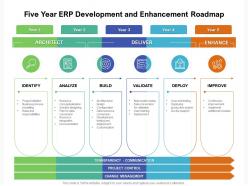
Hoja de ruta de desarrollo y mejora de ERP de cinco años
Try Before you Buy Download Free Sample Product
Audience
Editable
of Time
Visualice su plan de trabajo y comunique sus ideas de manera impactante con nuestra hoja de ruta de desarrollo y mejora de ERP de cinco años prediseñada. Muestre la descripción detallada del proyecto, los entregables clave y los hitos que se deben lograr con la ayuda de nuestro diseño de PowerPoint totalmente personalizable. Puede enfatizar fácilmente los objetivos del proyecto y discutir todas las actividades involucradas de una manera fácil de comprender utilizando nuestro tema PPT diseñado profesionalmente. Este diseño de hoja de ruta de PowerPoint es una herramienta de planificación estratégica perfecta que puede ayudar a mantener el proyecto en marcha. Con nuestro atractivo tema de PowerPoint, puede articular el flujo de trabajo, realizar un seguimiento del progreso del trabajo y tener una visión clara de la meta a alcanzar. Descargue esta hoja de ruta versátil de desarrollo y mejora de ERP de cinco años y ahorre horas de trabajo.
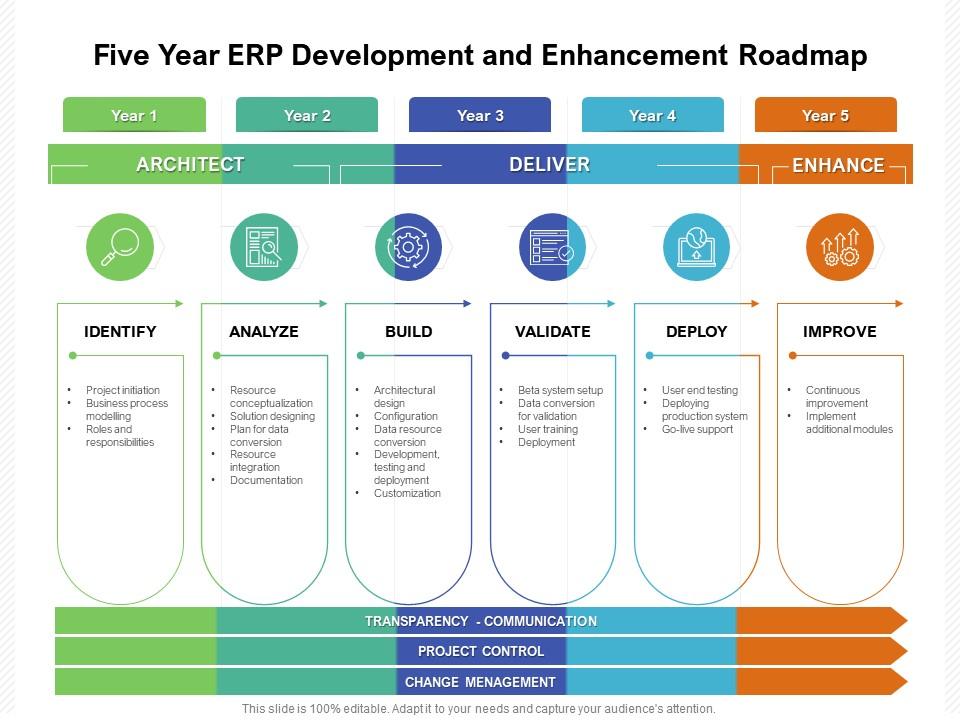
Características de estas diapositivas de presentación de PowerPoint:
Presentación de diapositivas de PowerPoint de hoja de ruta de desarrollo y mejora de ERP de cinco años. Este tema de PPT está disponible en relaciones de aspecto de 4,3 y 16,9. Esta plantilla de PowerPoint se puede personalizar para que pueda modificar el tamaño de fuente, el tipo de fuente, el color y las formas según sus requisitos. Esta presentación PPT es compatible con Google Slides, por lo que es fácilmente accesible. Puede descargar y guardar este diseño de PowerPoint en diferentes formatos como PDF, PNG y JPG.
People who downloaded this PowerPoint presentation also viewed the following :
Hoja de ruta de cinco años de desarrollo y mejora de ERP con las 2 diapositivas:
Utilice nuestra hoja de ruta de desarrollo y mejora de ERP de cinco años para ayudarlo de manera efectiva a ahorrar su valioso tiempo. Están listos para encajar en cualquier estructura de presentación.
FAQs for Five year erp development
Look, you'll want to start with where you are now versus where you need to be - that gap analysis is everything. Build your timeline around must-haves first, then nice-to-haves. Budget for way longer than you think because honestly, everyone screws up the timing. Get your stakeholders on board early or you're dead in the water. Map out your resources, risks, and how you'll actually measure success. Oh, and your change management strategy matters more than the tech itself - people hate switching systems. Focus phases around what users can actually handle adopting at once.
Start by talking to people from each department - finance, ops, sales, HR. Figure out what's actually broken with your current setup. Honestly, bringing in an outside consultant for these meetings is worth it because people get weirdly political about this stuff internally. Write down everything: what systems need to talk to each other, compliance stuff you can't ignore, reporting needs, how many users you'll have. Then sort it all into "we absolutely need this" vs "would be cool I guess." This becomes your cheat sheet when vendors start pitching you features that sound impressive but won't actually help.
Look, you absolutely need those stakeholders in the loop from day one. Finance, ops, IT, end users - they all see different pieces of what'll actually work in practice. I've seen too many ERP projects crash because people felt blindsided by changes nobody told them about. Get their input early and it'll save you from nasty surprises later. They know where the real roadblocks hide, plus you need buy-in or you're basically dead in the water. Regular check-ins are your friend here - find your key people and keep talking to them throughout planning.
Look, first figure out what's actually broken in your day-to-day stuff. What's making everyone want to pull their hair out? Survey your teams about their biggest headaches - they'll tell you real quick what needs fixing. Then rank features by ROI and how critical they are to keeping the lights on. I know it's tempting to go for all the cool bells and whistles, but honestly? Focus on what'll actually move your numbers. Don't forget implementation complexity either. Sometimes that fancy feature isn't worth pushing your launch back three months. Make a simple impact vs effort chart to keep yourself honest.
Ugh, change management is the worst part - nobody wants to learn new software and I totally get it. You really need executives pushing it hard though. Scope creep kills budgets fast since people keep adding "just one more thing" halfway through. Data migration? Way messier than expected every single time. Your old system's database is probably held together with digital duct tape lol. Timeline issues happen when you don't give people enough dedicated time. Lock down what you're actually building upfront and get full-time team members instead of juggling this with their regular jobs.
Honestly, go with Agile if you need flexibility or Waterfall if you want more structure. Most companies I've worked with end up doing some weird hybrid thing anyway - which actually works pretty well. Don't do a big bang rollout, that's just asking for trouble. Roll it out in phases instead. Change management is huge too, like your users will literally make or break this project. Oh and if you're using SAP or Oracle, they have their own frameworks (ASAP and AIM) that are decent. Main thing is just pick something that fits your company's vibe and don't keep switching methodologies halfway through.
Track the hard numbers first - system uptime, how much faster processes run, actual cost savings, adoption rates. But honestly, user satisfaction surveys matter just as much. People will find workarounds if they hate your system, which defeats the whole point. Compare everything against your original timeline and budget too. Oh, and set those benchmarks before you start implementing, not after (learned that one the hard way). Quarterly check-ins work well for spotting issues early and tweaking things as you go.
Don't try to do everything at once - that's where most projects crash and burn. Get your stakeholders on board early or you'll be fighting uphill battles later. Timelines? Whatever you think it'll take, double it. ERP projects are notorious for running long. Change management gets overlooked constantly but it's huge. Your data migration will be messier than expected too. Oh, and resist the urge to just recreate your current mess in a shiny new system. Go with phases instead of big bang. Loop in your power users from the start - they'll save you headaches down the road. Buffer time is your friend here.
Dude, change management is honestly the make-or-break thing with ERP projects. More crucial than the tech side, which sounds backwards but trust me on this. You're basically telling everyone "forget how you've done your job for years." Without proper buy-in, people will just work around your expensive new system or flat-out ignore it. Heavy investment in training is non-negotiable. Get champions in each department who actually believe in it - they'll do the convincing for you. I've seen perfectly good systems tank because leadership skipped this step. Natural human resistance is real.
Honestly, don't get caught up in fancy features that just look impressive. Map what you actually need to what the ERP can do. Get people from every department involved early - trust me, you don't want IT deciding how sales should work. Document your current mess of processes first, then figure out where ERP fills the gaps. Time it right with your business calendar too. This isn't just swapping out software, it's changing how you operate. Oh, and set up metrics that actually matter to your goals so you know if you're winning or just burning money.
First thing - back up absolutely everything before you touch anything. Seriously, I can't stress this enough after seeing projects blow up. Set up role-based access controls during the switch and run validation checks at each phase. Data needs encryption both ways - when it's moving and when it's sitting there. Oh, and automated monitoring is clutch for catching weird stuff early. Work with your IT security folks on a solid governance plan from day one. Also audit permissions regularly because access creep is real. This whole process separates the pros from the disasters, honestly.
So the big ERP stuff to watch: AI analytics, cloud platforms, and mobile interfaces. Honestly, the AI predictions for inventory are getting freaky accurate - like weirdly good at catching data anomalies. Industry-specific solutions are taking over instead of generic systems, which makes sense. Integration's getting way better too, so you won't need custom coding just to connect your tools. Oh, and start looking at vendors with these features now even if you're not upgrading yet. Trust me on that one - the good ones book up fast.
So basically, an ERP roadmap is like your growth game plan. You're mapping out how the system grows with your business instead of constantly playing catch-up. Picture designing a house where you can actually add rooms later - way smarter than getting stuck in something cramped, right? With a solid roadmap, you can plan for stuff like higher transaction volumes, new departments, extra integrations. Budget for upgrades becomes way easier too. Honestly, it beats the hell out of doing major overhauls down the road. Start with where you want to be in 3-5 years, then figure out what ERP features you'll actually need to get there.
Honestly, cloud ERP is pretty much running everything now. You can pull up your business data from anywhere, which is huge. No more crazy upfront costs that wreck your budget either - you just scale as needed. The automatic updates are nice too, and their security is way better than what most of us could set up ourselves. What really sold me though? How well it plays with other cloud stuff you're probably using already. My cousin's company made the switch last year and she won't shut up about it. If you're stuck on old systems, seriously look into cloud options soon.
First thing - map out what you absolutely need against what they're actually offering right now, plus their development pipeline. Don't trust vendor demos at all, they're basically theater. Instead, dig into their release history and talk to real customers. Check if they're financially solid and actually understand your industry. Their tech stack should mesh with your infrastructure too. Here's what really matters though: get specific dates for features you can't live without. Then - and this is key - put penalty clauses in the contract when they inevitably miss deadlines. Trust me on that one.
No Reviews