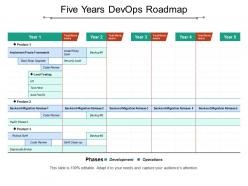
Fünf Jahre DevOps-Roadmap
Try Before you Buy Download Free Sample Product
Audience
Editable
of Time
Berechnen Sie mit unserer Fünf-Jahres-Devops-Roadmap, wie weit Ihre Wettbewerber gehen können. In der Lage sein, ihre Absichten einzuschätzen.
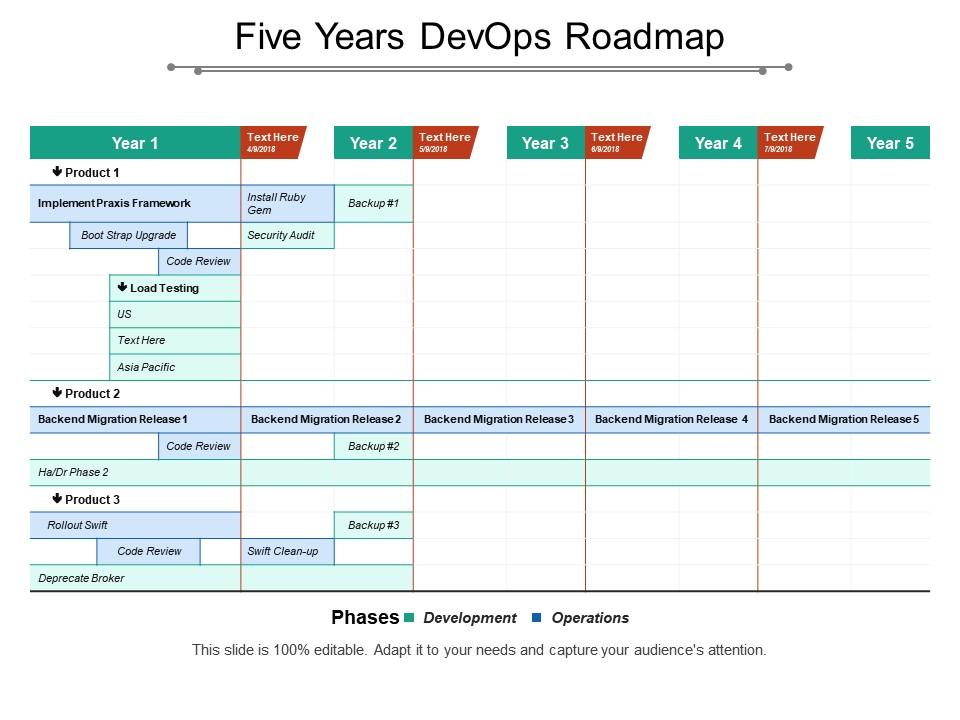
Merkmale dieser PowerPoint-Präsentationsfolien :
Präsentation dieses Satzes von Folien mit dem Namen – Five Years Devops Roadmap. Dies ist ein fünfstufiger Prozess. Die Phasen in diesem Prozess sind Devops Roadmap, Devops Timeline, Infinity Roadmap.
People who downloaded this PowerPoint presentation also viewed the following :
Fünf Jahre Devops-Roadmap mit allen 5 Folien:
Berücksichtigen Sie alle Eventualitäten mit unserer Fünf-Jahres-Devops-Roadmap. Gehen Sie umfassend vor.
FAQs for Five
**INPUT**: What are the key stages in a DevOps transformation journey? **OUTPUT**: DevOps transformation typically includes assessment and planning, cultural alignment, toolchain integration, automation implementation, and continuous monitoring phases. These stages enable organizations to streamline development cycles, enhance collaboration between teams, and accelerate deployment frequencies, with many enterprises finding that systematic progression through each phase ultimately delivers improved operational efficiency and competitive market responsiveness. [Word count: 54 words]
Continuous integration (CI) focuses on automatically merging code changes into a shared repository and running automated tests to catch issues early, while continuous deployment (CD) automates the release of tested code directly to production environments. Together, these practices enable development teams to deliver software faster and more reliably, with many organizations finding that this combination significantly reduces manual errors, accelerates time-to-market, and enhances overall operational efficiency.
Essential DevOps tools include Git for version control, Jenkins for continuous integration, Docker for containerization, Kubernetes for orchestration, and monitoring solutions like Prometheus or Nagios. These technologies streamline development workflows by automating deployments, enhancing collaboration, and enabling faster releases, with many organizations finding that strategic tool integration ultimately delivers improved operational efficiency and competitive advantage.
Organizations can measure DevOps success through deployment frequency, lead time for changes, mean time to recovery, and change failure rate metrics. These key performance indicators help teams track operational efficiency, while business metrics like customer satisfaction, revenue impact, and time-to-market improvements demonstrate strategic value, ultimately delivering competitive advantage and measurable ROI.
Automation streamlines DevOps processes by eliminating manual tasks, reducing human errors, accelerating deployment cycles, and enabling continuous integration and delivery. Through automated testing, infrastructure provisioning, and deployment pipelines, organizations achieve faster release cycles, improved reliability, and enhanced operational efficiency, with many finding that automation ultimately delivers competitive advantage and scalable growth.
Collaboration improves through shared tools like Git and Slack, cross-functional team structures, regular stand-ups, and joint accountability for deployment outcomes. Organizations in finance and healthcare find that implementing continuous integration platforms, establishing shared metrics for both development velocity and system reliability, ultimately streamlines workflows while reducing deployment conflicts and accelerating time-to-market.
Common DevOps adoption challenges include cultural resistance to change, skill gaps in automation tools, integration complexities between legacy systems, security implementation delays, and inadequate monitoring frameworks. Organizations often struggle with breaking down silos between development and operations teams, while simultaneously managing tool proliferation and establishing consistent deployment pipelines, ultimately requiring strategic change management and comprehensive training programs.
Microservices architecture and DevOps complement each other by enabling independent deployment, automated scaling, and faster development cycles through containerization, CI/CD pipelines, and service isolation. This strategic combination allows organizations to deploy individual services without affecting entire systems, ultimately delivering enhanced operational efficiency, reduced downtime, and accelerated feature releases across distributed applications.
Infrastructure as Code (IaC) is fundamental to DevOps roadmaps because it automates infrastructure provisioning, ensures consistency across environments, and enables version control of infrastructure configurations. Through IaC tools like Terraform and CloudFormation, organizations streamline deployment processes, reduce manual errors, and accelerate service delivery, while enabling teams to treat infrastructure with the same rigor as application code, ultimately delivering greater operational efficiency and scalability.
Security integrates into the DevOps lifecycle through automated vulnerability scanning, infrastructure as code security policies, continuous compliance monitoring, and shift-left security practices that embed controls early in development. Financial services and healthcare organizations streamline regulatory compliance while accelerating deployment cycles, with many finding that DevSecOps ultimately delivers faster incident response and reduced security risks.
Teams should establish cross-functional collaboration, implement continuous feedback loops, embrace automation for repetitive tasks, promote shared responsibility for deployments, and prioritize learning from failures over blame. These practices create psychological safety and operational efficiency, with organizations like Netflix and Amazon finding that breaking down silos between development and operations ultimately delivers faster deployment cycles, reduced system downtime, and enhanced innovation capacity.
Monitoring and observability enhance DevOps strategies by providing real-time visibility into application performance, infrastructure health, and user experiences across development and production environments. These practices enable teams to detect issues faster, reduce mean time to recovery, and make data-driven decisions, with many organizations finding that comprehensive observability ultimately delivers improved system reliability and accelerated deployment cycles.
Cloud computing revolutionizes DevOps practices by enabling scalable infrastructure provisioning, automated deployment pipelines, and seamless integration across development environments. Through cloud platforms, organizations streamline resource allocation, accelerate software delivery cycles, and enhance collaboration between development and operations teams, while reducing infrastructure costs and maintenance overhead, ultimately delivering faster time-to-market and improved operational efficiency.
Companies can effectively train employees on DevOps principles through hands-on workshops, cross-functional team rotations, mentorship programs, certification courses, and collaborative project-based learning. This strategic combination enables organizations to build internal expertise while fostering cultural transformation, with many enterprises finding that practical experience alongside formal training accelerates adoption and delivers measurable improvements in deployment frequency and operational efficiency.
Key DevOps metrics include deployment frequency, lead time for changes, mean time to recovery, change failure rate, and system uptime percentages. These measurements enable organizations to streamline release cycles, minimize downtime, and enhance operational efficiency, with many enterprises finding that tracking these indicators delivers faster deployments, improved reliability, and ultimately stronger competitive advantage.
-
Excellent work done on template design and graphics.
-
Qualitative and comprehensive slides.