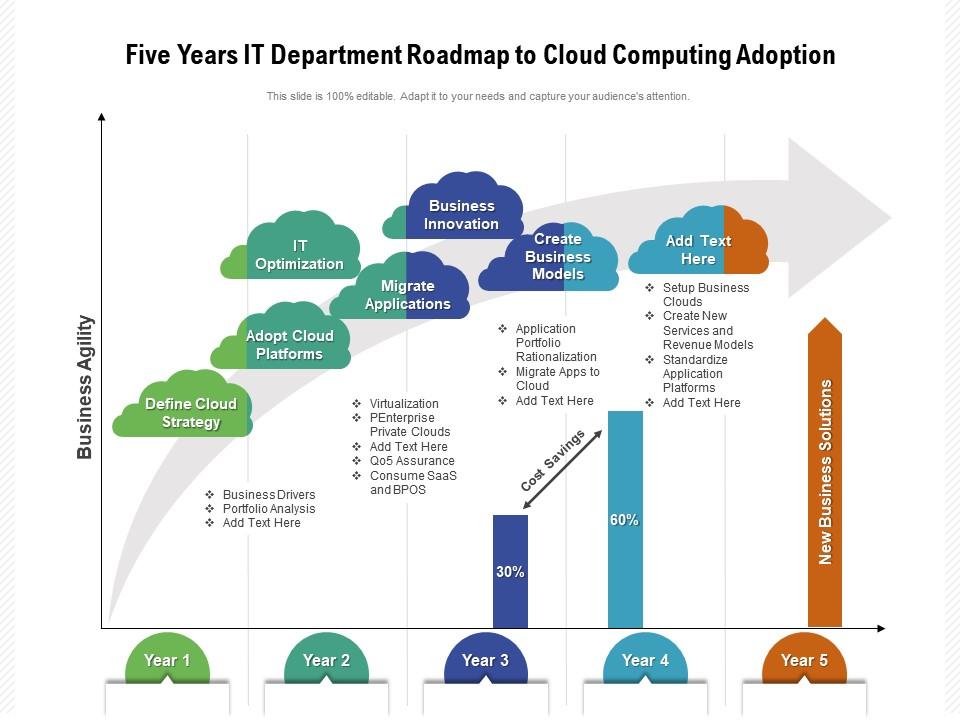
Feuille de route de cinq ans du service informatique pour l'adoption du cloud computing
Try Before you Buy Download Free Sample Product
Audience
Editable
of Time
Un plan d'action bien pensé facilite l'exécution et augmente considérablement les chances de succès. Assurez-vous de franchir toutes les étapes dans les délais en introduisant notre feuille de route de cinq ans du service informatique entièrement personnalisable pour l'adoption du cloud computing. Rationalisez les informations liées au travail, le budget, le calendrier, les livrables clés, les repères et les principales étapes impliquées, le tout en un seul endroit pour donner un aperçu organisé du projet en utilisant notre thème PowerPoint. Minimisez le décalage temporel et augmentez l'efficacité du travail en fournissant un aperçu du processus grâce à notre mise en page PowerPoint de feuille de route largement étudiée. Le codage couleur aide à mettre en évidence le processus et attire l'attention du public. Téléchargez notre feuille de route pratique de cinq ans du service informatique pour l'adoption du cloud computing pour identifier les problèmes éventuels en un temps beaucoup plus court et proposer des solutions. Organisez une session de brainstorming productive avec votre personnel en utilisant notre outil de visualisation de plan d'action.
Caractéristiques de ces diapositives de présentation PowerPoint :
Présentation de la feuille de route PowerPoint de cinq ans du département informatique pour l'adoption du cloud computing. Cette présentation PPT est compatible avec Google Slides, elle est donc facilement accessible. Ce thème PPT est disponible dans les formats d'image 4,3 et 16,9. Ce modèle PowerPoint est personnalisable afin que vous puissiez modifier la taille de la police, le type de police, la couleur et les formes selon vos besoins. Vous pouvez télécharger et enregistrer cette mise en page PowerPoint dans différents formats tels que PDF, PNG et JPG.
People who downloaded this PowerPoint presentation also viewed the following :
Feuille de route de cinq ans du service informatique pour l'adoption du cloud computing avec les 2 diapositives :
Utilisez notre feuille de route de cinq ans pour l'adoption du cloud computing par le service informatique pour vous aider efficacement à gagner un temps précieux. Ils sont prêts à l'emploi pour s'adapter à n'importe quelle structure de présentation.
FAQs for Five years it department roadmap to
Key components include current infrastructure assessment, workload prioritization, security and compliance frameworks, cost optimization strategies, and timeline planning. These elements work together by identifying migration candidates, establishing governance protocols, and defining success metrics, with many organizations finding that a phased approach ultimately delivers reduced operational costs and enhanced scalability.
Organizations can assess cloud readiness by evaluating existing hardware capabilities, software compatibility, network bandwidth, security protocols, and data governance frameworks. Through comprehensive audits and readiness assessments, businesses identify infrastructure gaps, integration challenges, and migration priorities, while determining cost implications and timeline requirements, ultimately enabling strategic cloud adoption that enhances operational efficiency and competitive advantage.
Common challenges during cloud transition include data security concerns, application compatibility issues, staff training requirements, cost management complexities, and integration difficulties with existing systems. Organizations often face resistance to change and vendor lock-in risks, while navigating compliance requirements and ensuring seamless migration workflows, with many enterprises finding that phased approaches and comprehensive planning ultimately deliver smoother transitions and better outcomes.
The choice between public, private, and hybrid cloud significantly influences roadmap timelines, resource allocation, and integration complexity, with each model requiring distinct migration strategies, security frameworks, and governance approaches. Private clouds often extend implementation phases but deliver enhanced control, while hybrid environments enable phased transitions and workload optimization, ultimately allowing organizations to balance compliance requirements with scalability needs across diverse operational contexts.
Essential security measures include multi-factor authentication, data encryption, identity management, network segmentation, and continuous monitoring systems. These technologies enhance protection by establishing zero-trust architectures, automating threat detection, and ensuring compliance across industries, with many financial institutions and healthcare organizations finding that integrated security frameworks ultimately deliver reduced vulnerabilities and stronger regulatory compliance.
Companies can effectively calculate cloud migration costs by assessing current infrastructure expenses, estimating cloud service pricing, factoring in migration labor costs, and accounting for potential downtime impacts. Through comprehensive cost modeling tools and pilot migrations, organizations like banks and retailers accurately forecast expenses while identifying long-term savings opportunities, ultimately enabling informed decisions that balance upfront investments with operational efficiency gains.
A cloud computing roadmap enhances collaboration by establishing shared infrastructure, standardized tools, unified communication platforms, centralized data access, and streamlined workflows across distributed teams. Through strategic cloud adoption, organizations enable real-time document sharing, seamless video conferencing, and integrated project management systems, while eliminating geographical barriers, ultimately delivering faster decision-making and improved productivity in increasingly remote work environments.
Compliance and regulatory requirements serve as foundational constraints that shape cloud architecture decisions, data residency choices, security protocols, and vendor selection criteria. Financial services firms navigating GDPR, healthcare organizations managing HIPAA compliance, and government agencies adhering to FedRAMP requirements find that regulatory frameworks ultimately guide their cloud strategies while enabling enhanced security, operational transparency, and strategic competitive advantage.
Organizations optimize cloud services through right-sizing resources, implementing auto-scaling, leveraging reserved instances, and utilizing monitoring tools for performance tracking. Strategic resource allocation, combined with multi-cloud approaches and regular cost audits, enables companies across retail, healthcare, and financial services to reduce operational expenses by 20-40% while enhancing application performance and user experiences.
Cloud migration success metrics include cost reduction percentages, application performance benchmarks, system uptime improvements, security compliance scores, and user satisfaction ratings. These measurements enable organizations to track operational efficiency gains, assess resource optimization, and validate strategic objectives, with many enterprises finding that comprehensive metric tracking delivers measurable ROI and competitive advantage.
Emerging technologies like AI and IoT significantly reshape cloud roadmaps by driving demand for edge computing capabilities, advanced analytics platforms, enhanced security frameworks, and scalable data processing infrastructure. These technologies enable organizations to process real-time data closer to sources, automate decision-making processes, and deliver faster customer experiences, with many enterprises finding that strategic cloud architecture becomes essential for competitive advantage.
Cloud data integrity and availability best practices include automated backups, multi-region replication, encryption at rest and in transit, regular data validation checks, and robust access controls. These strategies work together by minimizing downtime risks, preventing data corruption, and ensuring seamless recovery, with many financial services and healthcare organizations finding that comprehensive cloud governance frameworks ultimately deliver enhanced security and operational resilience.
Organizations should approach vendor selection by evaluating security certifications, compliance standards, scalability options, integration capabilities, and total cost of ownership. This strategic assessment enables businesses across healthcare, financial services, and retail to identify providers that align with their specific operational requirements, ultimately delivering enhanced performance, reduced risks, and sustainable competitive advantage.
Employees need cloud platform proficiency, data security awareness, automation tools knowledge, collaborative software skills, and basic understanding of cloud architecture principles. Through targeted training programs, organizations enhance workforce adaptability, streamline digital transformation processes, and improve operational efficiency, with many companies finding that comprehensive cloud literacy ultimately delivers competitive advantage and faster service delivery.
Continuous improvement integrates into cloud computing strategy through regular performance monitoring, automated optimization tools, iterative infrastructure updates, and feedback-driven enhancements. Organizations streamline this process by implementing DevOps practices, conducting quarterly assessments, and leveraging cloud-native analytics, ultimately delivering enhanced operational efficiency and competitive advantage in an increasingly dynamic digital landscape.
-
Nice and innovative design.
-
Very unique, user-friendly presentation interface.