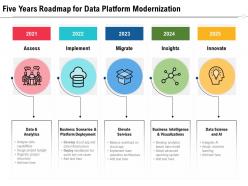
Hoja de ruta de cinco años para la modernización de la plataforma de datos
Try Before you Buy Download Free Sample Product
Audience
Editable
of Time
Utilice nuestra hoja de ruta de cinco años para la modernización de la plataforma de datos preconstruida para presentar su plan de acción de la manera más efectiva. Reduzca el papeleo y muestre cómo las diferentes actividades están vinculadas entre sí mediante la incorporación de este tema de PowerPoint que llama la atención. Este diseño PPT de hoja de ruta completamente editable es adecuado para satisfacer todas sus necesidades y para tener un esquema estructurado de todo el flujo del proceso mediante codificación de colores. Proporcione pautas a sus compañeros de equipo sobre el proceso de progresión empleando nuestro tema PPT. Los miembros del equipo se pueden designar fácilmente en equipos accediendo a los hitos de trabajo que se deben lograr dentro del marco de tiempo. Puede modificar fácilmente la diapositiva de PowerPoint de acuerdo con situaciones en tiempo real. Descargue nuestra impresionante hoja de ruta de cinco años para la modernización de la plataforma de datos y estará listo para probar su experiencia en planificación estratégica.
Características de estas diapositivas de presentación de PowerPoint:
Presentación de la hoja de ruta de cinco años para la plantilla de PowerPoint de modernización de la plataforma de datos. Esta presentación PPT es compatible con Google Slides, por lo que es fácilmente accesible. Puede descargar y guardar este diseño de PowerPoint en diferentes formatos como PDF, PNG y JPG. Este tema de PPT está disponible en relaciones de aspecto de 4,3 y 16,9. Esta plantilla de PowerPoint se puede personalizar para que pueda modificar el tamaño de fuente, el tipo de fuente, el color y las formas según sus requisitos.
People who downloaded this PowerPoint presentation also viewed the following :
Hoja de ruta de cinco años para la modernización de la plataforma de datos con las 2 diapositivas:
Utilice nuestra hoja de ruta de cinco años para la modernización de la plataforma de datos para ayudarlo de manera efectiva a ahorrar su valioso tiempo. Están listos para encajar en cualquier estructura de presentación.
FAQs for Five years roadmap for
Honestly, you'll feel it when things start breaking down constantly. Slow queries that make users want to scream? That's a big one. Your data keeps growing but the system just can't handle it anymore. Maintenance costs are probably killing your budget too. Real-time analytics? Forget about it with old systems. Security's another nightmare - compliance requirements these days are no joke. But here's what really gets me: when your team spends all day putting out fires instead of actually doing analysis work. Document everything that's going wrong and show how it impacts the business. Makes the case way easier.
Start by mapping out everything you've got - data sources, how it all connects, storage, the works. Honestly, this part's kind of tedious but worth it. Hunt for the stuff that's breaking constantly or requires someone to manually babysit it every week. Check your data quality and security against current standards too. Survey your team about what drives them crazy - they'll have opinions, trust me. Once you see the gaps between your current mess and where you want to be, make a simple scorecard. Prioritize the biggest pain points first.
Honestly, legacy system integration is going to be your biggest pain point. Data quality problems just keep snowballing too. Your team probably doesn't have all the right skills yet - that's normal but frustrating. Budget? Yeah, expect overruns. Stakeholders hate change, even when the current process sucks. Compliance stuff will slow you down more than you think. Data governance gets messy fast when you're running old and new systems together. Oh, and start with a small pilot project first - proves it actually works. Change management is huge from the start, don't skip that part.
Cloud tech totally flips how you think about building stuff. Instead of "can we handle this ourselves" it becomes "why would we even bother?" Managed databases, serverless functions, auto-scaling storage - suddenly you're not dealing with hardware headaches anymore. The sticker shock hits at first, not gonna lie. But then you realize you're free from all that capacity planning nonsense. Focus on vendor lock-in risks and which workloads to move first. Map your biggest pain points to cloud solutions - that's where you'll actually see the money back.
Oh man, data governance is like the foundation of your whole modernization thing - you gotta build it in from the start, not slap it on later. I've watched companies skip this step and it gets messy fast. First thing? Figure out what compliance stuff you're dealing with and who actually needs what data access. Set up your quality standards and controls right into the architecture itself. Otherwise you'll just have a shiny new system that's still a nightmare to manage. It sounds boring but honestly it's what separates the success stories from the disasters.
Look, don't make the mistake most teams do - they rush the migration then try to fix data quality issues later. Big headache. You want validation rules and quality checks built in from day one of the migration. Set up some dashboards to monitor your data lineage and accuracy as you go. Assign actual people as data stewards who can spot problems early (seriously, this part's crucial). Test everything on smaller datasets first before you commit to the full migration. Oh, and make sure your governance policies are crystal clear upfront. Way easier than retrofitting quality controls afterward.
You need four main things: cloud infrastructure, data governance, analytics tools, and change management. Most companies totally underestimate real-time processing and kick themselves later, so make sure your infrastructure handles both batch and real-time stuff. Data governance sounds boring but you'll need it for compliance. Self-service analytics is key so business users can stop pestering IT for every little report. Change management is honestly the hardest part - you're basically rewiring how everyone thinks about data, which is... a lot. I'd start by auditing where you're at now and figuring out which processes would benefit most from getting modernized first.
Don't go nuclear and replace everything at once - that's where projects die. Pick your most critical data flows first. Build some APIs or middleware to connect the old stuff with new systems. Most teams totally botch this step by rushing through it, tbh. You need solid data sync running between legacy and modern platforms while you slowly move things over. Business can't go down during all this chaos. Try a small pilot first, make sure it actually works, then expand from there. Takes longer but you won't hate yourself later.
Track both the techy stuff and business impact - you need both sides. Processing speed, uptime, query performance on one end. Time-to-insight for your analysts and cost savings on the other. Honestly, the ROI might look terrible at first because some benefits take forever to show up. Don't freak out about that. Set up some kind of monthly dashboard (nothing fancy) and share it with whoever's breathing down your neck about results. Oh, and measure everything before you start migrating - you'll kick yourself later if you don't have decent baselines to compare against.
Honestly, just bake the ML stuff directly into your data pipeline from day one. Modern platforms let you drop models right where your data already lives - data lakes, warehouses, streaming systems, whatever. The automation part is huge for feature engineering and deployments so you're not constantly shuffling data around. Set up your MLOps workflows early or your data scientists will just build endless notebooks that never see production (been there). Pick one use case first, get that whole process working smoothly, then expand. Way easier than trying to bolt everything on later.
First thing - figure out your data volumes, latency needs, and what your team actually knows how to use. That'll tell you if you need Snowflake or if building directly on AWS/Azure makes more sense. Honestly, I've watched so many teams get distracted by whatever's trendy and then hate themselves later. Stick with stuff that's proven and plays nice with your existing cloud setup. Don't just look at licensing costs either - factor in the whole picture. Oh, and make sure your team can actually handle whatever you pick long-term. Run a small pilot first before you go all-in.
So definitely track analytics during your modernization - it'll save your butt when things go sideways. Get baseline metrics first from your current setup (data volumes, response times, user rates). Monitor the same stuff as you migrate so you can see what's actually working. Dashboards are clutch here - set them up early to compare before/after performance. Trust me, when executives start grilling you about ROI, this data becomes gold. You can pivot fast instead of discovering issues at the end. Oh and honestly? Real-time validation beats crossing your fingers any day.
Honestly, the ROI shows up pretty quickly once you stop drowning in manual data cleanup. Your analysts can actually analyze instead of wrestling with spreadsheets all day. Infrastructure costs drop 20-30% in year one typically, plus your dashboards finally become trustworthy again (thank god). Decision-making speeds up when you're not waiting forever for insights. Oh, and no more hitting those annoying performance walls as data grows. Most companies I've seen get faster revenue growth from making data-driven calls quicker. Definitely track your current processing times first though - you'll want that baseline.
First thing - map out who's gonna be affected by this whole thing. Then figure out how often you need to talk to each group. Core team needs weekly check-ins, business users maybe monthly, executives quarterly (they don't want to be bothered more than that anyway). Be honest about what's working AND what's broken - nobody likes getting blindsided when their stuff stops working. Actually let people give input that matters, not just nod along to your updates. Set up some kind of chat channel for random questions. Oh, and make sure to celebrate the small wins publicly! Keeps everyone motivated.
Honestly, you're gonna need to hit both the tech training and the people side of this. Get everyone up to speed on cloud basics first, then dive into the modern stuff - Spark, Airflow, whatever stack you're going with. SQL training is huge too, even for your senior people (trust me on this one). The process side is just as critical since literally everything changes with modernization. Mix external vendors with internal mentoring programs. Oh, and spot your power users early - they'll be your secret weapon for rolling this out to everyone else once they get it down.
No Reviews