Flexible working hours employees ppt powerpoint presentation summary display cpb

Rating:
92%
Flexible working hours employees ppt powerpoint presentation summary display cpb
Slide 1 of 2

or

Favourites Favourites

Try Before you Buy Download Free Sample Product

Audience Impress Your
Audience
Editable 100%
Editable
Time Save Hours
of Time
The Biggest Sale is ending soon in
0
0
:
0
0
:
0
0
Rating:
92%
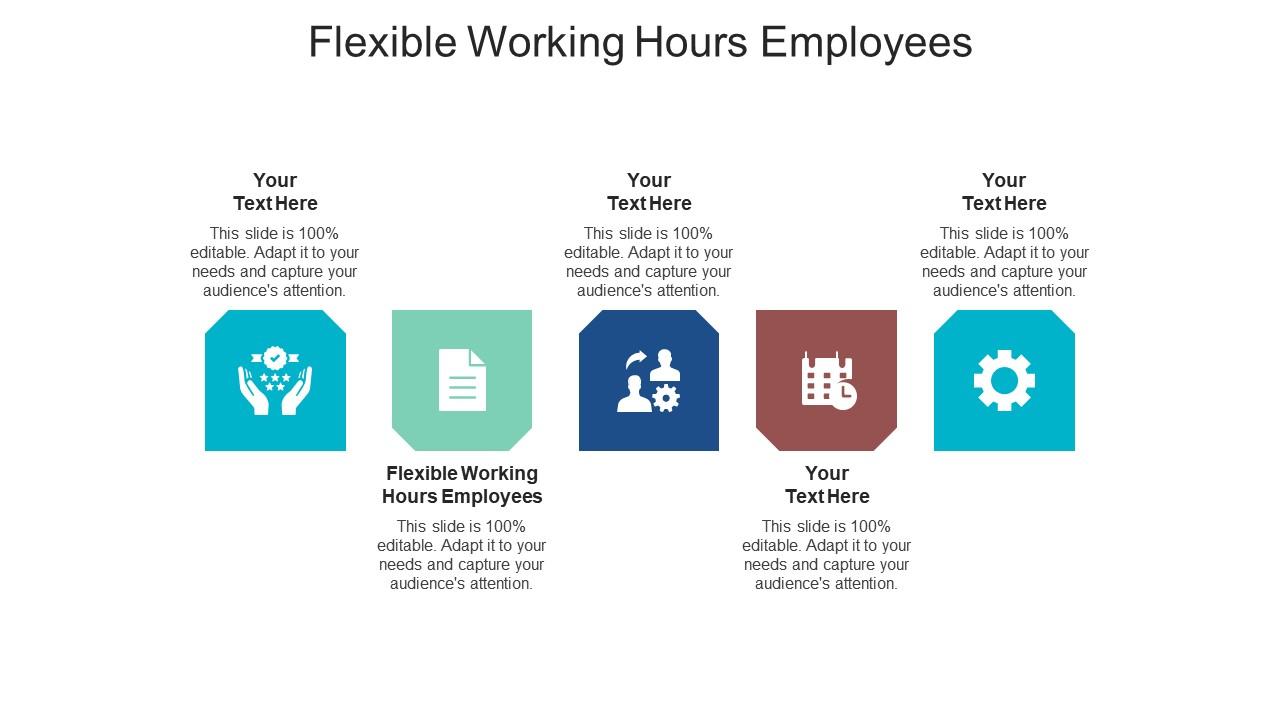
Presenting our Flexible Working Hours Employees Ppt Powerpoint Presentation Summary Display Cpb PowerPoint template design. This PowerPoint slide showcases five stages. It is useful to share insightful information on Flexible Working Hours Employees This PPT slide can be easily accessed in standard screen and widescreen aspect ratios. It is also available in various formats like PDF, PNG, and JPG. Not only this, the PowerPoint slideshow is completely editable and you can effortlessly modify the font size, font type, and shapes according to your wish. Our PPT layout is compatible with Google Slides as well, so download and edit it as per your knowledge.

FAQs for Flexible working hours employees ppt powerpoint presentation

Key benefits of implementing flexible working hours include improved work-life balance, increased employee satisfaction, enhanced productivity, reduced commuting stress, and greater talent retention. These arrangements streamline operations by enabling companies to attract top talent across different time zones, reduce office overhead costs, and boost employee engagement, with many organizations finding that flexible schedules ultimately deliver higher performance and competitive advantage.

Organizations can measure flexible working impact through employee productivity metrics, task completion rates, quality assessments, time-to-delivery analysis, and performance reviews. Companies in sectors like technology, consulting, and financial services increasingly track output-based indicators rather than hours worked, with many finding that goal-oriented measurements, client satisfaction scores, and project milestones deliver more accurate productivity insights than traditional time-based metrics.

Companies face challenges including establishing clear communication protocols, maintaining team collaboration, managing performance evaluation, ensuring equitable workload distribution, and adapting technology infrastructure for remote coordination. While these present initial complexities, organizations across sectors like finance and healthcare find that strategic implementation ultimately delivers enhanced employee satisfaction, reduced overhead costs, and improved talent retention in an increasingly competitive market.

Flexible working hours significantly enhance employee well-being by reducing commute stress, enabling better sleep schedules, and allowing personal appointment management without work disruption. These arrangements deliver improved work-life integration, with many organizations finding that employees experience lower burnout rates, increased job satisfaction, and enhanced productivity, ultimately creating a more engaged workforce and competitive talent retention advantage.

Technology serves as the backbone of flexible working by enabling remote collaboration, cloud-based file access, video conferencing, project management platforms, and real-time communication tools. These digital solutions streamline workflows across different time zones and locations, with many organizations finding that employees maintain productivity while enjoying better work-life balance, ultimately delivering enhanced talent retention and operational efficiency.

Technology, consulting, finance, marketing, and creative industries benefit most from flexible working hours due to their project-based nature, global client demands, and emphasis on output over presence. These sectors often involve knowledge work, remote collaboration, and varying peak productivity times, with many organizations finding that flexible schedules enhance talent retention while maintaining operational efficiency.

Managers can effectively supervise flexible teams by establishing clear communication protocols, setting defined deliverable deadlines, using collaborative project management tools, and scheduling regular check-ins across different time zones. Through digital platforms and outcome-focused performance metrics, organizations streamline coordination while maintaining accountability, with many companies finding that structured flexibility ultimately enhances productivity and employee satisfaction.

Organizations can utilize asynchronous communication tools, overlapping core hours, regular check-ins, shared digital workspaces, and clear documentation protocols to maintain effective remote communication. These strategies enable teams to collaborate seamlessly across different schedules while enhancing productivity and work-life balance, with many companies finding that structured flexibility ultimately delivers better project outcomes and employee satisfaction.

Employee engagement typically increases with flexible working hours by improving work-life balance, reducing commute stress, and allowing personalized productivity schedules. Organizations across sectors like technology, financial services, and healthcare find that flexible arrangements enhance job satisfaction, decrease turnover rates, and boost performance metrics, ultimately delivering higher retention and competitive talent acquisition advantages.

Companies should consider labor law compliance, overtime regulations, health and safety obligations, data protection requirements, and employment contract modifications when implementing flexible working policies. These legal frameworks vary by jurisdiction, with organizations in sectors like finance and healthcare finding that proactive legal review streamlines policy adoption while ensuring regulatory compliance and minimizing workplace disputes.

Organizations can tailor flexible working hours through core hours frameworks, compressed workweeks, remote work options, job-sharing arrangements, and personalized scheduling systems. By implementing flexible policies that consider individual circumstances, family responsibilities, and peak productivity periods, companies enhance employee satisfaction, reduce turnover, and ultimately improve overall organizational performance while maintaining operational efficiency.

Best practices for creating a flexible working hours policy include establishing clear core hours, defining communication protocols, setting performance metrics, implementing time-tracking systems, and ensuring equitable access across all roles. These policies enhance productivity by accommodating diverse schedules, reducing commute stress, and improving work-life balance, with many organizations finding that strategic flexibility ultimately delivers higher employee satisfaction and retention.

Organizations foster trust and accountability in flexible work environments by establishing clear performance metrics, implementing regular check-ins and transparent communication channels, and focusing on outcomes rather than hours worked. Through goal-setting frameworks and collaborative tools, companies enable managers to track progress while empowering employees with autonomy, ultimately delivering higher engagement and productivity across distributed teams.

Time management tools for flexible hours include project management platforms like Asana or Trello, calendar applications with scheduling features, time-tracking software, communication tools like Slack, and productivity apps with focus timers. These technologies streamline workflow organization, enhance team coordination, and minimize scheduling conflicts, with many remote-first companies finding that integrated digital toolkits ultimately deliver improved work-life balance and measurable productivity gains.

Flexibility in work hours significantly enhances employee retention by reducing turnover, improving job satisfaction, and enabling better work-life balance across diverse workforce demographics. Organizations offering flexible scheduling attract top talent more effectively, differentiate themselves in competitive job markets, and reduce recruitment costs, with many companies finding that adaptable work arrangements ultimately deliver stronger employee loyalty and broader candidate pools.

Ratings and Reviews

92% of 100
Review Form
Write a review
Most Relevant Reviews
  1. 100%

    by Darell Vargas

    The Designed Graphic are very professional and classic.
  2. 80%

    by Charles Nguyen

    Illustrative design with editable content. Exceptional value for money. Highly pleased with the product.
  3. 100%

    by Cyrus Ellis

    Much better than the original! Thanks for the quick turnaround.
  4. 80%

    by Demarcus Robertson

    Excellent products for quick understanding.
  5. 100%

    by Don Hansen

    Designs have enough space to add content.

5 Item(s)

per page: