


Fu six staged cyclic about us methodology flat powerpoint design






Try Before you Buy Download Free Sample Product
 Impress Your
 Audience
 100%
100% Editable
 Save Hours
 of Time


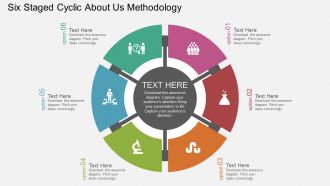
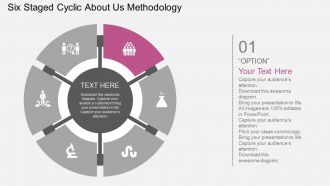
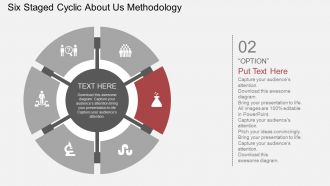
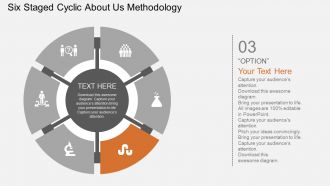
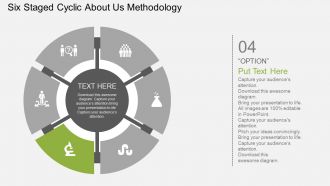
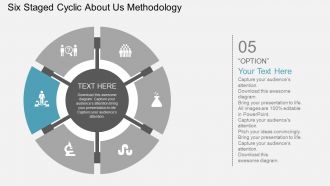
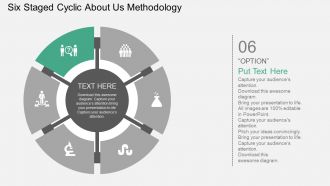
Attract the attention of your audience with our six staged cyclic about us methodology flat PowerPoint Template design. The amazingly created PPT slide has been designed with utmost care by the team of our innovative designers. With the help of our PPT slideshow, you can highlight the key features of your business and spread awareness about the products and services of your business organization. Use this PPT diagram for business and marketing related presentations. Our slide design has a graphic of six staged circular diagram which has professional colors with creative icons and can be used to showcase various other business concepts such as objectives, strategies, business goals, operations, etc. The graphic conveys the message in a creative manner and is fully editable, so you can even add more stages and further expand the horizon of your business activities. The fonts, text, colors, etc. everything can be modified as per your choice. Simply click download and create outstanding PowerPoint presentations which will create a long-lasting impact on the viewers. Give your employees cause to be faithful with our Fu Six Staged Cyclic About Us Methodology Flat Powerpoint Design. The amount of attrition is bound to come down.
People who downloaded this PowerPoint presentation also viewed the following :
Fu six staged cyclic about us methodology flat powerpoint design with all 10 slides:
Cut out the garbage with our Fu Six Staged Cyclic About Us Methodology Flat Powerpoint Design. They contain absolutely accurate data
FAQs for Fu six staged cyclic about us methodology
So there's six phases: Define, Discover, Develop, Deliver, Deploy, and Debrief. First you figure out what problem you're actually solving and set your goals. Then research and analyze to get insights. Development is where you build the thing - honestly, most teams get stuck here forever. After that, you deliver to stakeholders and deploy it live. Don't skip the debrief though! That's where you capture what went wrong (or right). The whole process loops back on itself, so debrief stuff helps you define the next round. Try figuring out which phase your current project's in - it'll help you know what to focus on next.
So Fu methodology is pretty wild - it uses six repeating cycles instead of those boring linear phases everyone's used to. Most project management follows this sequential path, right? But Fu treats everything like interconnected loops you keep coming back to. You're constantly cycling through planning, execution, and reflection rather than just ticking boxes and moving on. Honestly took me forever to wrap my head around it! The cool part is you can pivot super fast when stuff changes. Try mapping your current project using those six stages - you'll probably spot where traditional methods are screwing you over.
Fu's methodology works best for messy, complex stuff - software development, research projects, big organizational changes. Basically anything where requirements keep shifting or you need constant stakeholder check-ins. Don't bother with simple linear tasks though. Like, data entry projects? Total waste of time using this approach. The iterative cycles really shine when you're figuring things out as you go. Course-correcting becomes way easier. Multiple unknowns or changing scope? That's when you know this framework will actually help instead of just adding extra steps.
Hmm, I haven't come across that "Fu six staged cyclic methodology" before - doesn't ring a bell from any of the usual business frameworks I know. Are you maybe thinking of Six Sigma or Lean Six Sigma? Those cyclical processes have a million success stories across different industries. Manufacturing loves them, healthcare uses them constantly, finance too. Could've sworn I saw some tech companies doing implementations as well. If you remember where you heard about the Fu approach or can dig up more details, I'd be happy to help track down better examples. Otherwise those other methodologies might give you what you're looking for.
Honestly, the whole cyclic thing is pretty genius because you can constantly reassess without losing steam. You're not stuck on some rigid linear path - instead, you cycle through those six stages over and over. When stuff inevitably changes (because it always does), you just adjust in the next cycle instead of panicking and trying to fix everything at once. Each round gets better than the last since you're learning as you go. It's like having built-in checkpoints for course corrections. Next time you're working on something, try keeping track of which stage you're in - helps you see those pivot moments coming.
Honestly, just use whatever project management stuff your team already has - Jira, Asana, whatever. Don't overthink it. Miro or Lucidchart are great for mapping out those six stages visually (digital whiteboards are surprisingly fun for this). You'll need somewhere to dump all your insights between cycles - Confluence or Notion work perfectly. Some teams get obsessed with fancy process improvement software, but that's overkill IMO. The whole methodology is pretty flexible anyway. Start with your current tools and just add the six-stage framework on top. Way easier than switching everything up.
Honestly, most people rush through it or completely skip reflecting - then wonder why they keep making the same mistakes lol. Analysis paralysis is real too during the assessment part (trust me on this one). Set actual time limits for each stage and stick to them. Document what you learned between cycles, not just what happened. The whole thing works way better when you stop trying to make it perfect and just roll with the chaos. Oh, and definitely start with something small for your first go. You'll get the hang of the rhythm pretty quick.
So with Fu methodology, you're gonna be engaging stakeholders constantly but it changes as you go. Stages 1-2 are where you do the heavy lifting - getting everyone aligned on what the actual problem is and making sure they're bought in. Then 3-4 gets more collaborative since you're building solutions together. Stage 5 is honestly my favorite part - you're basically putting your approach through the wringer with stakeholders before you commit fully. Stage 6 needs those ongoing feedback loops or things fall apart. Oh, and your stakeholder map will definitely shift as you move through this, so don't get stuck using the same approach every time.
Track metrics that actually matter for each stage - completion rates, feedback scores, resource use. Set your baselines before starting, then measure how you improve with each cycle. Honestly, most teams obsess over vanity metrics that don't move the needle. Focus on what gets you closer to your actual goals, not just busy work. Overall cycle time and quality scores are huge too. Build a simple dashboard showing both individual stages and the whole process - makes it way easier to catch bottlenecks before they wreck everything. Oh, and stakeholder feedback is gold if you can get honest responses.
So basically, Fu methodology has these feedback loops built into every phase transition - you're always checking and tweaking based on what just happened. Pretty smart actually. Instead of waiting till the end to get input, you're course-correcting the whole time through all six stages. Stakeholders love it because they actually see their feedback making a difference right away, not just disappearing into some void. The trick is starting simple though - maybe just write down one piece of feedback each time you move phases. Once you get the rhythm down, it becomes second nature.
So the Fu methodology is basically built around this idea of constant feedback - you're not just going through the six stages once and calling it done. What I found interesting is how each stage loops back to earlier ones, so you're tweaking things as you go rather than waiting until the end to fix problems. Your outcomes get better because you're spotting issues early and adjusting on the fly. Each cycle you complete makes the next one smoother. Honestly, if you start tracking your improvements between cycles, you'll see some pretty solid gains stack up over time.
Build in regular checkpoints with leadership during each stage - don't wait till the end. I've watched teams get halfway through and suddenly realize they're building something nobody actually wants anymore. Super frustrating. Document how everything connects back to your company's main goals, and honestly, be ready to pivot when priorities change (they always do). That's kinda the whole point of Fu's cyclic thing anyway. Set up quick alignment checks after stages 2 and 4 at minimum. Always connect your progress to business outcomes that actually matter to the C-suite. Otherwise you'll be spinning your wheels.
Okay so definitely start with leadership training - they've gotta know this stuff cold before anyone else jumps in. After that, train your core people on all six stages: problem identification, analysis, solution design, implementation, monitoring, and evaluation. Monitoring is where most teams totally fall apart, honestly. Don't forget workshops on data collection and stakeholder engagement too. Those come up constantly throughout the whole cycle. I'd budget around 40 hours for the initial training, plus you'll want ongoing coaching sessions. Oh and the change management fundamentals - that's pretty crucial for the rollout piece.
Look, risk management isn't really its own separate thing in Fu's methodology - it's more like salt in cooking, you sprinkle it everywhere. The analysis and evaluation stages are where you'll see it most clearly, identifying what could go sideways and how bad it'd be. During planning you're thinking ahead about problems. Implementation means watching for red flags. Then review is where you figure out what actually sucked (or almost did). Honestly, the trick is just making it automatic at every transition instead of some boring checklist thing you rush through.
Yeah, definitely! Fu methodology pairs really well with agile since they're both about those iterative cycles. I'd map the six Fu stages right onto your sprints - it's weird how naturally they fit together. Each sprint becomes like a mini-cycle where you zip through the Fu stages instead of dragging them out for weeks. The reflection and analysis parts need to get compressed to match your sprint timing, which honestly isn't that hard once you get the hang of it. Try running one full Fu cycle in your next sprint and see how it lines up with your current ceremonies.
-
Enough space for editing and adding your own content.
-
Easy to edit slides with easy to understand instructions.