


Full Digital Marketing Agency Comparative Balance Sheet Statement For Digital Marketing BP SS





Try Before you Buy Download Free Sample Product
 Impress Your
Audience
 100%
Editable
 Save Hours
of Time


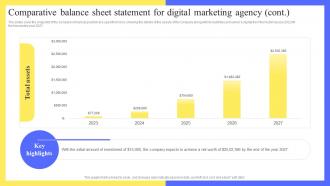
The slides cover the snapshot of the company financial position at a specific time by showing the details of the assets of the company along with its liabilities and owner capital from the historical year 2023 till the forecasted the year 2027.
People who downloaded this PowerPoint presentation also viewed the following :
Full Digital Marketing Agency Comparative Balance Sheet Statement For Digital Marketing BP SS with all 10 slides:
Use our Full Digital Marketing Agency Comparative Balance Sheet Statement For Digital Marketing BP SS to effectively help you save your valuable time. They are readymade to fit into any presentation structure.









FAQs for Full Digital Marketing Agency Comparative Balance Sheet Statement For Digital
Honestly, just track five things and you'll be golden. MRR and client lifetime value show if your revenue's actually stable. Client acquisition cost vs lifetime value ratio - don't burn cash chasing expensive clients. Team utilization should hit 75-85% billable hours (higher and people burn out). Cash flow will straight up kill you though - I've watched profitable agencies die because clients paid late. Track churn monthly too. Set up a simple dashboard, check it weekly. Way easier to fix small problems than dig out of disasters later.
Honestly, measuring ROI isn't as complicated as people make it seem. Just use the basic formula: (Revenue - Campaign Cost) / Campaign Cost × 100. First thing - set up UTM parameters on all your links so you can actually trace where sales came from. Google Analytics and Facebook Pixel are your best friends here, plus whatever CRM you're using. Don't get caught up in vanity metrics like impressions or clicks. Focus on what actually converts to sales. Set up proper attribution tracking too - you need to know which touchpoints are doing the heavy lifting. I've seen too many people obsess over engagement rates while their actual revenue stays flat.
Look, your client acquisition costs are basically what make or break your cash flow. Say you drop $2K to get a client worth $5K yearly - that's decent ROI but you're bleeding money for months first. Most people totally lowball these costs when they start out (I definitely did). You need way more runway than you think. Track what each channel actually costs you, not what you hope it'll cost. Build those real numbers into your forecasts because wishful thinking won't pay rent. Higher CAC just means you need deeper pockets before things turn profitable.
Dude, cash flow will make or break your agency. You're basically fronting money for ad spend and tools while clients take forever to pay you - sometimes 60 days. I've seen profitable agencies go under because of this exact thing. Track it weekly, not monthly. One big client paying late can screw you over fast. Build a forecast showing what's coming in and going out over 90 days. Oh, and keep at least two months of expenses sitting in the bank as backup. Trust me on this one.
Figure out your monthly churn first - just divide clients lost by total clients you had. Look back 12 months for retention rates too. Multiply your current MRR by that retention rate to get your baseline revenue projection. Q4 gets wonky for most agencies, so definitely account for seasonal stuff. When estimating new clients, be realistic about your actual close rates (not the numbers you tell yourself at 2am). I always build three scenarios - worst case, realistic, and best case with different churn assumptions. Update monthly with real data so you can catch trends before they bite you.
Look, profit margins are basically your scorecard for how efficiently you're running things. They show if you're actually turning revenue into real profit after covering all your costs. For digital agencies, you want 15-25% net margins - anything lower and you're probably undercharging or your operations are a mess. Revenue numbers look impressive, but margins? That's where the truth lives. I'd track both gross and net monthly, honestly. If you're stuck under 10% consistently, time to seriously look at your pricing and maybe cut some of that software bloat. High revenue means nothing if you can't keep any of it.
Look at your past ROI data first - which channels actually make you money, not just pretty numbers. Put about 60-70% into what's already working. I'd keep maybe 20-30% aside for testing new stuff or doubling down on what's promising. Facebook ads might seem cheap but if those customers bail after a month, you're screwed. Track lifetime value, not just how much it costs to get someone. Oh and run those attribution reports monthly - shift money toward whatever's bringing in the highest margins, not necessarily the most leads. Don't spread yourself too thin either.
Honestly, the cash flow rollercoaster will mess you up if you're not careful. One month you're drowning in retainers, next month three clients bail and you're eating ramen again. I learned this the hard way lol. Scope creep is brutal too - you think a project takes 10 hours, it takes 15, your margins disappear. Build up 3-6 months of expenses as backup, even if it's just $500 monthly. Pad your estimates by at least 20%. Don't let any client become more than 30% of your income or you're screwed when they leave. Track where clients come from religiously - some channels are total money pits.
Look at three main things: client relationships, brand rep, and any unique stuff you've built. Calculate client lifetime value and retention rates first - that's your relationship gold right there. Brand value shows up in organic traffic, social engagement, referrals without you even asking. Honestly, people sleep on how much this affects what you can charge. Then there's your proprietary methods, templates, whatever tools you've created that others don't have. I'd document it all and put conservative dollar amounts based on what it'd cost to replace or how much revenue it generates. Sometimes feels like guesswork but it's better than ignoring these assets completely.
Databox and Klipfolio are pretty solid for real-time dashboards - they'll automatically pull from all your marketing platforms. Google Data Studio works too if you're on a budget. Power BI's great for deeper analytics stuff. But honestly? I've seen so many agencies blow money on expensive tools when a good Google Sheets setup does the trick for smaller teams. The whole point is getting everything in one place so you can quickly see what's working and what's just bleeding money. Oh, and don't try to implement everything at once - pick one tool that plays nice with your main platforms first.
Oh man, seasonality is wild depending on what you're doing. Retainer clients are your lifeline - steady money every month. But project work? Total rollercoaster. January everyone wants new websites, then August hits and it's dead. E-commerce goes absolutely nuts Q4 (holiday money is the best), then January's rough. B2B folks love freezing budgets in December and July for some reason. You gotta track this stuff by client type so you can actually plan ahead. Maybe pitch maintenance work during slow months or something.
ROI and ROAS are what I'd watch first - they're the ones that actually tell you if you're making money. CPA matters too since you need to know what each customer costs you. Conversion rates and CTR are good for a quick health check, but honestly? Start with ROI and CPA. If those numbers look solid, then dive into the other stuff. Customer lifetime value is super important but takes forever to calculate properly - kind of a pain. Set up some automated reports so you're checking these weekly instead of scrambling at the end.
Honestly, freelancers are a lifesaver for cash flow - you only pay when there's actual work coming in. Employees hit you with that steady 1.3-1.5x salary cost every month (taxes, benefits, all that fun stuff). Sure, freelancers cost more per hour, but at least you're not bleeding money during slow periods. The downside? You'll have less control and sometimes the quality gets wonky between different people. I'd probably test both in a spreadsheet first - maybe start with freelancers until you've got consistent revenue, then bring the important stuff in-house. Way less risky that way.
Your revenue forecasts are totally at the mercy of whatever Apple and Google decide to do next. iOS 14.5 destroyed Facebook ad performance for tons of agencies overnight - like, cut it in half. Privacy updates, policy changes, platform shifts - they'll wreck your projections faster than you can update your spreadsheets. Don't just look at past performance either. Economic downturns? Marketing budgets get slashed first. Plus AI is changing everything cost-wise (though honestly still figuring out how much). Build different scenarios and update them every quarter based on whatever chaos the platforms throw at you next.
Honestly, start by breaking down your profit margins by service type and client size - you'll probably find some eye-opening gaps. I'd bet money that some of your services are way underpriced compared to what clients actually get from them. Check your time tracking against what you're billing. Sure, compare rates to industry standards, but here's what matters more: figure out which clients stick around longest and pay without drama. Those are your goldmine clients who value good work. Once you've got that data, bump up prices on your most profitable services first. Oh, and maybe think about creating different pricing tiers - makes it easier to upsell later.
-
Templates are beautiful and easy to use. An amateur can also create a presentation using these slides. It is amazing.
-
Incredibly beautiful designs that will help you get noticed! These eye-catching templates are perfect for corporate presentations that can be altered to fit any occasion or taste.