

Fuzzy Clustering Method In Machine Learning Training Ppt




Try Before you Buy Download Free Sample Product
 Impress Your
 Audience
 100%
100% Editable
 Save Hours
 of Time


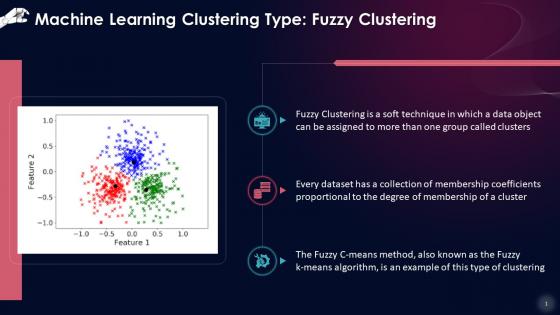
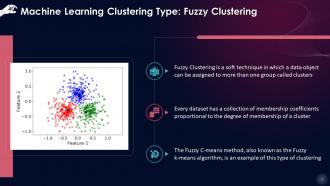
This slide states that Fuzzy Clustering is a soft technique in which a data object can be assigned to more than one group called clusters. Every dataset has a collection of membership coefficients proportional to the degree of membership of a cluster.
People who downloaded this PowerPoint presentation also viewed the following :
Fuzzy Clustering Method In Machine Learning Training Ppt with all 17 slides:
Use our Fuzzy Clustering Method In Machine Learning Training Ppt to effectively help you save your valuable time. They are readymade to fit into any presentation structure.












FAQs for Fuzzy Clustering Method In Machine
Fuzzy clustering's foundational principles include partial membership assignment, overlapping cluster boundaries, membership degree quantification, probabilistic data point allocation, and iterative optimization techniques that allow objects to belong to multiple clusters simultaneously. Unlike traditional hard clustering methods that assign each data point to exactly one cluster, fuzzy clustering enables gradual transitions between clusters, with financial institutions and healthcare organizations finding this approach delivers more nuanced customer segmentation and diagnostic classification.
Membership degrees in fuzzy clustering assign partial belonging probabilities to each data point across multiple clusters, rather than forcing hard assignments, enabling points to belong to several clusters simultaneously with varying strengths. This approach proves particularly valuable in customer segmentation, medical diagnosis, and market analysis, where entities naturally exhibit mixed characteristics, ultimately delivering more nuanced insights and flexible decision-making capabilities for complex business scenarios.
Common fuzzy clustering algorithms include Fuzzy C-Means (FCM), Gustafson-Kessel, Possibilistic C-Means, and Fuzzy Subspace Clustering, each offering different strengths for data analysis applications. FCM delivers computational efficiency for large datasets, while Gustafson-Kessel handles complex cluster shapes more accurately, with many organizations in healthcare and finance finding that algorithm selection depends on data complexity and processing requirements.
Fuzzy clustering excels when data points naturally belong to multiple categories simultaneously, such as customer segmentation where buyers exhibit mixed preferences, medical diagnosis with overlapping symptoms, or market analysis with cross-demographic behaviors. Unlike hard clustering's rigid boundaries, fuzzy methods enable organizations to capture nuanced patterns and gradual transitions, ultimately delivering more sophisticated insights and strategic decision-making capabilities.
Fuzzy clustering enhances image segmentation by enabling pixels to belong partially to multiple segments, creating smoother boundaries in medical imaging, satellite analysis, and computer vision applications. In customer segmentation, it allows individuals to exist across multiple behavioral groups simultaneously, helping retailers, banks, and marketing teams develop nuanced targeting strategies that reflect real customer complexity, ultimately delivering more personalized experiences and improved campaign effectiveness.
Fuzzy clustering implementation faces challenges including determining optimal cluster numbers, managing computational complexity with large datasets, handling noise and outliers effectively, and selecting appropriate membership functions. These algorithms require careful parameter tuning and significant processing power, though organizations in healthcare, finance, and manufacturing find that proper implementation ultimately delivers enhanced pattern recognition and more nuanced data insights than traditional clustering methods.
Common evaluation metrics for fuzzy clustering include partition coefficient, partition entropy, silhouette coefficient, Xie-Beni index, and Dunn's index. These metrics assess cluster validity by measuring separation quality, membership clarity, and internal cohesion, with organizations in finance and healthcare finding that proper evaluation enhances decision-making accuracy and operational efficiency.
Selecting appropriate cluster numbers in fuzzy clustering involves evaluating partition coefficient, partition entropy, silhouette analysis, and elbow method validation across different cluster configurations. These techniques enable data scientists to balance model complexity with interpretability, with many organizations in retail, healthcare, and financial services finding that combining multiple validation metrics delivers optimal segmentation accuracy and actionable business insights.
The fuzziness parameter controls the degree of overlap between clusters in fuzzy c-means, with higher values creating softer boundaries and more shared membership across clusters, while lower values produce crisper, more distinct groupings. This parameter significantly impacts clustering outcomes, with financial institutions and healthcare organizations finding that optimal fuzziness levels enhance pattern recognition in customer segmentation and medical diagnostics, ultimately delivering more nuanced data insights and improved decision-making capabilities.
Fuzzy clustering integrates seamlessly with dimensionality reduction techniques like PCA or t-SNE to enhance data visualization, and with classification methods such as neural networks or decision trees to improve prediction accuracy. This strategic combination enables organizations across manufacturing, healthcare, and financial services to streamline pattern recognition, minimize computational complexity, and ultimately deliver more precise customer segmentation and operational insights.
Popular fuzzy clustering tools include MATLAB's Fuzzy Logic Toolbox, Python's scikit-fuzzy and fuzzy-c-means libraries, R's cluster package, and Weka's machine learning suite. These platforms streamline implementation by providing pre-built algorithms, visualization capabilities, and data preprocessing functions, with many organizations finding that integrated toolsets accelerate deployment while reducing development complexity.
Fuzzy clustering handles outliers more gracefully than hard clustering methods by assigning partial membership values rather than forcing complete assignment to clusters, which prevents outliers from drastically skewing cluster centers. This approach enables organizations in fraud detection, customer segmentation, and quality control to maintain clustering accuracy while identifying anomalous data points, ultimately delivering more robust analytical insights and better decision-making capabilities.
Preprocessing data before fuzzy clustering is crucial because it ensures algorithm accuracy, removes noise and outliers, normalizes varying scales, and handles missing values effectively. Through proper data cleaning and transformation, organizations in healthcare, finance, and retail can achieve more reliable customer segmentation, risk assessment, and pattern recognition, ultimately delivering enhanced decision-making capabilities and competitive analytical advantages.
Fuzzy clustering can be effectively applied to high-dimensional datasets through dimensionality reduction techniques like PCA, feature selection methods, distance metric optimization, and kernel-based approaches. These strategies enable organizations in finance, healthcare, and retail to streamline customer segmentation, medical diagnosis, and market analysis, ultimately delivering enhanced pattern recognition and competitive advantage in increasingly complex data environments.
Future trends in fuzzy clustering research include explainable AI integration, quantum-enhanced algorithms, deep learning hybridization, real-time processing capabilities, and automated parameter optimization. These advancements enable organizations across healthcare, finance, and manufacturing to achieve more transparent decision-making, faster pattern recognition, and enhanced scalability, with many enterprises finding that these evolving technologies deliver improved accuracy and competitive advantage in data-driven operations.
-
Innovative and Colorful designs.
-
Editable templates with innovative design and color combination.