GPT 4 Compliance With Safety Standards And Everything About Chat GPT Generative ChatGPT SS
Try Before you Buy Download Free Sample Product
Audience
Editable
of Time
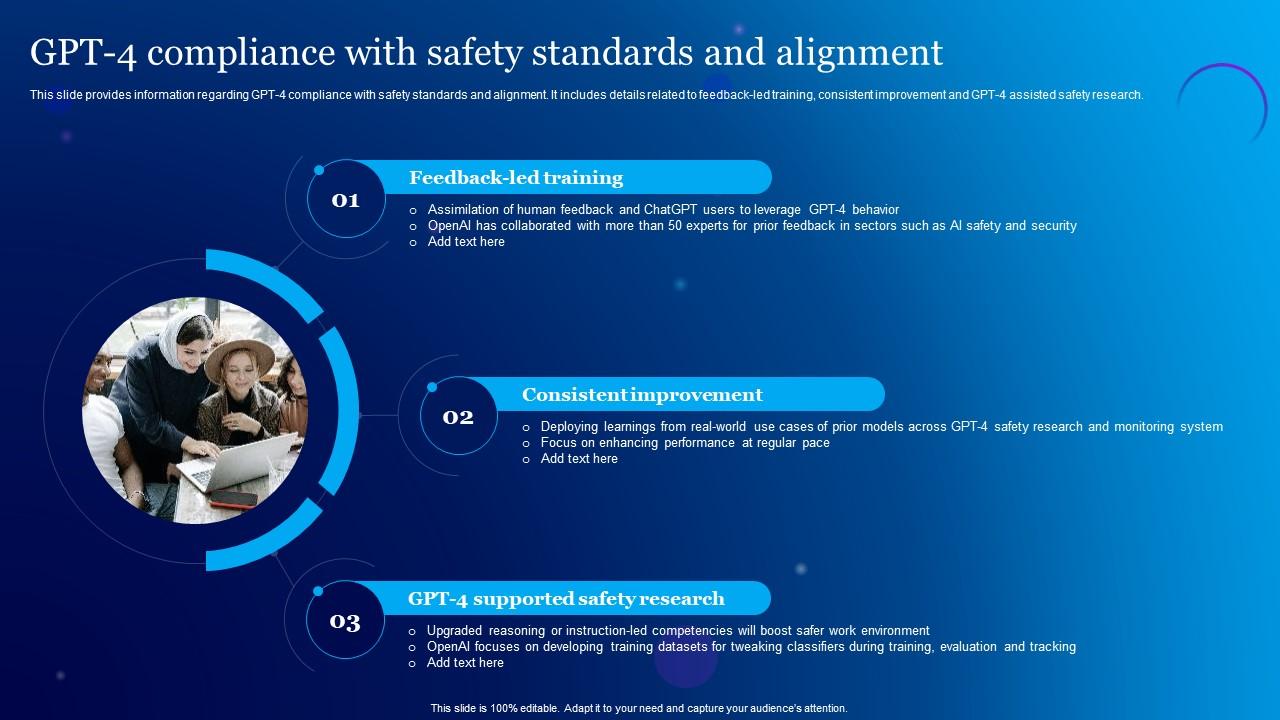
This slide provides information regarding GPT 4 compliance with safety standards and alignment. It includes details related to feedback led training, consistent improvement and GPT 4 assisted safety research.
People who downloaded this PowerPoint presentation also viewed the following :
GPT 4 Compliance With Safety Standards And Everything About Chat GPT Generative ChatGPT SS with all 6 slides:
Use our GPT 4 Compliance With Safety Standards And Everything About Chat GPT Generative ChatGPT SS to effectively help you save your valuable time. They are readymade to fit into any presentation structure.
FAQs for GPT 4 Compliance With Safety Standards And Everything About Chat GPT
AI models like GPT-4 must comply with emerging frameworks including NIST's AI Risk Management Framework, ISO/IEC 23053 for AI governance, EU AI Act requirements, and sector-specific regulations like GDPR for data protection. These standards streamline risk assessment, enhance transparency, and ensure responsible deployment, with many organizations finding that proactive compliance delivers competitive advantage while minimizing regulatory exposure.
GPT-4 ensures compliance with data privacy regulations through advanced data anonymization techniques, encrypted processing protocols, strict access controls, and automated deletion of personal information after processing sessions. These security measures enable organizations in healthcare, finance, and legal sectors to leverage AI capabilities while maintaining GDPR and CCPA compliance, ultimately delivering enhanced operational efficiency without compromising sensitive data protection requirements.
GPT-4 addresses potential biases through reinforcement learning from human feedback, diverse training data curation, constitutional AI principles, and continuous model refinement processes. These approaches help minimize demographic, cultural, and ideological biases in responses, while ongoing monitoring and feedback loops enable developers to identify problematic patterns, ultimately delivering more balanced perspectives for organizations across sectors like healthcare, finance, and education.
GPT-4 employs multi-layered safety mechanisms including reinforcement learning from human feedback, constitutional AI training, content filtering systems, real-time monitoring algorithms, and adversarial testing protocols. These systems work together by detecting potential risks, preventing harmful outputs, and continuously learning from user interactions, with many organizations finding that combining automated detection with human oversight ultimately delivers safer AI deployment and enhanced user trust.
GPT-4 handles sensitive topics through multi-layered safety protocols including content filtering, contextual analysis, harm prevention systems, and ethical guidelines that identify and mitigate potentially harmful outputs. These safety measures enable organizations in healthcare, finance, and education to deploy AI responsibly while maintaining user trust, ultimately delivering secure interactions and regulatory compliance in increasingly regulated environments.
Human oversight serves as a critical safety mechanism in GPT-4 compliance through continuous monitoring, content review, bias detection, and real-time intervention capabilities. Organizations across healthcare, finance, and legal sectors implement multi-layered human supervision to ensure responsible AI deployment, with many finding that combining automated safeguards with expert human judgment ultimately delivers enhanced reliability and regulatory adherence.
GPT-4's design incorporates multi-layered safety protocols including reinforcement learning from human feedback, constitutional AI training, robust content filtering, automated bias detection, and comprehensive output monitoring systems. These architectural safeguards enable organizations across sectors like healthcare, finance, and education to maintain regulatory compliance while delivering enhanced user experiences, ultimately providing competitive advantage in increasingly regulated AI deployment environments.
GPT-4 faces compliance challenges including rapidly changing AI governance frameworks, varying international regulatory standards, data privacy requirements, algorithmic transparency mandates, and sector-specific safety protocols. These evolving regulations create complexity for organizations deploying GPT-4, with many financial services and healthcare institutions finding that maintaining compliance requires continuous monitoring, regular audits, and adaptive governance strategies, ultimately delivering enhanced trust and competitive advantage.
GPT-4's training data significantly impacts safety compliance through comprehensive filtering, diverse sourcing, and rigorous content curation that removes harmful materials while maintaining balanced perspectives. Through advanced preprocessing techniques, OpenAI streamlines bias reduction, enhances contextual understanding, and minimizes inappropriate outputs, with many organizations finding that these data refinements ultimately deliver more reliable AI interactions and better regulatory alignment.
GPT-4 undergoes comprehensive safety testing including adversarial testing, red team evaluations, bias assessments, harmful content detection, and alignment verification protocols. These procedures enable organizations to validate model behavior across financial services, healthcare, and customer-facing applications, ultimately delivering regulatory compliance and risk mitigation while maintaining operational efficiency in increasingly regulated environments.
OpenAI continuously updates GPT-4's safety protocols through ongoing monitoring, red team testing, stakeholder feedback, and emerging research insights. These iterative improvements occur regularly rather than on fixed schedules, with many organizations in healthcare, finance, and legal sectors finding that this adaptive approach ensures compliance with evolving regulatory requirements while maintaining operational efficiency and user trust.
User feedback significantly influences GPT-4's safety measures through bias reporting, harmful content identification, vulnerability disclosure, and behavioral pattern analysis. These feedback mechanisms enable OpenAI to refine filtering systems, update training protocols, and strengthen content moderation, with many organizations finding that continuous user input enhances model reliability and regulatory compliance across industries.
GPT-4 distinguishes between acceptable and harmful content through multi-layered safety mechanisms, including reinforcement learning from human feedback, constitutional AI training, and real-time content filtering systems. These technologies work by analyzing query context, detecting potential policy violations, and applying nuanced judgment to edge cases, with many organizations finding that this approach enables safer AI deployment while maintaining functionality for legitimate business applications.
OpenAI collaborates with academic institutions, government agencies, industry organizations, and safety research groups to enhance GPT-4's compliance with evolving safety standards. These partnerships facilitate knowledge sharing, standardized testing protocols, and regulatory alignment, while enabling continuous improvement through collective expertise, ultimately delivering more robust safety frameworks and enhanced trust for enterprise deployments.
GPT-4 safety audit results are communicated through comprehensive technical reports, public documentation, research publications, and stakeholder briefings that detail performance metrics, identified risks, and mitigation strategies. These communications enable organizations, regulators, and users to make informed deployment decisions while maintaining transparency, with many finding that clear audit documentation enhances trust and facilitates compliance with industry standards.
-
Extremely professional slides with attractive designs. I especially appreciate how easily they can be modified and come in different colors, shapes, and sizes!
-
I’m not a design person, so I couldn’t make a presentation to save my life. Thankfully, they have all kinds of templates that I regularly use for my work.