

Guide For Implementing Strategies To Enhance Tourism Marketing Powerpoint Presentation Slides MKT CD




Try Before you Buy Download Free Sample Product
 Impress Your
 Audience
 100%
100% Editable
 Save Hours
 of Time


Tourism marketing is a marketing strategy that uses a specialized marketing plan and strategies to promote tourist items and services. Grab our Guide for implementing strategies to enhance tourism marketing template. It introduces the concept of tourism marketing and the benefits of marketing in tourism. Our Travel marketing deck covers the pre analysis of tourism marketing to identify the brand position in the tourism sector. Additionally, it includes tourism marketing strategies such as website optimization, mobile optimization, social media strategies, video marketing strategies, e mail marketing strategies, Virtual reality, Artificial intelligence, and Enhanced online bookings. Further, our Tourism industry PPT contains significant slides highlighting the impact of tourism marketing strategies and the cost involved in implementing the plan. Lastly, it also covers a dashboard showing the social media channels performance. To learn more about new customer acquisitions, download our 100 percentage editable and customizable template, which is also compatible with Google Slides.
People who downloaded this PowerPoint presentation also viewed the following :
Content of this Powerpoint Presentation
Slide 1: This slide introduces Guide for Implementing Strategies to Enhance Tourism Marketing. Commence by stating Your Company Name.
Slide 2: This slide depicts the Agenda of the presentation.
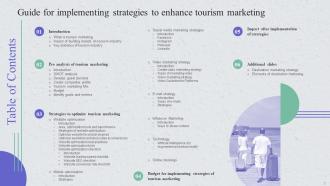
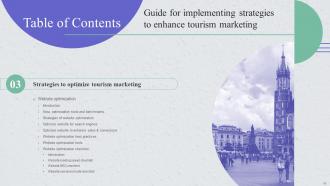
Slide 3: This slide incorporates the Table of Contents.
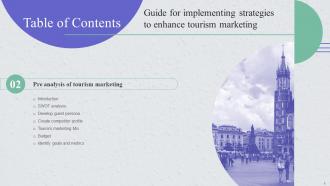
Slide 4: This slide highlights the Title for the Topics to be covered further.
Slide 5: This slide reveals the Introduction to tourism marketing and its benefits.
Slide 6: This slide showcases that influence of building brands on tourism industry.
Slide 7: This slide presents the important facts and figures about tourism marketing globally.
Slide 8: This slide incorporates the Heading for the Contents to be discussed next.
Slide 9: This slide portrays the pre-analysis for developing tourism marketing strategy.
Slide 10: This slide highlights the SWOT analysis of tourism industry to identify marketing opportunities.
Slide 11: This slide showcases the detailed description of an ideal customer.
Slide 12: This slide portrays to develop competitor’s profile to identify potential threats and opportunities.
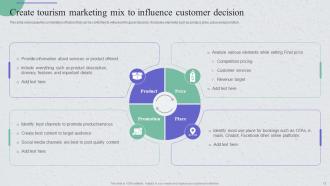
Slide 13: This slide mentions the combination of factors that can be controlled to influence the guest decision.
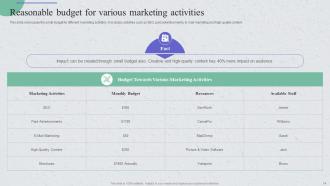
Slide 14: This slide talks about the Reasonable budget for various marketing activities.
Slide 15: This slide deals with Identify goals, metrics and key activities in tourism marketing.
Slide 16: This slide incorporates the Title for the Ideas to be covered in the forth-coming template.
Slide 17: This slide showcases the introduction to website optimization to increase user experience.
Slide 18: This slide presents the website important optimization areas, tools and benchmark.
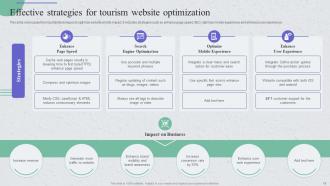
Slide 19: This slide illustrates the Effective strategies for tourism website optimization.
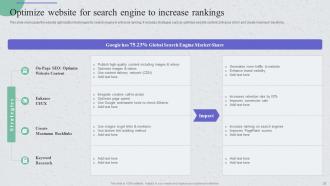
Slide 20: This slide displays the website optimization techniques for search engine to enhance ranking.
Slide 21: This slide reveals the Process to optimize website to increase sales.
Slide 22: This slide exhibits the Website optimization effective best practices.
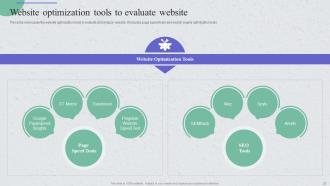
Slide 23: This slide showcases the website optimization tools to evaluate and analyze website.
Slide 24: This slide elucidates the Website optimization checklist to keep track.
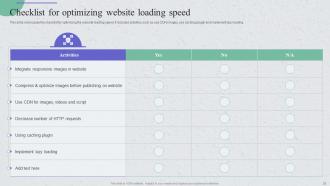
Slide 25: This slide presents the Checklist for optimizing website loading speed.
Slide 26: THis slide depicts the Checklist for optimizing website search engine optimization (SEO).
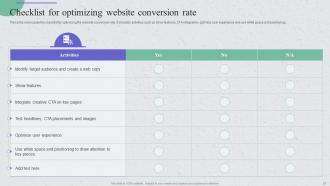
Slide 27: This slide highlights the Checklist for optimizing website conversion rate.
Slide 28: This slide includes the Heading for the Ideas to be discussed next.
Slide 29: This slide showcases the introduction to mobile optimization to enhance conversion rate and its importance.
Slide 30: This slide talks about the Mobile optimization strategies to attract customers.
Slide 31: This slide indicates the Title for the Contents to be covered in the upcoming template.
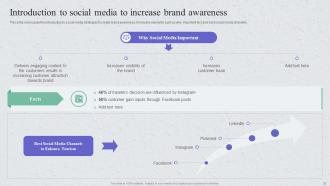
Slide 32: This slide presents the introduction to social media strategies to create brand awareness.
Slide 33: This slide exhibits the Facebook techniques to attract more customers.
Slide 34: This slide reveals the Instagram techniques to attract more customers.
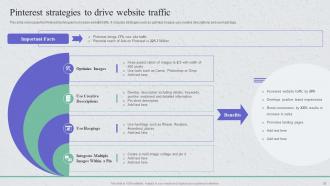
Slide 35: This slide portrays the Pinterest techniques to increase website traffic.
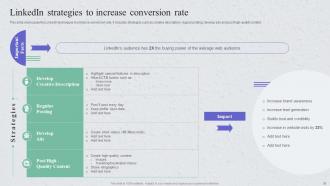
Slide 36: This slide elucidates the LinkedIn techniques to enhance conversion rate.
Slide 37: This slide mentions the Heading for the Topics to be discussed in the following template.
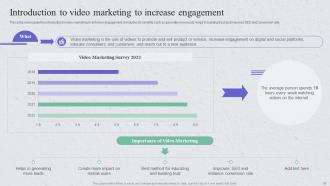
Slide 38: This slide showcases the introduction to video marketing to enhance engagement.
Slide 39: This slide states the steps to create video marketing strategy.
Slide 40: This slide lists the Types of marketing videos to increase customer attention.
Slide 41: This slide talks about the Video marketing strategies to increase brand awareness.
Slide 42: This slide indicates the Video guidelines for social media platform.
Slide 43: This slide states the Title for the Topics to be covered in the following template.
Slide 44: This slide shows the introduction to e-mail strategy to create new customer base and retain old customers.
Slide 45: This slide states the types of e-mails in marketing program.
Slide 46: This slide talks about the E-mail marketing strategies to increases sales.
Slide 47: This slide reveals the Heading for the Contents to be discussed further.
Slide 48: This slide presents the concept of influencer marketing.
Slide 49: This slide showcases the types of methods for influencers to share content among customers.
Slide 50: This slide contains the Title for the Ideas to be covered in the upcoming template.
Slide 51: This slide represents the introduction about AI chatbot.
Slide 52: This slide focuses on Virtual reality marketing to enhance customer attention.
Slide 53: This slide includes the Heading for the Ideas to be discussed in the forth-coming template.
Slide 54: This slide showcases strategies to enhance online bookings.
Slide 55: This slide mentions the Title for the Contents to be covered further.
Slide 56: This slide portrays tourism marketing strategies budget plan.
Slide 57: This slide incorporates the Heading for the Topics to be discussed next.
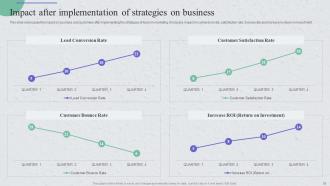
Slide 58: This slide reveals the impact on business and customers after implementing the strategies of tourism marketing.
Slide 59: This slide elucidates the Title for the Topics to be covered further.
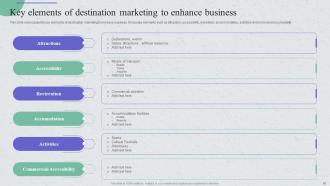
Slide 60: This slide showcases the key elements of destination marketing to increase business.
Slide 61: This slide states the 4 step process to develop destination marketing strategy.
Slide 62: This is the Icons slide containing all the Icons used in the plan.
Slide 63: This slide is used for displaying some Additional information.
Slide 64: This slide represents the company's Vision, Mission, and Goal.
Slide 65: This is the About us slide. State your company-related information here.
Slide 66: This is Our team slide. Mention your team-related information here.
Slide 67: This slide is used for depicting the organization's targets.
Slide 68: This slide contains the Post it notes for reminders and deadlines.
Slide 69: This is the Venn diagram slide.
Slide 70: This is the 30 60 90 days plan slide for effective planning.
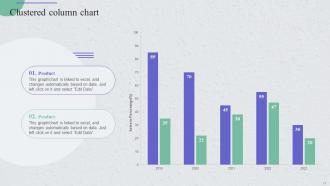
Slide 71: This slide reveals the Clustered column chart.
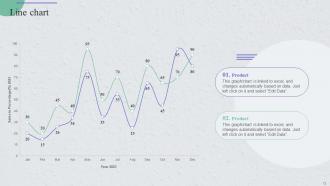
Slide 72: This slide presents the Line chart.
Slide 73: This is the Thank You slide for acknowledgement.
Guide For Implementing Strategies To Enhance Tourism Marketing Powerpoint Presentation Slides MKT CD with all 78 slides:
Use our Guide For Implementing Strategies To Enhance Tourism Marketing Powerpoint Presentation Slides MKT CD to effectively help you save your valuable time. They are readymade to fit into any presentation structure.







































FAQs for Guide For Implementing Strategies To Enhance Tourism Marketing Powerpoint Presentation
Effective digital marketing strategies for tourist destinations include social media campaigns, influencer partnerships, virtual tours, search engine optimization, and targeted content marketing. These approaches enhance destination visibility by showcasing authentic experiences, leveraging user-generated content, and optimizing for local searches, with many tourism boards finding that strategic social media storytelling and influencer collaborations significantly boost visitor engagement and bookings.
Social media influences travelers' destination choices by showcasing authentic experiences through user-generated content, providing real-time reviews and recommendations, and enabling direct engagement with tourism boards and local businesses. Through platforms like Instagram and TikTok, destinations can reach targeted demographics with visual storytelling, ultimately driving bookings and brand awareness, with many tourism boards finding that strategic social campaigns significantly increase visitor inquiries and conversions.
Influencer marketing significantly enhances tourism promotion by building authentic connections, showcasing destinations through compelling visual storytelling, and reaching targeted demographics with trusted recommendations. Travel bloggers, photographers, and lifestyle influencers create immersive content that inspires wanderlust, with many tourism boards finding that influencer partnerships deliver higher engagement rates and bookings than traditional advertising methods.
Personalized marketing campaigns significantly enhance tourist engagement by delivering targeted content, customized recommendations, and tailored experiences based on individual preferences, travel history, and behavioral data. Through advanced analytics and segmentation, tourism businesses create more relevant messaging, increase booking conversions, and build stronger customer loyalty, with many hotels and travel platforms finding that personalized approaches generate substantially higher engagement rates and repeat visits.
**INPUT**: What are some innovative ways to leverage content marketing in tourism? **OUTPUT**: Innovative tourism content marketing includes virtual reality destination previews, user-generated social media campaigns, interactive travel guides, influencer partnerships, and personalized video content based on traveler preferences. These approaches enhance customer engagement by showcasing authentic experiences, building trust through peer recommendations, and creating immersive pre-trip connections, ultimately driving bookings while delivering more targeted marketing ROI. [Word count: 58 words]
Virtual reality experiences enhance travel marketing by enabling immersive destination previews, reducing booking uncertainty, and creating emotional connections before purchase. Hotels, cruise lines, and tourism boards leverage VR to showcase accommodations, attractions, and experiences remotely, ultimately driving higher conversion rates and customer confidence while differentiating themselves in competitive markets.
Sustainable tourism branding holds critical importance as modern travelers increasingly prioritize environmental responsibility, authenticity, and social impact when making travel decisions. Through eco-certifications, community partnerships, and transparent practices, destinations like Costa Rica and New Zealand attract conscious travelers while commanding premium pricing, ultimately delivering enhanced reputation, customer loyalty, and long-term competitive advantage in an increasingly values-driven market.
Data analytics enables tourism businesses to segment audiences by age, income, travel preferences, and booking behaviors, creating highly targeted campaigns for each demographic group. Through predictive modeling and customer journey mapping, hotels and destinations can personalize messaging, optimize channel selection, and time promotions strategically, ultimately delivering higher conversion rates and improved customer experiences across diverse market segments.
Best practices for creating effective travel brochures include high-quality destination photography, clear layout hierarchy, compelling headlines, concise destination descriptions, and strategic use of white space. These design elements work together by capturing attention through stunning visuals, guiding readers through information seamlessly, and inspiring action, with many tourism boards finding that well-designed brochures significantly increase booking inquiries and destination interest.
Local cultural elements can be effectively integrated into marketing strategies through authentic storytelling, community partnerships, cultural festival promotions, traditional craft showcases, and local cuisine highlights. This approach enables tourism businesses to create distinctive brand positioning, enhance visitor experiences through meaningful cultural connections, and build sustainable competitive advantages, with many destinations finding that authentic cultural integration significantly increases visitor engagement and repeat tourism rates.
Online reviews and testimonials significantly influence potential tourists' booking decisions by providing authentic insights into experiences, service quality, accommodations, and local attractions from previous visitors. These peer-generated endorsements build trust and credibility that traditional advertising cannot match, with many hospitality businesses and tour operators finding that positive review management directly correlates with increased bookings and revenue growth.
Partnerships with local businesses enhance tourism marketing by creating authentic experiences, expanding promotional reach, and sharing marketing costs across multiple stakeholders. Hotels collaborating with restaurants, tour operators, and retailers can offer comprehensive packages, cross-promote services, and leverage each other's customer bases, ultimately delivering more compelling visitor experiences while reducing individual marketing expenses.
Tourism websites can optimize SEO through keyword research targeting destination-specific terms, creating location-based landing pages, implementing local SEO strategies, optimizing for mobile users, and developing high-quality content featuring attractions and experiences. These techniques enhance search visibility by improving rankings for travel queries, attracting qualified traffic from potential visitors, and ultimately driving more bookings for hotels, tour operators, and destination marketing organizations.
Email marketing maintains engagement with past travelers through personalized destination updates, exclusive return-visitor discounts, loyalty program communications, and curated travel inspiration content. These targeted campaigns strengthen customer relationships by delivering relevant seasonal promotions, anniversary trip reminders, and destination-specific newsletters, ultimately encouraging repeat bookings and referrals while building long-term brand loyalty.
Mobile marketing serves as the primary touchpoint for reaching travelers during their journey through location-based ads, push notifications, real-time booking apps, social media targeting, and personalized recommendations. These strategies enable tourism businesses to deliver timely offers, seamless booking experiences, and destination guidance directly to travelers' devices, ultimately enhancing customer engagement and driving immediate conversions.
-
Thank you SlideTeam for such an excellent service.
-
A beautiful, professional design paired with high-quality images and content that is sure to impress. It is a must-use PPT template in my opinion.