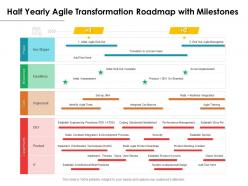
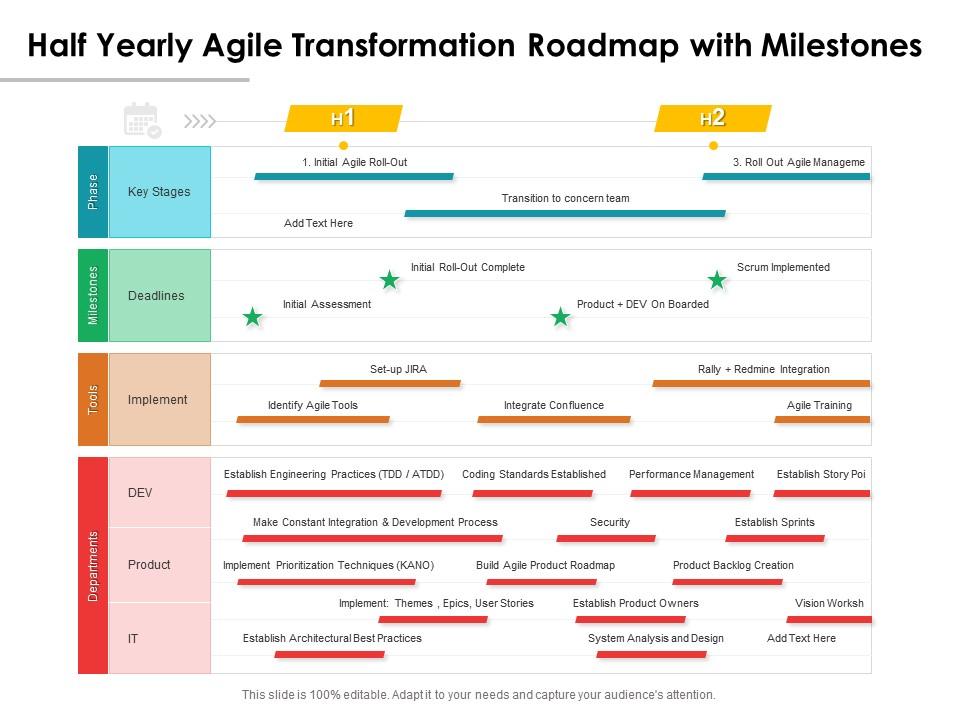
Hoja de ruta de transformación ágil semestral con hitos
Try Before you Buy Download Free Sample Product
Audience
Editable
of Time
Un plan de trabajo cohesivo es esencial para lograr el objetivo deseado. Comunique su visión y establezca un terreno firme frente a su audiencia con nuestro diseño de PowerPoint. Alinee los hitos de su proyecto, los presupuestos, los entregables, los plazos y toda la información necesaria para una presentación dinámica empleando esta hoja de ruta de transformación ágil semestral increíblemente diseñada con hitos. Maximice la eficiencia del equipo y agilice un plan de trabajo de manera eficiente al presentar nuestro tema de PowerPoint de hoja de ruta ya preparado. Puede establecer rápidamente la coordinación entre diferentes actividades en toda la organización y presentar una perspectiva a sus colegas mediante el uso de esta útil herramienta comercial. Codifique con color tareas específicas, priorice y vigile de cerca los plazos con la ayuda de nuestra llamativa plantilla de PowerPoint. Descargue nuestra hoja de ruta de transformación ágil semestral con hitos para sobresalir en la gestión productiva.
Características de estas diapositivas de presentación de PowerPoint:
Presentación de la hoja de ruta de transformación ágil semestral con hitos Diapositiva de PowerPoint que es 100 por ciento editable. Puede cambiar el color, el tamaño de fuente, el tipo de fuente y las formas de este diseño PPT según sus necesidades. Esta plantilla PPT es compatible con Google Slides y está disponible en proporciones de aspecto de 4,3 y 16,9. Esta presentación de PowerPoint lista para usar se puede descargar en varios formatos como PDF, JPG y PNG.
People who downloaded this PowerPoint presentation also viewed the following :
Hoja de ruta de transformación ágil semestral con hitos con las 2 diapositivas:
Ofrezca a su audiencia una experiencia satisfactoria. Encontrarán nuestra hoja de ruta de transformación ágil semestral con hitos elevando.
FAQs for Half yearly agile transformation
Agile transformation roadmaps typically include assessment and readiness evaluation, pilot program implementation, scaled adoption across teams, cultural change management, and continuous improvement cycles. These phases enable organizations to systematically transition from traditional methodologies to Agile practices, with many companies finding that structured phased approaches deliver faster delivery cycles, enhanced collaboration, and ultimately sustainable competitive advantage in increasingly dynamic markets.
Assessing Agile readiness involves evaluating leadership commitment, cultural openness to change, current project management maturity, team collaboration capabilities, and organizational structure flexibility. Through comprehensive readiness assessments, organizations identify potential resistance points, skill gaps, and process dependencies, while financial services and manufacturing companies increasingly find that early assessment enables targeted change management strategies, ultimately delivering smoother transformations and higher adoption rates.
Agile transformation success metrics include velocity, sprint burndown rates, cycle time, defect density, customer satisfaction scores, and employee engagement levels. These measurements enable organizations to track delivery speed, quality improvements, and team morale simultaneously, with many enterprises finding that combining quantitative performance data with qualitative feedback delivers comprehensive insights into transformation effectiveness and competitive advantage.
Leadership supports Agile culture by demonstrating commitment through regular participation in ceremonies, empowering teams with decision-making autonomy, and removing organizational impediments that hinder workflow. Through transparent communication and resource allocation, leaders enable cross-functional collaboration, psychological safety for experimentation, and continuous learning initiatives, ultimately delivering faster adaptation cycles and enhanced team engagement across the organization.
Employee training serves as the foundation of successful Agile transformation, encompassing mindset shifts, framework knowledge, collaborative practices, and continuous learning principles. Through comprehensive training programs, organizations enable teams to embrace iterative workflows, enhance cross-functional collaboration, and deliver customer value more effectively, with many companies finding that well-trained employees accelerate transformation timelines significantly.
Aligning Agile practices with business objectives requires mapping sprint goals to strategic priorities, establishing cross-functional teams around customer value streams, and implementing metrics that track both delivery velocity and business outcomes. Organizations achieve this through regular stakeholder collaboration, adaptive planning cycles, and transparent reporting frameworks, with many finding that iterative delivery accelerates objective achievement while maintaining strategic focus.
Organizations should avoid rushing transformation without proper training, maintaining rigid hierarchical structures, focusing solely on processes while neglecting cultural change, and implementing Agile in isolated teams rather than organization-wide. These pitfalls undermine adoption by creating confusion, resistance, and inconsistent practices, with many companies finding that gradual, well-supported transformation delivers sustainable results.
Cross-functional teams in Agile environments are structured by combining diverse skill sets, establishing clear roles and responsibilities, implementing collaborative workflows, and maintaining consistent communication channels. These teams streamline project delivery by reducing dependencies, accelerating decision-making, and enhancing product quality, with many organizations finding that strategic team composition ultimately delivers faster time-to-market and improved customer experiences.
Essential tools for Agile transformation include project management platforms like Jira and Azure DevOps, collaboration tools such as Slack and Microsoft Teams, CI/CD pipelines, automated testing frameworks, and analytics dashboards. These technologies streamline workflow visibility, enhance cross-functional communication, and accelerate delivery cycles, with many organizations finding that integrated toolchains ultimately deliver faster time-to-market and improved team productivity.
Ensuring stakeholder engagement requires regular communication through town halls, progress dashboards, and feedback sessions, combined with clear role definitions and transparent milestone tracking. Through inclusive planning workshops and cross-functional teams, organizations maintain momentum by demonstrating quick wins, addressing concerns proactively, and celebrating achievements, ultimately building sustained commitment and reducing resistance across all organizational levels.
Overcoming Agile resistance requires comprehensive change management, including leadership buy-in, transparent communication, gradual implementation phases, and continuous training programs. Organizations find success through pilot projects in receptive departments, celebrating early wins, addressing cultural barriers directly, and demonstrating tangible benefits like faster delivery cycles, ultimately building momentum that transforms skeptics into advocates.
Organizations can adapt Agile frameworks by customizing sprint lengths, team structures, ceremonies, and governance processes to match their industry, culture, and operational constraints. Through hybrid approaches combining Scrum, Kanban, or SAFe elements, companies in manufacturing, healthcare, and financial services streamline workflows, enhance cross-functional collaboration, and accelerate delivery timelines while maintaining regulatory compliance.
Continuous improvement is fundamental to Agile transformation roadmaps because it enables organizations to adapt methodologies, refine processes, and enhance team performance based on real-world feedback and changing business requirements. This iterative approach helps companies in manufacturing, financial services, and healthcare identify bottlenecks, streamline workflows, and accelerate delivery cycles, ultimately delivering sustained competitive advantage and organizational agility.
Feedback loops integrate into Agile through daily standups, sprint retrospectives, continuous integration testing, stakeholder reviews, and real-time user feedback collection. These mechanisms enable teams to identify issues early, adapt quickly to changing requirements, and improve product quality iteratively, with many organizations finding that structured feedback cycles reduce development costs while accelerating delivery timelines.
Best practices for scaling Agile across large organizations include establishing clear governance frameworks, implementing standardized processes, investing in comprehensive training programs, creating cross-functional teams, and maintaining consistent communication channels. These approaches streamline coordination by aligning multiple teams around shared objectives, reducing implementation complexity, and ensuring cultural adoption, with many enterprises finding that strategic combination of structured methodology and adaptive practices ultimately delivers improved project velocity and enhanced organizational agility.
No Reviews