


Handling restaurant operations effectively powerpoint presentation slides




Try Before you Buy Download Free Sample Product
 Impress Your
 Audience
 100%
100% Editable
 Save Hours
 of Time


Improve the food and workplace safety standards with efficient handling of restaurant operations using our Handling Restaurant Operations Effectively Powerpoint Presentation Slides. With this improvement PPT slideshow share with your team the current challenges, weekly sales report, competitive analysis of the business along with possible solutions for overcoming it. This cafe management PowerPoint design explains how the stock inventory management, data consolidation, smooth ordering process, negligible employee attrition will help in achieving a smooth management process. Use our snack bar management PowerPoint templates to showcase the increase in sales by upgrading the sale system, point of sale interface, cashier counter interface, kitchen display and pos system. Besides this, also highlight more key areas like inventory management, staff management, food safety management, and marketing management with this upscaling PPT graphic. You can conclude your presentation by exhibiting the impact of the system, cost savings, and projected financial analysis with this service retaining PowerPoint slideshow.
People who downloaded this PowerPoint presentation also viewed the following :
Content of this Powerpoint Presentation
Slide 1: This title slide introduces Handling Restaurant Operations Effectively. Add the name of your company here.
Slide 2: This slide presents the Objectives for Handling Restaurant Operations Effectively.
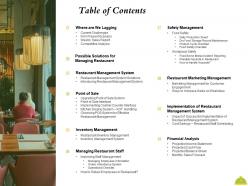
Slide 3: This slide contains the Table of Contents. It includes - Where are We Lagging, Possible Solutions for Managing Restaurant, Restaurant Management System, etc.
Slide 4: This is a table of content slide showing Where are We Lagging.
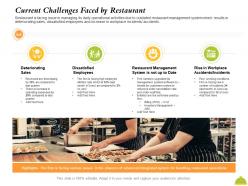
Slide 5: This slide presents the Current Challenges Faced by restaurants. The Restaurant is facing issues in managing its daily operational activities due to an outdated restaurant management system.
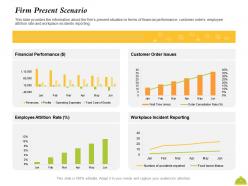
Slide 6: This slide presents the Firm Present Scenario. It provides information about the firm’s present situation in terms of financial performance, customer orders, employee attrition rate, and workplace incident reporting.
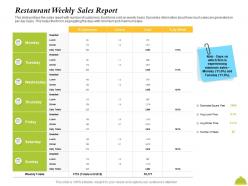
Slide 7: This slide presents the Restaurant Weekly Sales Report. It portrays the sales report with the number of customers, food items sold on a weekly basis.
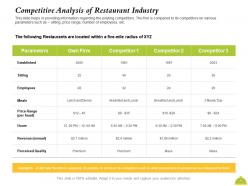
Slide 8: This slide presents the Competitive Analysis of the Restaurant Industry. It helps in providing information regarding the existing competitors.
Slide 9: This is a table of content slide showing the Possible Solutions for Managing Restaurant/
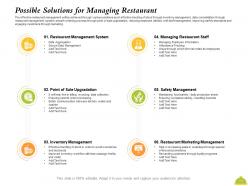
Slide 10: This slide presents the Possible Solutions for Managing Restaurant. Effective restaurant management will be achieved through various solutions.
Slide 11: This is a table of content slide showing the Restaurant Management System.
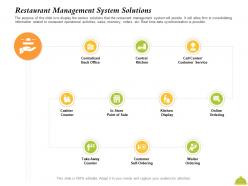
Slide 12: This slide presents the Restaurant Management System Solutions. It displays the various solutions that the restaurant management system will provide.
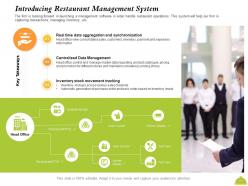
Slide 13: This slide presents the Introducing Restaurant Management System. The firm is looking forward to launching a management software in order to handle restaurant operations.
Slide 14: This is a table of content slide showing the Point of Sale.
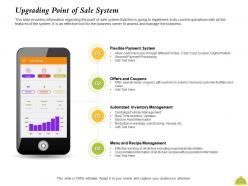
Slide 15: This slide presents the Upgrading Point of Sale System. It provides information regarding the point-of-sale system that the firm is going to implement in its current operations with all the features of the system.
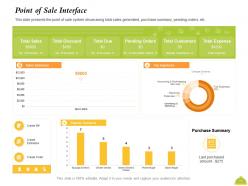
Slide 16: This slide presents the Point-of-Sale Interface. It presents the point-of-sale system showcasing total sales generated, purchases summary, pending orders, etc.
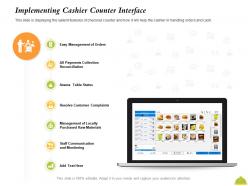
Slide 17: This slide presents the Implementing Cashier Counter Interface. It displays the salient features of the checkout counter and how it will help the cashier in handling orders and cash.
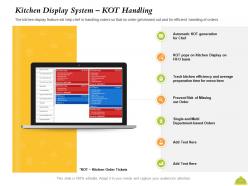
Slide 18: This slide presents the Kitchen Display System – KOT Handling. The kitchen display feature will help the chef in handling orders so that no orders get missed out and for efficient handling of orders.
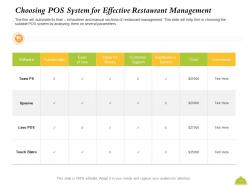
Slide 19: This slide presents the Choosing POS System for Effective Restaurant Management. The firm will automate its time – exhaustive and manual sections of restaurant management.
Slide 20: This is a table of content slide showing Inventory Management.
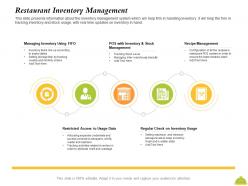
Slide 21: This slide presents the Restaurant Inventory Management. It presents information about the inventory management system which will help the firm in handling inventory.
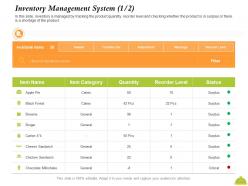
Slide 22: This slide presents the Inventory Management System (1/2). In this slide, inventory is managed by tracking the product quantity, reorder level and checking whether the product is in surplus or there is a shortage of the product.
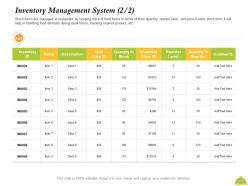
Slide 23: This slide presents the Inventory Management System (2/2). Stock items are managed in restaurants by keeping track of food items in terms of their quantity, reorder level, the unit price of each stock item.
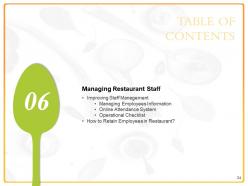
Slide 24: This is a table of content slide showing the Managing Restaurant Staff.
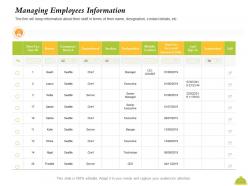
Slide 25: This slide presents the Managing Employees Information. The firm will keep information about their staff in terms of their name, designation, contact details, etc.
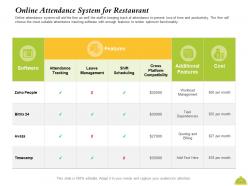
Slide 26: This slide presents the Online Attendance System for Restaurant. An online attendance system will aid the firm as well the staff in keeping track of attendance to prevent loss of time and productivity.
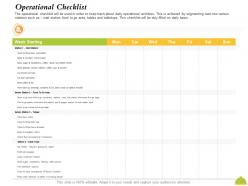
Slide 27: This slide presents the Operational Checklist. It will be used in order to keep track of daily operational activities.
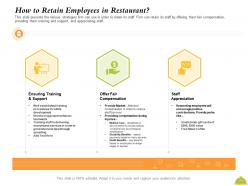
Slide 28: This slide presents How to Retain Employees in Restaurant? It presents the various strategies firm can use in order to retain its staff.
Slide 29: This is a table of content slide showing the Safety Management.
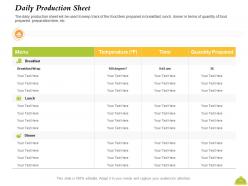
Slide 30: This slide presents the Daily Production Sheet. The daily production sheet will be used to keep track of the food item prepared in terms of quantity of food prepared, preparation time, etc.
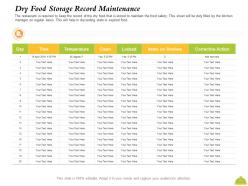
Slide 31: This slide presents the Dry Food Storage Record Maintenance. The restaurant is required to keep a record of the dry food that is stored to maintain food safety.
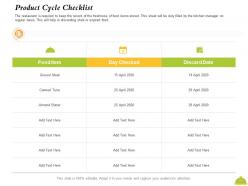
Slide 32: This slide presents the Product Cycle Checklist. The restaurant is required to keep a record of the freshness of food items stored.
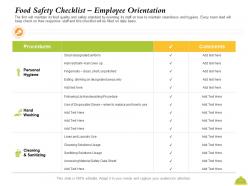
Slide 33: This slide presents the Food Safety Checklist – Employee Orientation. The firm will maintain its food quality and safety standards by orienting its staff on how to maintain cleanliness and hygiene.
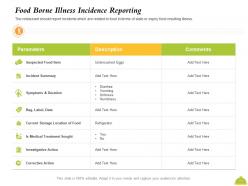
Slide 34: This slide presents the Food Borne Illness Incidence Reporting. The restaurant should report incidents that are related to food in terms of stale or expiry food resulting in illness.
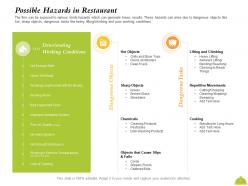
Slide 35: This slide presents the Possible Hazards in restaurants. The firm can be exposed to various kinds of hazards which can generate havoc results.
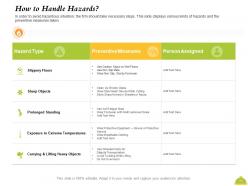
Slide 36: This slide presents How to Handle Hazards? It displays various kinds of hazards and the preventive measures taken.
Slide 37: This is a table of content slide showing Restaurant Marketing Management.
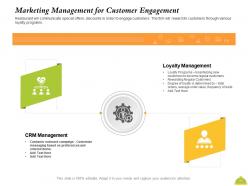
Slide 38: This slide presents the Marketing Management for Customer Engagement. Restaurants will communicate special offers, discounts in order to engage customers.
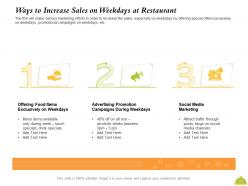
Slide 39: This slide presents the Ways to Increase Sales on Weekdays at Restaurant. The firm will make various marketing efforts in order to increase sales.
Slide 40: This is a table of content slide showing the Implementation of the Restaurant Management System.
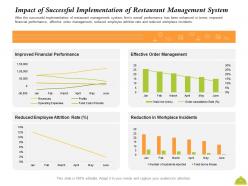
Slide 41: This slide presents the Impact of the Successful Implementation of the Restaurant Management System. After the successful implementation of the restaurant management system, the firm’s overall performance has been enhanced.
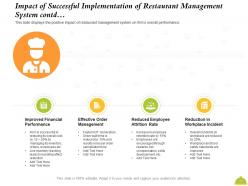
Slide 42: This slide presents the Impact of the Successful Implementation of the Restaurant Management System continued. It displays the positive impact of the restaurant management system on a firm’s overall performance.
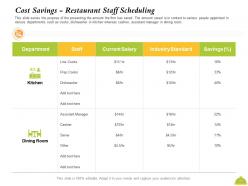
Slide 43: This slide presents the Cost Savings - Restaurant Staff Scheduling. It serves the purpose of presenting the amount the firm has saved.
Slide 44: This is a table of content slide showing the Financial Analysis.
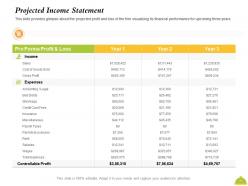
Slide 45: This slide presents the Projected Income Statement. It provides a glimpse of the projected profit and loss of the firm visualizing its financial performance for the upcoming three years.
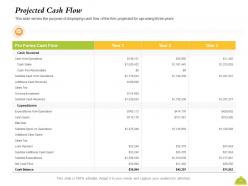
Slide 46: This slide presents the Projected Cash Flow. It serves the purpose of displaying the cash flow of the firm projected for the upcoming three years.
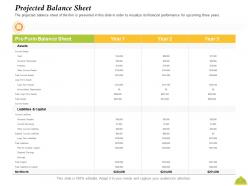
Slide 47: This slide presents the Projected Balance Sheet. The projected balance sheet of the firm is presented in this slide in order to visualize its financial performance for the upcoming three years.
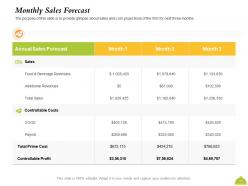
Slide 48: This slide presents the Monthly Sales Forecast. It provides a glimpse of sales and cost projections of the firm for the next three months.
Slide 49: This is the Handling Restaurant Operations Effectively Icons Slide.
Slide 50: This slide introduces the Additional Slides.
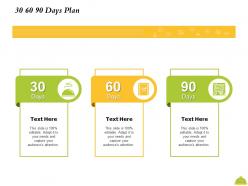
Slide 51: This is a slide with a 30 60 90 Days Plan to set goals for these important intervals.
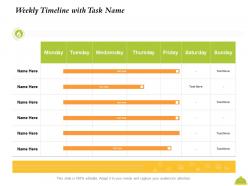
Slide 52: This slide presents the Weekly Timeline with Task Name.
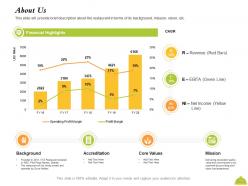
Slide 53: This is the About Us slide.
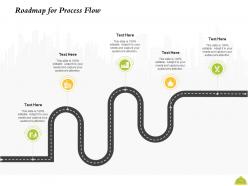
Slide 54: This slide is a Roadmap for Process Flow template to showcase the stages of a project, for example.
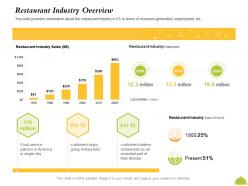
Slide 55: This slide presents the Restaurant Industry Overview. It provides information about the restaurant industry in the US in terms of revenues generated, employment, etc.
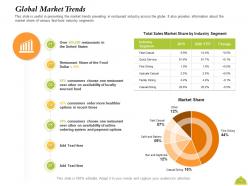
Slide 56: This slide presents the Global Market Trends. It presents the market trends prevailing in the restaurant industry across the globe.
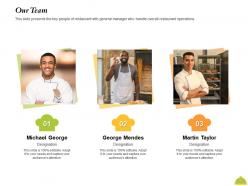
Slide 57: This slide presents the key people of the restaurant with a general manager who handles overall restaurant operations.
Slide 58: This slide contains Post It Notes that can be used to express any brief thoughts or ideas.
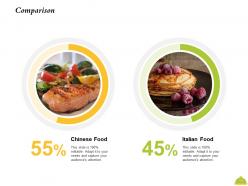
Slide 59: This slide shows the Comparison between Chinese and Italian food.
Slide 60: This slide provides the Mission for the entire company. This includes the vision, the mission, and the goal.
Slide 61: This is a Thank You slide where details such as the address, contact number, email address are added.
Handling restaurant operations effectively powerpoint presentation slides with all 61 slides:
Use our Handling Restaurant Operations Effectively Powerpoint Presentation Slides to effectively help you save your valuable time. They are readymade to fit into any presentation structure.
FAQs for Handling restaurant operations effectively
Honestly, inventory's gonna be your biggest headache - perishables are brutal. Food cost percentage should be your starting point though, get that dialed in first. Staff scheduling and customer service standards matter too, but without solid cost control you're screwed. I'd focus on finding a decent POS system that actually talks to your other software instead of having everything scattered. Training your team with clear protocols is clutch for consistency. Oh, and track your table turnover rates religiously - that's money sitting there. Labor percentages too. It's a lot but tackle food costs first, then build everything else around that foundation.
Dude, tech is a lifesaver for restaurants. POS systems that sync with inventory are clutch - no more guessing what you need to order. Kitchen display screens beat those awful paper tickets every time (trust me on this one). Mobile ordering cuts down lines and gives your staff a break. For scheduling, there's software that actually helps you not overspend on labor costs. Oh, and analytics dashboards show you when you're slammed and what's flying off the menu. Just pick one thing that's driving you crazy right now and start there. Don't go nuts trying to upgrade everything at once.
Dude, you HAVE to invest in proper training - I can't stress this enough. Your staff needs to know food safety, customer service, all that basic stuff. Otherwise you'll deal with constant mistakes and slow service. Trained employees actually stick around longer too, which saves you from that endless cycle of hiring new people (been there, it sucks). I've watched places completely crash because they rushed people onto the floor without proper training. Do solid onboarding first, then regular check-ins. Trust me on this one.
Look, inventory management literally makes or breaks restaurants. Poor tracking means you're hemorrhaging 5-10% of revenue to spoilage and theft - that's insane when margins are already razor thin. Do weekly counts on expensive stuff like meat and booze first. You'll spot where money's disappearing fast. Good rotation prevents waste, plus you won't get stuck panic-ordering at awful prices when you run out of salmon on a Friday night. Also catches servers who think a "6oz" portion means "whatever looks good." Honestly, most owners would rather ignore it, but those weekly protein counts will shock you into action.
Honestly, most service problems boil down to communication issues, so train your staff on active listening and how to handle complaints without getting defensive. Get your kitchen timing down so food's coming out hot - nothing kills the mood like lukewarm pasta. Your team needs to know the menu inside and out too. Clean space obviously matters, but here's the real game changer: let your servers comp a drink or throw in a free app when things go wrong. Don't make them hunt down a manager every time. That autonomy will save you so many bad reviews. Oh, and invest in decent ordering systems - the backend stuff isn't glamorous but it makes everything smoother.
Honestly, the trick is making it part of your daily thing instead of panicking when inspectors show up. Train your staff properly - and I mean actually train them, not just stick them in front of those mind-numbing videos. Document everything: temps, cleaning schedules, any weird incidents. Inspectors eat that stuff up. I'd do weekly self-audits using their own checklist and fix issues before they become real problems. Oh, and keep those records organized because nothing looks worse than scrambling through a messy filing system while someone's watching.
Honestly, start with food and labor costs - those percentages will make or break you. Table turnover and average ticket size matter too, but don't overwhelm yourself tracking everything at once. Wait times are critical because angry customers = brutal reviews, trust me on that one. Daily sales per square foot shows if you're actually using your space well. Oh, and inventory waste - that sneaky stuff drains profit faster than you'd think. Pick maybe 2-3 metrics that match your biggest headaches right now, then add more later.
Your menu layout is actually huge for kitchen efficiency and sales. Group dishes by how they're cooked - if three items all use the fryer, put them together so your cooks aren't scrambling. Smart placement drives profits too. People scan menus in predictable patterns, so stick your high-margin stuff where eyes naturally go. You'd be surprised how much faster service gets when tickets make sense to the kitchen. Oh, and those customers who stare at menus forever? Clear sections fix that. Start with whatever's slowing down your kitchen most - that's usually where the biggest wins are hiding.
Look, you gotta treat suppliers like actual partners, not just order-takers. Share your forecasts with them, give them a heads up when you'll be slammed. Pay on time too - crazy idea, right? Don't put all your eggs in one basket though. Having backup suppliers saved my ass more times than I can count. Monthly check-ins with your top three are gold. Oh, and diversify but still keep those core relationships tight - when they do well, you do well. Start those calls this week.
Dude, prep is everything - seriously can't stress that enough. Get your team cross-trained so servers can run food and hosts can clear tables when it gets crazy. During rush, only feature stuff that cooks fast and keeps your kitchen moving smoothly. Actually use your reservation system and give people realistic wait times. Don't let tables just sit there chatting when you've got a line out the door! Have everyone do a pre-shift huddle so they know what's up. Oh and start tracking your busy times now - you'll thank me later when you can actually staff right.
Dude, your layout can totally make or break everything. Bad kitchen flow means your servers are basically running a marathon just to get food out - I've literally seen places where the design was so terrible that orders would sit dying under heat lamps while staff played human pinball. Fast turnover starts with logical movement patterns. Cramped dining rooms slow down bussing, which kills your table flips. Here's what actually works: watch your team during the dinner rush and map out where they're getting stuck. Those bottlenecks? That's where you start fixing things. Trust me, it's night and day once you get the flow right.
Dude, your POS system is sitting on a goldmine of info you're probably not using. Start tracking peak hours and which menu items actually sell - you'll be shocked at what's just taking up space. I'd focus on labor scheduling first since that's where you can see quick wins. Your historical traffic patterns will show you when you're overstaffed on Tuesdays or whatever. Also look at prep planning - if you know Fridays are always crazy for wings, you can plan better. The data's already there, just gotta dig into it. Pick one thing first though, don't try to analyze everything at once.
Honestly, the money thing hits first - sustainable stuff is expensive upfront. Equipment, eco-friendly packaging, waste systems... it all adds up fast. Finding reliable suppliers for organic/local ingredients can be a pain too, especially if you're not in a big city. Staff training is another headache - some people just hate learning new routines, no matter how you explain it. My advice? Don't try to change everything overnight. Start with something simple like composting or swapping your takeout containers for biodegradable ones. Way less overwhelming that way.
Honestly, it all comes down to respect and actually listening to people. When your team brings up problems, don't just nod and move on - fix the stuff you can fix. Flexible schedules help way more than you'd think. Clear promotion paths are huge too, nobody wants to feel stuck forever. Skip the pizza parties (sorry but it's true) and focus on real recognition and fair treatment instead. Oh, and training that actually builds skills they can use? Game changer. But here's the thing - just ask your current people what would make them stick around. You'll probably get answers you weren't expecting.
Dude, you HAVE to get your teams talking to each other. Kitchen and front of house especially - I've watched places completely implode just from those two not communicating. Like, servers promising the salmon special when kitchen ran out an hour ago? Total disaster. Your whole operation depends on everyone being on the same page about what's happening. Pre-shift meetings are honestly a lifesaver - that's when kitchen can update on what you're low on, management shares info about reservations, and servers can ask questions before the chaos starts. Makes such a difference.
-
Very well designed and informative templates.
-
Easily Editable.
-
Informative presentations that are easily editable.
-
Top Quality presentations that are easily editable.
-
Great quality slides in rapid time.
-
Innovative and Colorful designs.
-
Much better than the original! Thanks for the quick turnaround.
-
Awesome use of colors and designs in product templates.
-
Innovative and Colorful designs.
-
Best Representation of topics, really appreciable.
-
Page:
- You're currently reading page 1
- Page 2
-
