


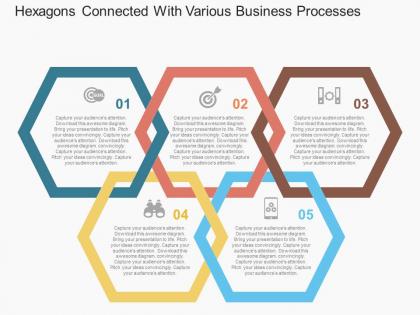
Hexagons connected with various business processes flat powerpoint design





Try Before you Buy Download Free Sample Product
 Impress Your
 Audience
 100%
100% Editable
 Save Hours
 of Time


Select our hexagons connected with various business processes flat PowerPoint template and make magnificent presentation slides. This slide show is helpful for you and your team as you can explain your important business processes and achieve your organizational goals. The PPT graphic can be used to represent all your crucial business functions such as sales and marketing, administration and operations, etc. without which it will be hard to achieve your objectives. With the help of our Presentation design you can perform a series of tasks in sequence and deliver a service, a product or some other organizational goal. Representing data in bullets points is boring and not easily understandable. Add visualization to it by incorporating our business process slide template and create something that everybody can easily understand. There is ample space in the presentation visual so that you can showcase your business process in an interesting way. Also, the content displayed in this illustration can be completely altered by any user at any point of time. So, simply click download and let your thoughts fall into viewer’s mind. Enhance collective competency with our Hexagons Connected With Various Business Processes Flat Powerpoint Design. Facilitate efficient acts of collaboration.
People who downloaded this PowerPoint presentation also viewed the following :
Hexagons connected with various business processes flat powerpoint design with all 4 slides:
Get across clearly to all with our Hexagons Connected With Various Business Processes Flat Powerpoint Design. Connectivity is no constraint.

FAQs for Hexagons connected with various business processes
Hexagonal business processes feature modular design, flexible port-based interfaces, clear separation between core logic and external systems, adaptable integration points, and technology-agnostic architecture. Unlike traditional linear models, these processes enable organizations to seamlessly integrate with multiple databases, APIs, and third-party services while maintaining core business logic integrity, ultimately delivering greater scalability and operational flexibility.
Organizations implement hexagonal business processes by creating modular, interconnected workflows that separate core business logic from external systems, enabling flexible integration with multiple channels, databases, and third-party services. This architectural approach streamlines operations through standardized interfaces, reduces system dependencies, and accelerates response times, with many enterprises finding that hexagonal structures enhance scalability while minimizing disruption during technology upgrades.
Customer feedback serves as a critical external input that drives continuous refinement of hexagonal business processes, influencing product development, service delivery, operational workflows, and strategic decision-making across all organizational layers. Through systematic feedback integration, companies can adapt their hexagonal frameworks dynamically, with many organizations finding that customer insights enable more responsive processes, enhanced user experiences, and ultimately stronger competitive positioning in increasingly customer-centric markets.
Hexagonal business processes facilitate cross-functional collaboration by creating interconnected workflows that break down departmental silos, enable seamless information sharing, and establish clear touchpoints between different organizational functions. Through strategic process mapping and integrated communication channels, organizations streamline decision-making, enhance project coordination, and accelerate problem-solving across teams, ultimately delivering improved operational efficiency and faster project outcomes.
Hexagonal business processes improve strategy-operations alignment by creating modular, interconnected workflows that adapt quickly to strategic shifts, enable cross-functional collaboration, and provide clear visibility into how tactical activities support broader objectives. This architectural approach allows organizations to reconfigure operations seamlessly when strategies evolve, with many enterprises finding that hexagonal structures deliver faster strategic implementation, reduced operational silos, and enhanced agility in competitive markets.
Tools for visualizing hexagonal business processes include process mapping software like Visio and Lucidchart, business process management platforms such as Bizagi and Camunda, and specialized diagramming tools like Draw.io and Creately. These technologies streamline workflow documentation, enhance cross-functional collaboration, and enable real-time process optimization, with many organizations finding that visual mapping significantly improves operational efficiency and strategic decision-making across departments.
Hexagonal business processes enable organizations to respond more effectively to market changes by creating modular, interconnected workflows that can be rapidly reconfigured, isolating core business logic from external dependencies, and facilitating seamless integration of new technologies or partnerships. This architectural approach allows companies in sectors like retail and financial services to pivot quickly during disruptions, adapt customer touchpoints without overhauling entire systems, and maintain operational continuity while competitors struggle with rigid legacy processes.
Common challenges include legacy system integration complexities, employee resistance to new workflows, initial implementation costs, coordinating cross-functional teams, and maintaining data consistency across decoupled services. While these obstacles require strategic planning and change management, organizations increasingly find that the transition delivers enhanced scalability, improved operational flexibility, and stronger competitive positioning in dynamic markets.
Hexagonal business processes contribute to innovation by creating flexible, interconnected workflows that adapt quickly to market changes, integrate diverse data sources, and enable rapid experimentation across departments. This modular approach allows companies to test new ideas efficiently, scale successful innovations seamlessly, and maintain competitive agility, with many organizations finding that hexagonal structures accelerate time-to-market for breakthrough solutions.
Hexagonal business processes can be applied across diverse sectors, from financial services and healthcare to manufacturing and retail, due to their flexible, modular architecture that adapts to different operational requirements. While technology-driven industries like fintech and e-commerce often see faster implementation, traditional sectors increasingly adopt this approach for enhanced agility, streamlined workflows, and improved integration capabilities, ultimately delivering competitive advantage regardless of industry type.
Key metrics for evaluating hexagonal business processes include cycle time reduction, cross-functional collaboration scores, adaptability index, customer satisfaction rates, and integration efficiency measurements. These metrics enable organizations to assess operational flexibility, communication effectiveness, and response speed across interconnected departments, with many companies finding that hexagonal structures deliver enhanced agility, streamlined workflows, and ultimately stronger competitive positioning in dynamic markets.
Hexagonal business processes enhance customer experience by creating flexible, interconnected workflows that adapt quickly to customer needs, integrate seamlessly across departments, and enable personalized service delivery. Through this modular approach, organizations streamline customer interactions, reduce response times, and eliminate service gaps, with many retail and financial services companies finding that hexagonal structures ultimately deliver more consistent, responsive customer experiences and higher satisfaction rates.
Employees need training in systems thinking, cross-functional collaboration, API integration basics, and agile methodologies to navigate interconnected hexagonal processes effectively. Organizations like financial services firms and healthcare systems find that combining technical literacy with process mapping skills, communication training, and data analysis capabilities enables teams to leverage modular workflows, streamline operations, and deliver enhanced customer experiences.
Hexagonal business processes influence decision-making by creating interconnected feedback loops across operational, tactical, and strategic levels, enabling real-time data flow and collaborative input from multiple departments. This architecture streamlines executive decisions through enhanced visibility, accelerates middle management responses to market changes, and empowers frontline teams with comprehensive context, ultimately delivering faster organizational alignment and more informed strategic outcomes.
Successful hexagonal business process implementations include Netflix's microservices architecture, Amazon's modular e-commerce platform, and Spotify's autonomous team structure. These companies demonstrate how hexagonal approaches enable rapid scaling, independent service deployment, and enhanced system flexibility, with many organizations finding that this architectural pattern reduces technical debt while accelerating innovation cycles.
-
Innovative and Colorful designs.
-
Excellent products for quick understanding.