How Gpt Technology Intercepts Medical Imaging How Chatgpt Can Transform Healthcare Chatgpt SS

Rating:
100%
How Gpt Technology Intercepts Medical Imaging How Chatgpt Can Transform Healthcare Chatgpt SS
Slide 1 of 9
Favourites Favourites

Try Before you Buy Download Free Sample Product

Audience Impress Your
Audience
Editable 100%
Editable
Time Save Hours
of Time
The Biggest Sale is ending soon in
0
0
:
0
0
:
0
0
Rating:
100%
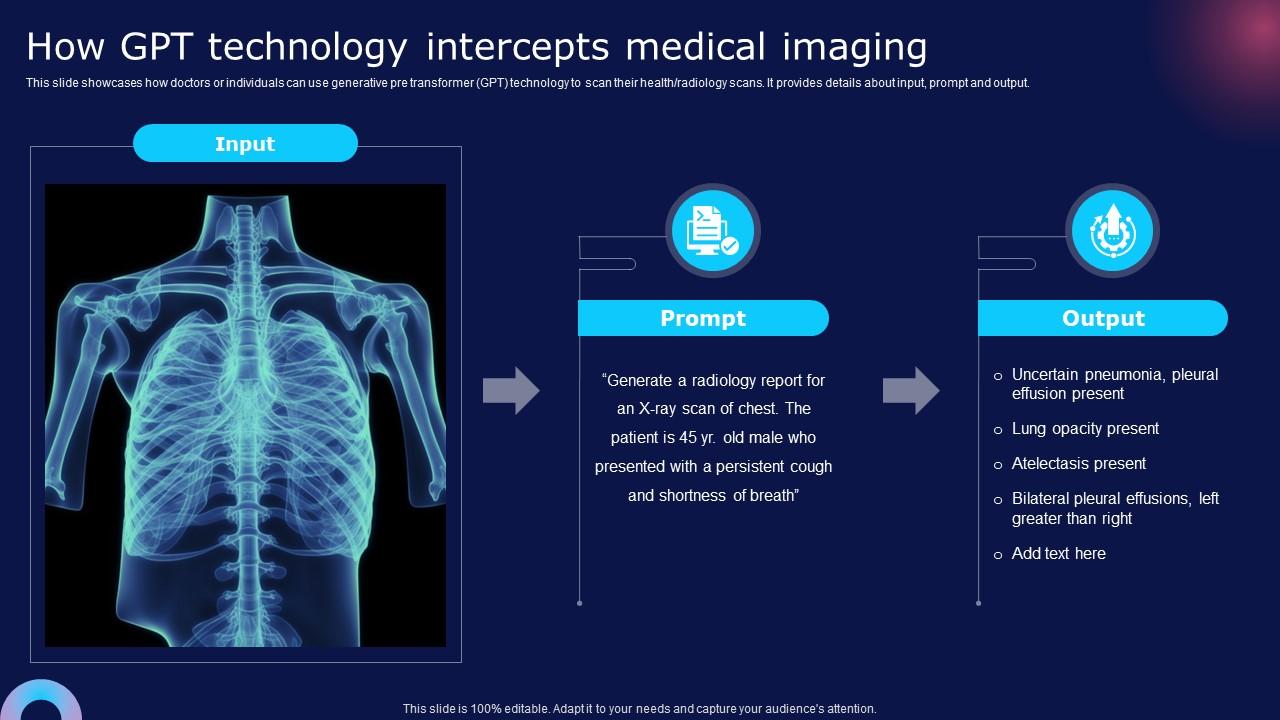
This slide showcases how doctors or individuals can use generative pre transformer GPT technology to scan their health or radiology scans. It provides details about input, prompt and output. Present the topic in a bit more detail with this How Gpt Technology Intercepts Medical Imaging How Chatgpt Can Transform Healthcare Chatgpt SS. Use it as a tool for discussion and navigation on Technology, Atelectasis, Transformer. This template is free to edit as deemed fit for your organization. Therefore download it now.

FAQs for How Gpt Technology Intercepts Medical Imaging How Chatgpt Can Transform

GPT models in medical imaging deliver enhanced diagnostic accuracy, accelerated image analysis, pattern recognition across multiple imaging modalities, automated report generation, and consistent interpretation standards. These capabilities enable radiologists to streamline workflows, reduce diagnostic errors, and handle larger patient volumes more efficiently, while hospitals benefit from faster turnaround times and improved clinical decision-making processes.

GPT assists radiologists by analyzing imaging data and automatically generating structured, standardized reports that highlight key findings, anomalies, and diagnostic impressions. Through natural language processing, radiologists can streamline report creation, reduce documentation time, and enhance diagnostic accuracy, with many hospitals finding that AI-assisted reporting delivers faster patient care and improved clinical workflow efficiency.

GPT models face significant limitations in medical imaging analysis, including lack of native visual processing capabilities, inability to interpret complex spatial relationships, limited training on specialized medical datasets, and challenges with diagnostic accuracy requirements. While these models excel at text analysis, medical imaging demands precise visual pattern recognition, regulatory compliance standards, and integration with existing radiology workflows, ultimately requiring specialized computer vision architectures for reliable clinical applications.

GPT enhances radiology workflows by automating report generation, analyzing imaging patterns, prioritizing urgent cases, integrating patient history, and streamlining interdisciplinary communication. Through natural language processing, hospitals and imaging centers accelerate diagnosis turnaround times, reduce reporting backlogs, and enable radiologists to focus on complex cases, ultimately delivering faster patient care while maintaining diagnostic accuracy in increasingly demanding healthcare environments.

GPT models handle medical imaging uncertainty by providing probabilistic assessments, confidence intervals, and multiple diagnostic possibilities rather than definitive conclusions. These models integrate pattern recognition with clinical context, enabling radiologists to make more informed decisions while acknowledging diagnostic limitations, ultimately enhancing accuracy through collaborative human-AI interpretation and reducing misdiagnosis rates across healthcare institutions.

Natural language processing enables GPT to analyze radiology reports, patient histories, and clinical notes alongside imaging data, creating comprehensive diagnostic insights that combine visual findings with contextual medical information. Through NLP integration, radiologists can generate automated preliminary reports, extract relevant patient symptoms, and correlate imaging findings with clinical presentations, ultimately delivering faster diagnoses and enhanced accuracy in medical decision-making.

Yes, GPT can be adapted to recognize medical image anomalies through multimodal training that combines visual data with clinical text, transfer learning from pre-trained models, and specialized architectures that process both imaging features and contextual information. This approach enables radiologists and healthcare institutions to enhance diagnostic accuracy, reduce interpretation time, and standardize anomaly detection across diverse medical specialties, ultimately delivering faster patient outcomes and competitive advantages in clinical workflows.

Ethical considerations in GPT-driven medical imaging include ensuring diagnostic accuracy, maintaining patient privacy, addressing algorithmic bias, establishing clear accountability frameworks, and preserving physician oversight. These technologies must balance automation with human expertise, especially in hospitals and diagnostic centers, while ensuring equitable healthcare access and transparent decision-making processes that ultimately enhance patient outcomes.

GPT could lead to misinterpretation in medical imaging through inadequate training data, algorithmic bias, or complex cases requiring nuanced clinical judgment and contextual patient history. Over-reliance presents challenges when radiologists defer critical thinking to AI systems, while insufficient validation across diverse populations can compromise diagnostic accuracy, ultimately requiring balanced human-AI collaboration for optimal patient outcomes.

GPT can revolutionize radiology education by providing interactive learning experiences, real-time case analysis assistance, and personalized curriculum development tailored to individual learning patterns. Through AI-powered educational platforms, medical schools and residency programs can enhance diagnostic training, accelerate pattern recognition skills, and deliver comprehensive feedback, ultimately preparing radiologists with advanced analytical capabilities for an increasingly technology-integrated healthcare environment.

GPT models integrate with existing imaging systems through APIs that connect to PACS networks, cloud-based platforms, and diagnostic workstations, enabling seamless data exchange and automated reporting capabilities. Healthcare institutions leverage these integrations to streamline radiologist workflows, accelerate diagnosis turnaround times, and enhance patient care coordination, ultimately delivering improved operational efficiency and diagnostic accuracy.

Multimodal data integration enables GPT applications to combine imaging data with clinical records, lab results, genomic information, and patient histories, creating comprehensive diagnostic profiles that enhance accuracy and clinical decision-making. This strategic combination allows healthcare providers to deliver more personalized treatment plans, reduce diagnostic errors, and streamline workflows, with many medical institutions finding that integrated approaches ultimately improve patient outcomes while optimizing resource allocation.

Patient privacy and data security issues complicate GPT use in medical settings by requiring strict HIPAA compliance, encrypted data transmission, and controlled access protocols. Healthcare organizations must balance AI capabilities with regulatory requirements, implementing secure cloud infrastructures, anonymization processes, and audit trails, while many hospitals finding that robust cybersecurity frameworks ultimately enable both innovation and patient trust.

Current research trends include multimodal integration combining text and imaging data, federated learning for privacy-preserving model training, few-shot learning for rare conditions, explainable AI for clinical transparency, and real-time processing optimization. These advancements enable healthcare institutions to deliver faster diagnostic services, reduce radiologist workloads, and enhance patient outcomes, with many hospitals finding that strategic AI integration significantly improves operational efficiency.

Collaborations between AI developers and healthcare professionals enhance GPT's medical imaging applications by combining technical expertise with clinical knowledge, ensuring regulatory compliance, and addressing real-world diagnostic challenges. These partnerships enable more accurate algorithm training, streamlined integration with existing healthcare systems, and improved patient outcomes, with many hospitals finding that interdisciplinary teams deliver faster, more reliable diagnostic tools while maintaining clinical standards.

Ratings and Reviews

100% of 100
Review Form
Write a review
Most Relevant Reviews
  1. 100%

    by Joe Thomas

    Delighted to see unique and eye-catching PowerPoint designs that are so easy to customize.
  2. 100%

    by Edward Nunez

    Informative design.

2 Item(s)

per page: