

HR Department Strategy For Talent Acquisition




Try Before you Buy Download Free Sample Product
 Impress Your
 Audience
 100%
100% Editable
 Save Hours
 of Time


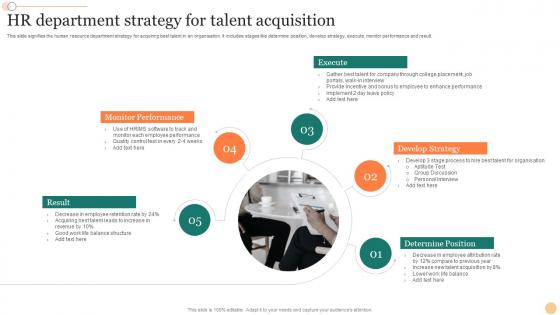
This slide signifies the human resource department strategy for acquiring best talent in an organisation. It includes stages like determine position, develop strategy, execute, monitor performance and result.
People who downloaded this PowerPoint presentation also viewed the following :
HR Department Strategy For Talent Acquisition with all 6 slides:
Use our HR Department Strategy For Talent Acquisition to effectively help you save your valuable time. They are readymade to fit into any presentation structure.





FAQs for HR Department Strategy
A successful talent acquisition strategy includes employer branding, targeted sourcing channels, streamlined selection processes, candidate experience optimization, and data-driven performance metrics. These components work together by attracting quality candidates, accelerating hiring timelines, and reducing recruitment costs, with many organizations finding that strategic integration of these elements delivers competitive talent advantages and enhanced workforce quality.
Organizations effectively assess their talent acquisition needs by conducting comprehensive workforce planning analysis, mapping current skill gaps against strategic objectives, forecasting future role requirements, and aligning hiring timelines with business milestones. This strategic approach enables companies to prioritize critical positions, optimize resource allocation, and build targeted recruitment pipelines, ultimately delivering competitive advantage through proactive talent positioning.
Employer branding significantly enhances talent acquisition by attracting quality candidates, reducing recruitment costs, accelerating hiring timelines, and improving candidate experience throughout the process. Through strategic brand positioning, companies streamline talent pipelines while building competitive advantage, with organizations in technology, healthcare, and financial services finding that strong employer brands ultimately deliver faster placements and higher acceptance rates.
Data analytics enhances talent acquisition decision-making by identifying top-performing sourcing channels, predicting candidate success through skills assessments, and analyzing hiring timeline bottlenecks. Through predictive modeling and performance tracking, organizations streamline recruitment processes, reduce time-to-hire, and improve candidate quality, with many companies finding significantly better hiring outcomes and reduced turnover rates.
Creating a diverse talent pipeline involves expanding recruitment channels, partnering with diverse organizations, implementing blind resume screening, establishing mentorship programs, and setting measurable diversity goals. These practices streamline hiring by reducing unconscious bias, accessing broader talent pools, and enhancing company culture, with many organizations finding that diverse teams deliver improved innovation, better decision-making, and stronger financial performance in increasingly competitive markets.
Companies leverage social media to attract top talent by showcasing company culture, sharing employee testimonials, posting behind-the-scenes content, highlighting career development opportunities, and actively engaging with industry professionals on platforms like LinkedIn, Twitter, and Instagram. Through strategic social media presence, organizations enhance their employer brand, reach passive candidates more effectively, and demonstrate workplace authenticity, ultimately delivering competitive recruitment advantages and attracting higher-quality applicants.
Strategies to reduce time-to-hire include streamlined interview processes, pre-screening assessments, automated candidate sourcing, structured evaluation criteria, and collaborative hiring workflows. These approaches enhance recruitment efficiency by eliminating bottlenecks, standardizing decisions, and leveraging technology for faster candidate identification, with many organizations finding that strategic automation ultimately delivers both speed and quality while maintaining rigorous selection standards.
Key metrics include time-to-hire, cost-per-hire, quality of hire scores, candidate satisfaction ratings, and retention rates of new hires. These measurements enable organizations to streamline recruitment workflows, optimize resource allocation, and enhance candidate experiences, with many companies finding that comprehensive analytics ultimately deliver faster hiring cycles and improved talent quality.
Modern talent acquisition strategies should integrate AI-powered candidate screening, applicant tracking systems, video interviewing platforms, social media recruiting tools, and predictive analytics software. These technologies streamline recruitment by automating initial screenings, enhancing candidate experiences, and enabling data-driven hiring decisions, with many organizations finding that strategic integration reduces time-to-hire while improving candidate quality and retention rates.
Talent acquisition teams can collaborate with hiring managers by establishing clear role requirements, implementing structured interview processes, creating shared evaluation criteria, and maintaining regular communication touchpoints throughout recruitment cycles. Through collaborative hiring platforms and standardized feedback mechanisms, organizations streamline decision-making, reduce time-to-hire, and enhance candidate experiences, with many companies finding that structured partnership approaches ultimately deliver faster placements and improved hire quality.
Remote work expands talent acquisition strategies by removing geographical constraints, enabling access to global talent pools, and requiring digital-first recruitment processes. Organizations increasingly leverage virtual interviews, remote onboarding systems, and digital collaboration assessments, while many companies find that competitive compensation packages now emphasize flexibility over location premiums, ultimately delivering broader candidate diversity and reduced operational costs.
Organizations can create positive candidate experiences through transparent communication, streamlined application processes, timely feedback, respectful interviews, and clear timeline expectations throughout each hiring stage. Companies like Google and Salesforce enhance their employer brand by providing personalized updates, comprehensive onboarding materials, and constructive feedback even to unsuccessful candidates, ultimately attracting top talent while building lasting professional relationships.
Employee referral programs serve as cost-effective talent acquisition channels that leverage existing employees' networks to identify qualified candidates, reduce hiring costs, accelerate recruitment timelines, and improve cultural fit assessments. These programs deliver significant value by generating higher retention rates, faster onboarding processes, and enhanced employee engagement, with many organizations finding that referred candidates often outperform traditional hires while strengthening workplace relationships.
Organizations can tailor talent acquisition strategies for Gen Z by emphasizing digital-first recruitment, authentic company values, career development opportunities, and flexible work arrangements. Through social media recruiting, transparent communication about purpose-driven missions, and streamlined mobile-optimized application processes, companies across sectors like tech, healthcare, and retail are attracting younger talent while enhancing their overall recruitment efficiency and employer brand competitiveness.
Common pitfalls in talent acquisition include unclear job descriptions, lengthy hiring processes, poor candidate communication, inadequate employer branding, and relying solely on traditional recruiting channels. These challenges can be avoided by streamlining interview workflows, enhancing candidate experience through regular updates, leveraging social media and employee referrals, and defining role requirements clearly, with many organizations finding that strategic recruitment approaches ultimately deliver faster hiring cycles and higher-quality talent retention.
-
Very well designed and informative templates.
-
Helpful product design for delivering presentation.