

Hyperautomation Technology Transforming Business Processes IT Powerpoint Presentation Slides





Try Before you Buy Download Free Sample Product
 Impress Your
 Audience
 100%
100% Editable
 Save Hours
 of Time


Grab our Hyperautomation Technology Transforming Business Processes IT template. It provides an insightful overview of hyperautomation technology, encompassing its introduction, benefits, etc. Additionally, our Hyperautomation Introduction deck explores why businesses adopt hyperautomation, compares it to traditional automation, and offers an end-to-end perspective based on ISGs research. Our Hyperautomation Services PPT identifies the specific components that require these tools and showcases the top hyperautomation software available. It offers a helpful checklist, steps to develop an automation plan and platform, implementation guidelines, a framework, and solutions to common challenges during hyperautomation implementation. Furthermore, our Hyperautomation Tools PPT explores real-life applications of hyperautomation across different sectors like healthcare, banking and finance, retail, supply chain, and business operations. By examining these applications, you will gain a deeper understanding of how hyperautomation can revolutionize processes and workflows in various industries. Additionally, our Hyperautomation Technology template caters to essential considerations, including cost analysis, implementation timeline, a roadmap for successful hyperautomation implementation, and a performance tracking dashboard to monitor progress and outcomes. Finally, it outlines the significant impact that hyperautomation can have on businesses and presents a compelling case study to illustrate its successful implementation. Get instant access.
People who downloaded this PowerPoint presentation also viewed the following :
Content of this Powerpoint Presentation
Slide 1: This slide introduces Hyperautomation Technology Transforming Business Processes (IT). Commence by stating Your Company Name.
Slide 2: This slide depicts the Agenda of the presentation.
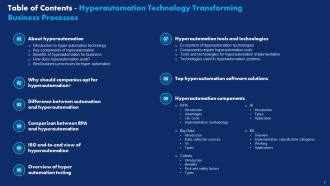
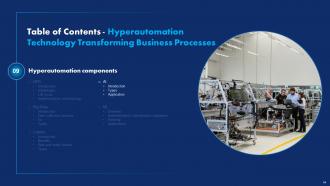
Slide 3: This slide includes the Table of Contents.
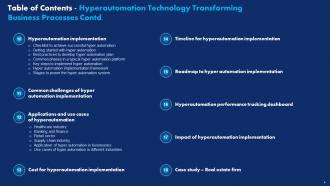
Slide 4: This slide further continues the Table of Contents.
Slide 5: This slide states the Title for the Topics to be discussed further.
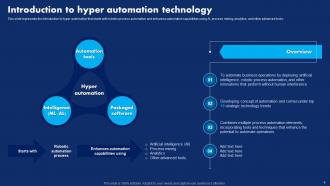
Slide 6: This slide represents the Introduction to hyper automation technology.
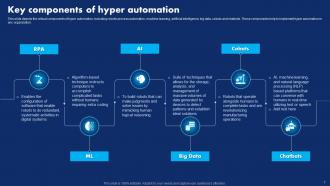
Slide 7: This slide depicts the critical components of hyper automation.
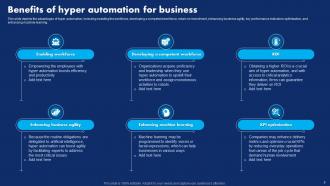
Slide 8: This slide exhibits the Benefits of hyper automation for business.
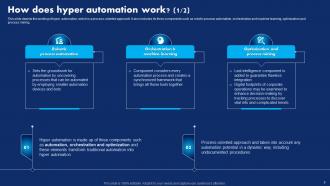
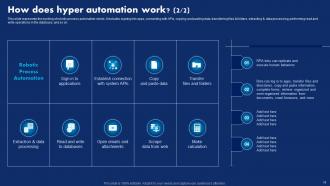
Slide 9: This slide portrays the working of hyper automation.
Slide 10: This slide continues the working of robotic process automation robots.
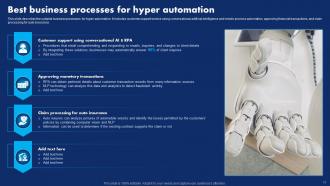
Slide 11: This slide describes the suitable business processes for hyper-automation.
Slide 12: This slide includes the Heading for the Contents to be covered next.
Slide 13: This slide outlines why businesses should invest in hyper-automation.
Slide 14: This slide depicts the Title for the Ideas to be discussed further.
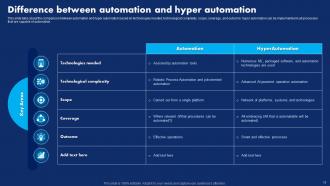
Slide 15: This slide states the Difference between automation and hyper automation.
Slide 16: This slide includes the Heading for the Ideas to be covered in the upocming template.
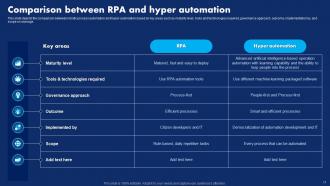
Slide 17: This slide shows the Comparison between RPA and hyper automation.
Slide 18: This slide indicates the Title for the Contents to be discussed next.
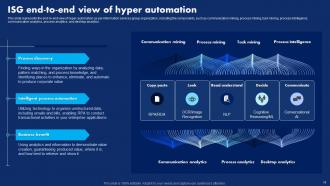
Slide 19: This slide represents the end-to-end view of hyper-automation as per information services group organization.
Slide 20: This slide contains the Heading for the Topics to be covered in the upcoming template.
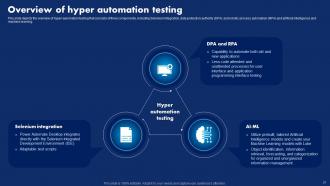
Slide 21: This slide depicts the overview of hyper-automation testing that consists of three components.
Slide 22: This slide reveals the Title for the Topics to be covered in the upcoming template.
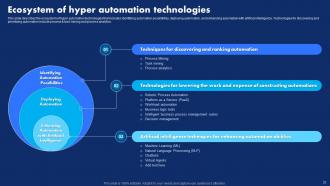
Slide 23: This slide describes the ecosystem of hyper automation technologies.
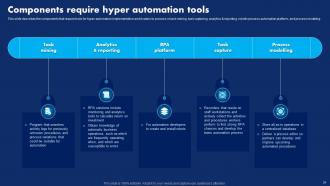
Slide 24: This slide depicts the Components require hyper automation tools.
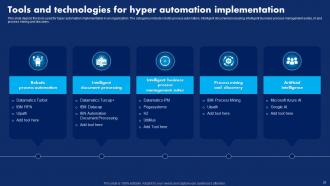
Slide 25: This slide includes the Tools and technologies for hyper automation implementation.
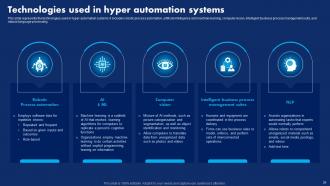
Slide 26: This slide represents the technologies used in hyper-automation systems.
Slide 27: This slide portrays the Heading for the Contents to be discussed further.
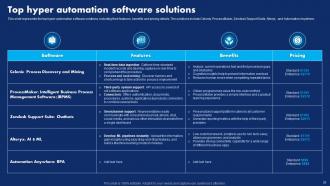
Slide 28: This slide presents the top hyper-automation software solutions, including their features, benefits and pricing details.
Slide 29: This slide highlights the Title for the Ideas to be covered next.
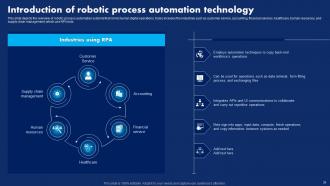
Slide 30: This slide depicts the overview of robotic process automation systems that mimic human digital operations.
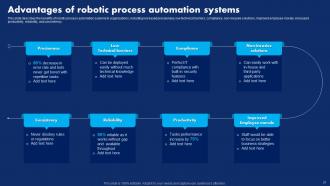
Slide 31: This slide describes the benefits of robotic process automation systems to organizations.
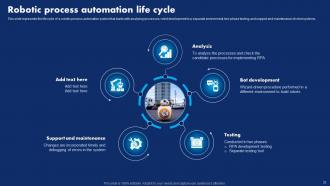
Slide 32: This slide portrays the Robotic process automation life cycle.
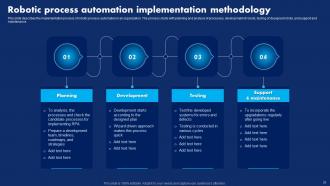
Slide 33: This slide shows the implementation process of robotic process automation in an organization.
Slide 34: This slide presents the Heading for the Ideas to be discussed further.
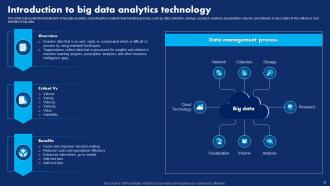
Slide 35: This slide displays the Introduction to big data analytics technology.
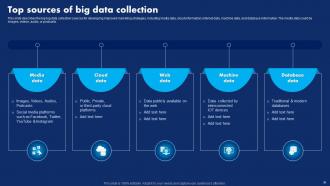
Slide 36: This slide describes the top big data collection sources.
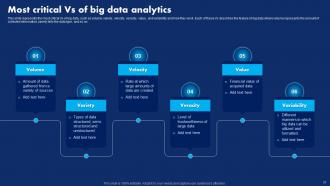
Slide 37: This slide represents the most critical Vs of big data.
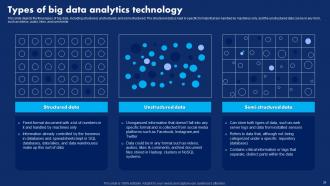
Slide 38: This slide states the Types of big data analytics technology.
Slide 39: This slide contains the Title for the Contents to be covered in the next template.
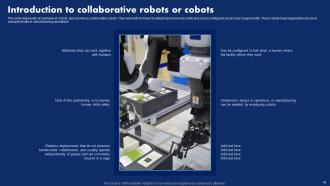
Slide 40: This slide reveals the Introduction to collaborative robots or cobots.
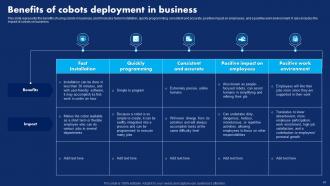
Slide 41: This slide exhibits the Benefits of cobots deployment in business.
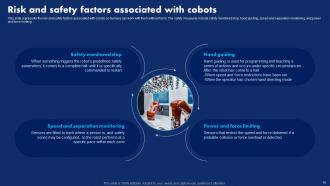
Slide 42: This slide represents the risk and safety factors associated with cobots so humans can work with them without harm.
Slide 43: This slide states the Types of collaborative robots for human assistance.
Slide 44: This slide portrays the Heading for the Topics to be discussed further.
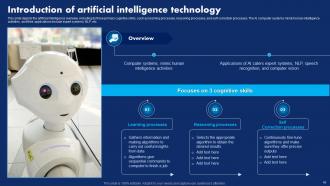
Slide 45: This slide reveals the Introduction of artificial intelligence technology.
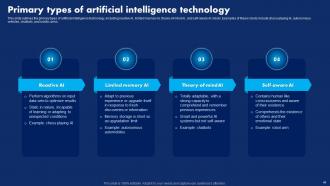
Slide 46: This slide outlines the primary types of artificial intelligence technology.
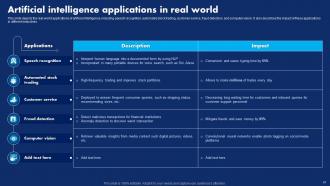
Slide 47: This slide depicts the real-world applications of artificial intelligence.
Slide 48: This slide presents the Title for the Topics to be covered next.
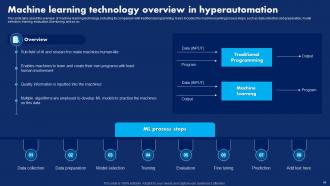
Slide 49: This slide talks about the overview of machine learning technology, including its comparison with traditional programming.
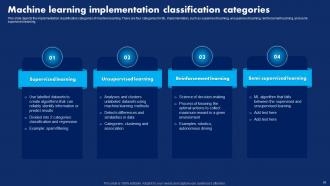
Slide 50: This slide displays the implementation classification categories of machine learning.
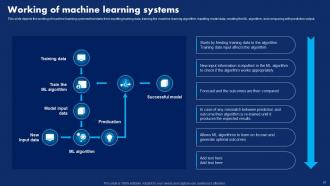
Slide 51: This slide illustrates the Working of machine learning systems.
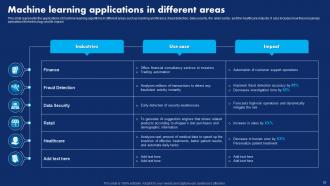
Slide 52: This slide represents the applications of machine learning algorithms in different areas.
Slide 53: This slide indicates the Heading for the Contents to be discussed further.
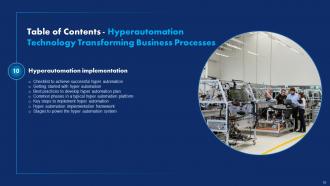
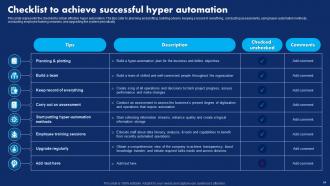
Slide 54: This slide represents the checklist to obtain effective hyper automation.
Slide 55: This slide talks about Getting started with hyper automation.
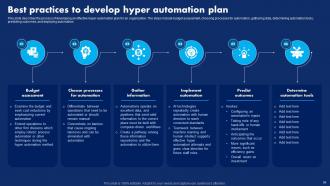
Slide 56: This slide describes the process of developing an effective hyper-automation plan for an organization.
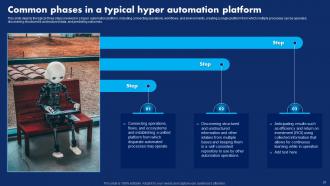
Slide 57: This slide depicts the typical three steps involved in a hyper automation platform.
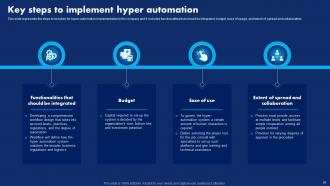
Slide 58: This slide states the Key steps to implement hyper automation.
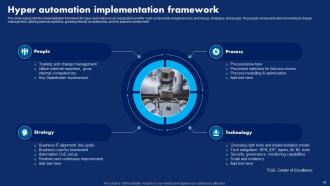
Slide 59: This slide reveals the Hyper automation implementation framework.
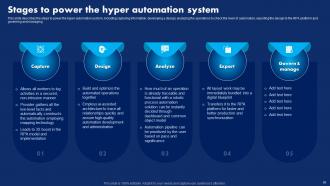
Slide 60: This slide describes the steps to power the hyper-automation system.
Slide 61: This slide presents the Title for the Ideas to be covered next.
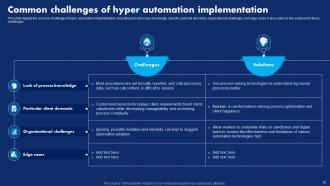
Slide 62: This slide reveals the Common challenges of hyper automation implementation.
Slide 63: This slide indicates the Heading for the Ideas to be discussed further.
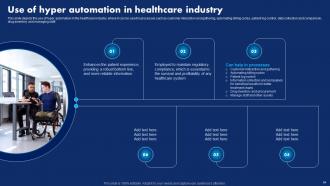
Slide 64: This slide depicts the use of hyper automation in the healthcare industry.
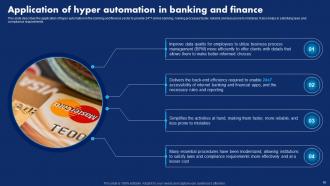
Slide 65: This slide describes the application of hyper automation in the banking and finance sector.
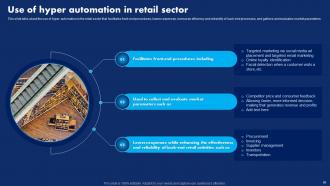
Slide 66: This slide talks about the use of hyper automation in the retail sector.
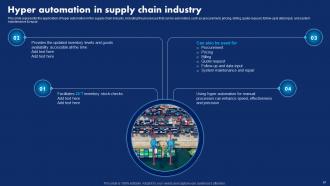
Slide 67: This slide delas with the Hyper automation in supply chain industry.
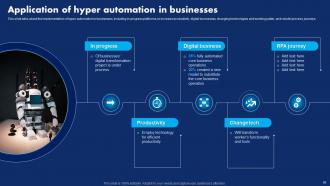
Slide 68: This slide mentions about the Application of hyper automation in businesses.
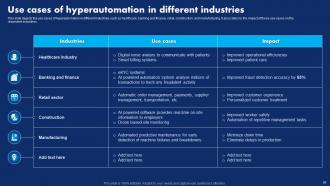
Slide 69: This slide depicts the use cases of hyperautomation in different industries.
Slide 70: This slide contains the Title for the Contents to be covered next.
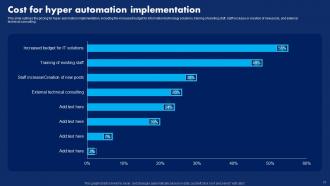
Slide 71: This slide outlines the pricing for hyper-automation implementation.
Slide 72: This slide exhibits the Heading for the Topics to be discussed further.
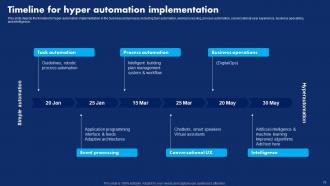
Slide 73: This slide depicts the timeline for hyper-automation implementation in the business and process.
Slide 74: This slide portrays the Title for the Topics to be covered in the upcoming template.
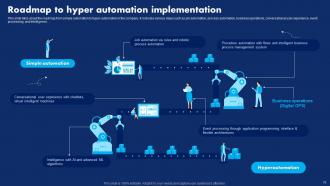
Slide 75: This slide talks about the roadmap from simple automation to hyper-automation in the company.
Slide 76: This slide represents the Heading for the Contents to be further discussed.
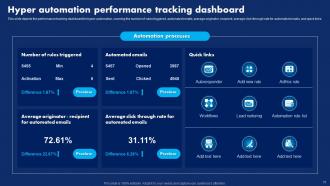
Slide 77: This slide depicts the performance tracking dashboard for hyper-automation.
Slide 78: This slide displays the Title for the Ideas to be covered in the upcoming template.
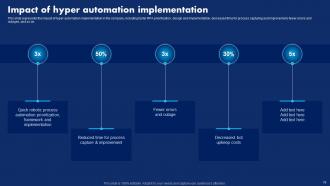
Slide 79: This slide presents the impact of hyper-automation implementation in the company.
Slide 80: This slide includes the Heading for the Ideas to be discussed further.
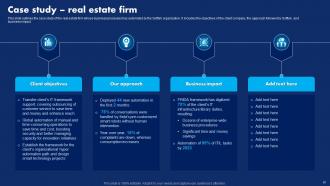
Slide 81: This slide outlines the case study of the real estate firm whose business processes has automated by the Softtek organization.
Slide 82: This is the Icons slide containing all the Icons used in the plan.
Slide 83: This slide is used for depicting some Additional information.
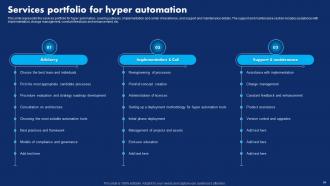
Slide 84: This slide shows the Services portfolio for hyper automation.
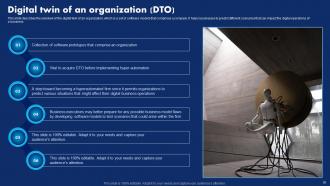
Slide 85: This slide describes the overview of the digital twin of an organization.
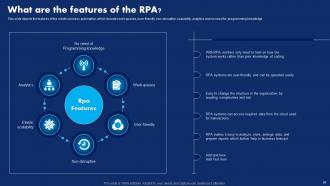
Slide 86: This slide depicts the features of the robotic process automation.
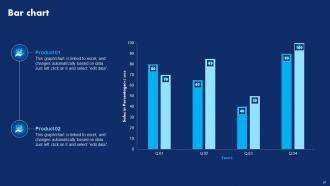
Slide 87: This slide portrays the Bar chart.
Slide 88: This slide contains the Post it notes for reminders and deadlines.
Slide 89: This is the Puzzle slide with related imagery.
Slide 90: This is the Idea generation slide for encouraging fresh ideas.
Slide 91: This slide displays the company's Roadmap.
Slide 92: This is the 30-60-90 days plan slide for effective planning.
Slide 93: This is the Thank You slide for acknowledgement.
Hyperautomation Technology Transforming Business Processes IT Powerpoint Presentation Slides with all 98 slides:
Use our Hyperautomation Technology Transforming Business Processes IT Powerpoint Presentation Slides to effectively help you save your valuable time. They are readymade to fit into any presentation structure.












FAQs for Hyperautomation Technology Transforming Business Processes IT
Key technologies driving hyperautomation include artificial intelligence, machine learning, robotic process automation, natural language processing, and intelligent document processing. These technologies work synergistically by automating complex workflows, enhancing decision-making capabilities, and streamlining operations across industries, with many organizations finding that this strategic combination delivers significant operational efficiency and competitive advantage.
Hyperautomation differs from traditional automation by combining multiple technologies like AI, machine learning, RPA, and process mining to automate entire workflows, not just individual tasks. While traditional automation handles repetitive, rule-based processes, hyperautomation intelligently adapts to complex scenarios, enabling organizations to achieve end-to-end digital transformation and significantly greater operational efficiency.
Healthcare, financial services, manufacturing, retail, and telecommunications are experiencing the most significant hyperautomation benefits through streamlined operations and enhanced customer experiences. These industries leverage intelligent process automation for claims processing, patient care workflows, supply chain optimization, and fraud detection, ultimately delivering faster services, reduced operational costs, and improved competitive positioning in increasingly digital markets.
Organizations can assess hyperautomation readiness by evaluating their current digital infrastructure, data quality, process documentation, and workforce capabilities, while analyzing existing automation maturity and integration complexity. Through comprehensive readiness assessments, companies identify automation opportunities, skill gaps, and technology requirements, with many finding that strategic pilot programs in areas like finance or customer service deliver measurable ROI insights before broader implementation.
Artificial intelligence serves as the cognitive engine of hyperautomation, enabling intelligent decision-making, pattern recognition, predictive analytics, and adaptive learning across automated processes. Through machine learning and natural language processing, AI empowers systems to handle complex exceptions, optimize workflows dynamically, and continuously improve performance, ultimately delivering more sophisticated automation capabilities than traditional rule-based approaches.
Businesses face challenges including legacy system compatibility, employee resistance to change, complex integration requirements, skills gaps in automation technologies, and substantial upfront investment costs. While these obstacles can slow initial implementation, organizations increasingly find that strategic phasing, comprehensive training programs, and partnering with automation experts ultimately delivers streamlined operations, reduced costs, and significant competitive advantage across industries.
Hyperautomation transforms workforce dynamics by automating routine tasks, enabling employees to focus on strategic initiatives, creative problem-solving, and customer relationship management. This shift creates new roles in automation governance, data analysis, and human-AI collaboration, while requiring upskilling programs, ultimately delivering enhanced job satisfaction and competitive advantage for organizations embracing workforce evolution.
Hyperautomation significantly enhances customer experiences by streamlining service delivery, reducing response times, and enabling personalized interactions through integrated AI, machine learning, and process automation. Banks leverage hyperautomation for instant loan approvals, while retailers automate inventory management and customer support, ultimately delivering faster services, 24/7 availability, and seamless omnichannel experiences that boost satisfaction.
Best practices for selecting hyperautomation tools include assessing integration capabilities, scalability potential, user-friendliness, vendor support quality, and total cost of ownership. Organizations should evaluate platforms based on their existing technology stack, compliance requirements, and specific automation objectives, with many enterprises finding that pilot programs and proof-of-concept implementations help validate tool effectiveness before full deployment.
Hyperautomation contributes to cost savings by eliminating manual processes, reducing operational overhead, and minimizing human error across workflows. Through strategic combination of AI, RPA, and machine learning, organizations streamline repetitive tasks, accelerate decision-making, and optimize resource allocation, with many enterprises finding 30-50% efficiency improvements in administrative functions.
Hyperautomation presents risks including job displacement, algorithmic bias, data security vulnerabilities, over-reliance on automated systems, and reduced human oversight in critical decisions. While these challenges require careful management, organizations implementing hyperautomation can mitigate risks through ethical AI frameworks, employee reskilling programs, and maintaining human oversight, ultimately delivering competitive advantage when balanced responsibly.
Businesses measure hyperautomation success through key performance indicators including process completion times, error reduction rates, cost savings, employee productivity gains, and customer satisfaction scores. Financial services and manufacturing companies track metrics like transaction processing speed, compliance accuracy, and resource optimization, with many organizations finding that comprehensive dashboards ultimately deliver measurable ROI and competitive advantage.
Future trends shaping hyperautomation include advanced AI/ML algorithms, edge computing, quantum computing, natural language processing, and enhanced cybersecurity frameworks. These technologies streamline decision-making, enable real-time processing, and deliver seamless integration across industries, with many organizations finding that strategic combinations ultimately enhance operational efficiency and competitive advantage.
Organizations ensure compliance and governance in hyperautomation through centralized oversight frameworks, automated audit trails, role-based access controls, and real-time monitoring systems that track all process modifications. These governance mechanisms enable financial services firms, healthcare institutions, and manufacturing companies to maintain regulatory compliance while scaling automation, ultimately delivering transparent operations and reduced compliance risks across increasingly complex automated workflows.
Companies can foster hyperautomation adoption through comprehensive training programs, cross-functional collaboration initiatives, change management frameworks, leadership advocacy, and continuous communication about benefits. By involving employees in automation planning, providing upskilling opportunities, and celebrating early wins, organizations create psychological safety around technological change, ultimately building workforce confidence and reducing resistance to digital transformation initiatives.
-
What an exhaustive collection of templates you guys have there in slideteam. Impressive!!!
-
“Excellent information with easy access.”