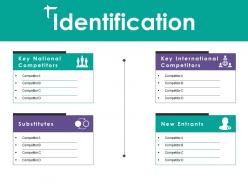
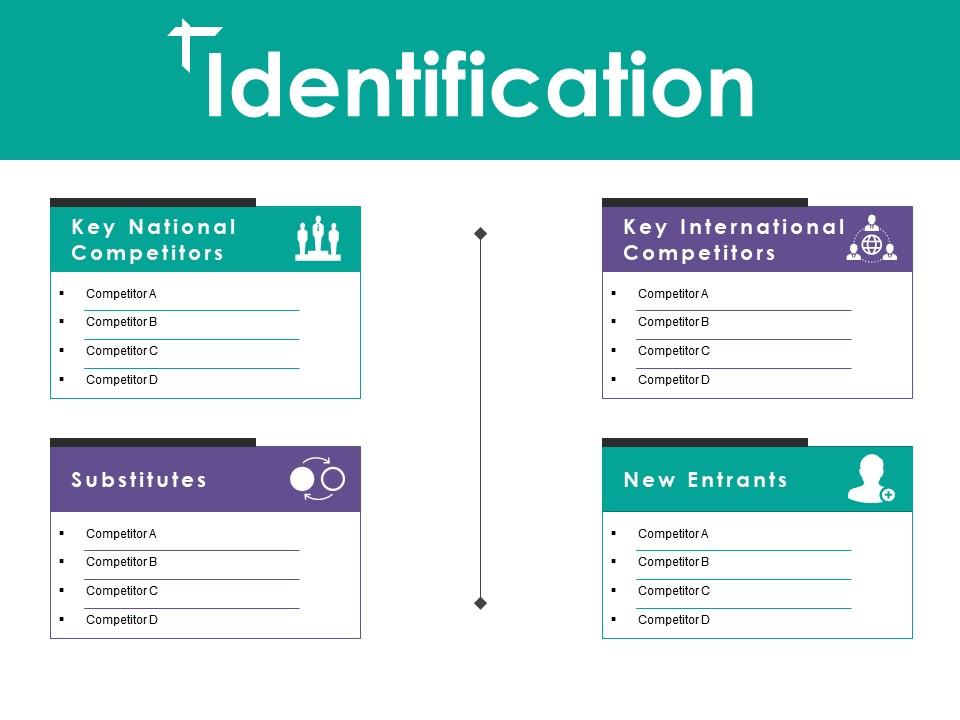
Identification ppt templates
Try Before you Buy Download Free Sample Product
Audience
Editable
of Time
Your exotic thoughts need a base. Our Identification Ppt Templates will welcome them in warmly.
People who downloaded this PowerPoint presentation also viewed the following :
Identification ppt templates with all 5 slides:
Our Identification Ppt Templates believe in a clutter free approach. Their excellent graphics are a great example.
FAQs for
Effective target audience identification criteria include demographic analysis, psychographic profiling, professional roles, decision-making authority, and specific pain points or needs. These factors enable presenters to tailor content, messaging, and visual approaches strategically, with many organizations finding that detailed audience research ultimately delivers higher engagement rates, more compelling narratives, and significantly improved presentation outcomes.
Visual elements enhance key message identification through strategic use of color coding, typography hierarchy, icons, infographics, and whitespace manipulation. These design techniques streamline audience comprehension by creating clear focal points, reducing cognitive load, and establishing visual pathways, with many presenters finding that strategic visual emphasis delivers faster message retention and more impactful audience engagement.
Branding serves as a visual and strategic anchor during presentations, establishing immediate credibility through consistent logos, color schemes, typography, and messaging that reinforce company identity. This strategic combination helps audiences quickly recognize and connect with the presenter's organization, while professional branding elements enhance trust, memorability, and competitive differentiation, ultimately delivering stronger audience engagement and lasting brand recall.
Presenters can effectively identify audience concerns through pre-presentation surveys, observing body language during delivery, encouraging questions, and conducting real-time polls or feedback sessions. These strategies enable speakers to address objections proactively by acknowledging concerns directly, providing evidence-based responses, and adapting content dynamically, ultimately delivering more persuasive presentations and enhanced audience engagement.
Techniques include demographic analysis, psychographic profiling, behavioral segmentation, surveys and interviews, and social listening tools. These methods streamline audience understanding by revealing shared values, pain points, and preferences across different segments, with many marketers finding that strategic combination of these approaches delivers enhanced targeting precision and ultimately more effective, personalized communication strategies.
Cultural background significantly influences theme identification by shaping interpretive frameworks, value systems, communication styles, and contextual understanding that audiences bring to presentations. Audiences from collectivist cultures may emphasize community-focused themes while individualistic cultures highlight personal achievement, with presenters increasingly adapting content and visual storytelling to resonate across diverse cultural perspectives, ultimately delivering more inclusive and effective communication.
**INPUT**: What are some tools or software that can assist in identifying effective presentation structures? **OUTPUT**: Presentation structure tools include mind mapping software like MindMeister, outline builders such as Workflowy, AI-powered platforms like Gamma, template libraries from Canva, and analytics tools like SlideShare Insights. These technologies streamline content organization by automating flow logic, providing structural templates, and analyzing audience engagement patterns, with many organizations finding that strategic combinations ultimately deliver more compelling narratives and improved presentation outcomes.
Presenters can identify impactful stories by analyzing audience pain points, selecting narratives that demonstrate clear problem-solution outcomes, and choosing examples with measurable results or emotional resonance. Stories from similar industries, successful transformations, or relatable challenges work particularly well, with many presenters finding that customer case studies, personal experiences, and data-driven narratives deliver maximum engagement and credibility.
**INPUT**: What methods can be employed for identifying and highlighting key data points in slides? **OUTPUT**: Effective methods include color coding, bold typography, callout boxes, data labels, and strategic whitespace to draw attention to critical information. These visual techniques streamline audience comprehension by creating clear hierarchies, emphasizing trends, and isolating important metrics, with many presenters finding that consistent highlighting conventions ultimately deliver faster decision-making and enhanced stakeholder engagement. *[Word count: 54]*
Facial recognition technologies analyze micro-expressions, attention patterns, eye movement, and emotional responses to measure audience engagement in real-time during presentations, meetings, and events. Through advanced emotion detection algorithms, organizations can identify disengagement early, adjust content delivery dynamically, and optimize communication strategies, ultimately delivering more impactful presentations and improved audience experiences.
Presenters can identify their unique selling propositions by conducting competitor analysis, surveying target audiences, analyzing their expertise and experience, evaluating their presentation style and delivery methods, and assessing their specific industry knowledge. Through strategic self-assessment and market research, presenters can pinpoint differentiators like specialized skills, unique perspectives, or innovative approaches, ultimately delivering compelling value propositions that resonate with clients and distinguish them in increasingly competitive consulting and speaking markets.
Identifying the presentation's objective before content creation is crucial for strategic messaging, focused narrative development, and audience alignment. This foundational step enables presenters to streamline content selection, enhance message clarity, and deliver targeted outcomes, with many organizations finding that objective-driven presentations significantly improve stakeholder engagement and decision-making effectiveness.
Common pitfalls include misreading audience expectations, over-formalizing content for casual settings, under-preparing for executive presentations, ignoring cultural nuances, and failing to match tone with presentation objectives. These missteps often result from inadequate audience research and inflexible presentation approaches, with many presenters finding that tone misalignment significantly undermines message effectiveness and stakeholder engagement.
**INPUT**: How can feedback loops be established to identify areas of improvement for future presentations? **OUTPUT**: Feedback loops can be established through post-presentation surveys, stakeholder interviews, analytics tracking, peer reviews, and audience engagement metrics during delivery. These mechanisms enable presenters to identify content gaps, delivery effectiveness, and audience comprehension patterns, with many organizations finding that systematic feedback collection ultimately enhances presentation impact and drives measurable improvements in communication outcomes. [Word count: 54 words]
Presentation effectiveness metrics include audience engagement scores, retention rates, feedback surveys, conversion rates, and behavioral indicators like questions asked or follow-up actions taken. These measurements enable organizations to assess presentation impact through quantifiable data, audience response analysis, and goal achievement tracking, with many businesses finding that comprehensive metric evaluation ultimately enhances communication strategies and drives better stakeholder outcomes.
-
The content is very helpful from business point of view.
-
Easily Understandable slides.