Identifiez vos diapositives PPT de liste de marketing cible
Try Before you Buy Download Free Sample Product
Audience
Editable
of Time
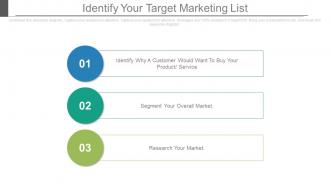
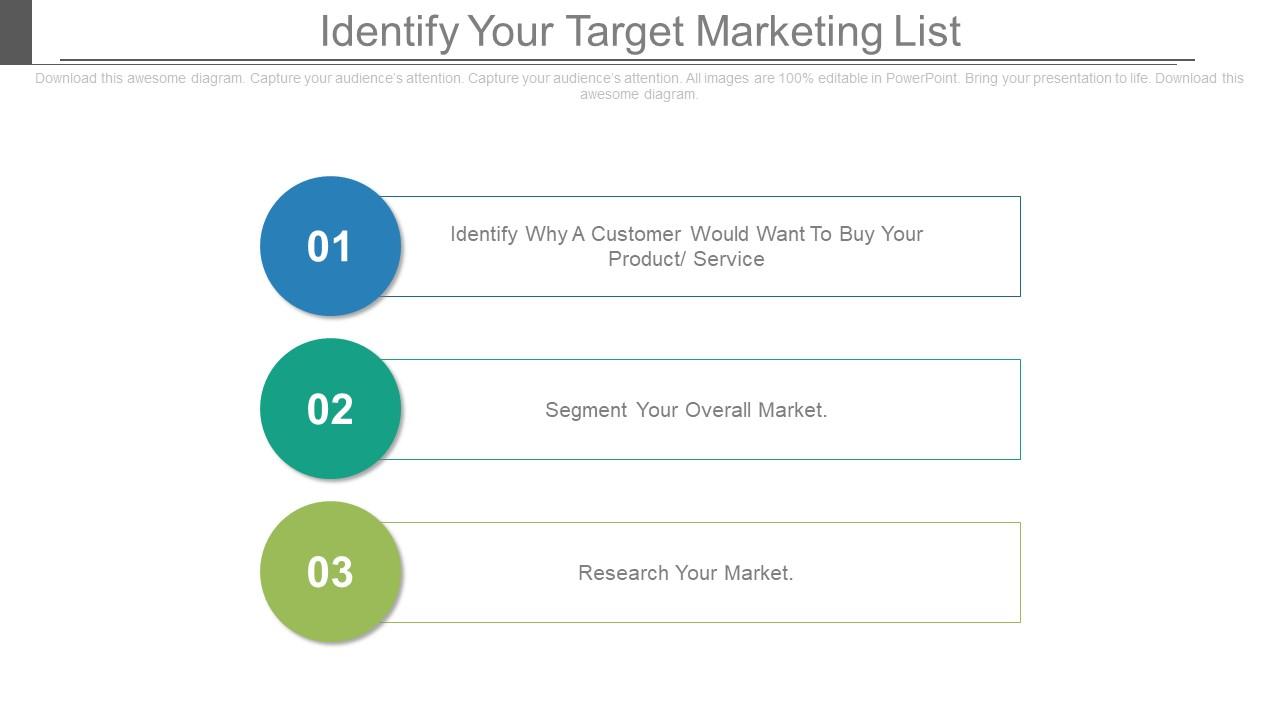
Utilisez notre diapositive PPT d'identification de votre marketing cible pour démontrer le concept de réalisation d'une étude de marché avant d'atteindre le client cible avec votre nouveau produit ou service. La segmentation du marché est le meilleur moyen de comprendre qui est susceptible d'acheter le produit ou qui le parcourt simplement pour voir ce que vous proposez. Le visuel PowerPoint montre trois fonctionnalités intéressantes que vous pouvez montrer à vos téléspectateurs. Les caractéristiques répertoriées dans la diapositive identifient les raisons pour lesquelles un client souhaite acheter votre produit ou service, segmenter votre marché global et effectuer des recherches sur votre marché. La segmentation vous permet de cibler le consommateur selon ses besoins, c'est-à-dire de créer l'offre qui l'incitera à acheter votre produit. L'image graphique de présentation vous aidera sûrement à créer une campagne marketing réussie. Alors, laissez ce design PPT attrayant vous aider à transmettre votre message à vos téléspectateurs de manière efficace. En outre, faites défiler l'ensemble de notre site Web pour choisir votre design préféré. Nos diapositives Ppt Identifiez votre liste de marketing cible ont une idée de l'exotisme. Vous ferez des découvertes extraordinaires.
Caractéristiques de ces diapositives de présentation PowerPoint :
La qualité de l'image ne décourage pas lorsqu'elle est ouverte sur un grand écran. Intégration sans problème de contenu ou de graphiques personnalisés. Fourni des conseils pour modifier le contenu graphique. Enregistrez le visuel de présentation au format JPG ou PDF. Arrière-plan vif des icônes de diapositives. Convient aux responsables marketing, aux gestionnaires, aux professionnels et aux associés. Les étapes de ce processus sont les affaires, le marketing et la stratégie.
People who downloaded this PowerPoint presentation also viewed the following :
Identifiez les diapositives Ppt de votre liste de marketing cible avec les 4 diapositives :
Offrez-leur une bonne expérience de marque avec nos diapositives Ppt Identifiez votre liste de marketing cible. Ils développeront une fantaisie pour votre savoir-faire.
FAQs for Identify your target marketing
Effective target marketing lists include demographic data, psychographic profiles, behavioral patterns, geographic information, and purchase history. These components work together by enabling precise audience segmentation, personalized messaging, and strategic resource allocation, with companies across retail, financial services, and healthcare finding that comprehensive targeting delivers higher conversion rates and significantly improved ROI.
Businesses identify relevant demographics through customer data analysis, market research surveys, social media analytics, purchase behavior tracking, and competitor audience studies. These methods enable companies to segment audiences by age, income, location, and interests, with retail brands and financial services finding that data-driven demographic targeting significantly enhances campaign effectiveness and customer acquisition rates.
Effective data sources include CRM systems, website analytics, social media insights, customer surveys, and third-party databases like industry reports or demographic tools. These sources streamline audience identification by combining behavioral patterns, purchase history, and demographic characteristics, with many marketing teams finding that integrating multiple data streams delivers more precise targeting and higher conversion rates.
Target marketing lists should be updated quarterly or bi-annually to maintain effectiveness, with frequency depending on industry dynamics, customer lifecycle patterns, and campaign performance metrics. Companies in fast-moving sectors like technology and retail often update monthly, while B2B organizations typically refresh every 3-6 months, ultimately ensuring higher engagement rates and improved ROI.
Target marketing list segmentation strategies include demographic profiling, behavioral analysis, psychographic categorization, geographic targeting, and purchase history evaluation. These approaches enhance engagement by enabling personalized messaging, tailored content delivery, and strategic timing optimization, with many retail and financial services organizations finding that segmented campaigns deliver significantly higher conversion rates and customer satisfaction.
Buyer personas influence target marketing lists by defining specific demographic characteristics, behavioral patterns, purchasing preferences, and communication channels for ideal customers. Through detailed persona profiles, marketers can segment audiences more precisely, prioritize high-value prospects, and customize messaging strategies, with companies like retail brands and financial services finding that persona-driven targeting significantly improves conversion rates and marketing ROI.
Customer feedback plays a crucial role in refining target marketing lists by revealing actual customer preferences, identifying unmet needs, and highlighting segments that respond most effectively to specific campaigns. Through surveys, reviews, and behavioral data analysis, businesses can eliminate low-performing segments while expanding high-value customer profiles, ultimately delivering more personalized campaigns and improved conversion rates across industries.
Businesses can leverage CRM systems, marketing automation platforms, data analytics tools, AI-powered segmentation, and integration APIs to streamline target marketing list management. These technologies enhance efficiency by automating data collection, enabling real-time segmentation, and providing predictive insights, with many organizations finding that automated workflows reduce manual effort while delivering more personalized campaigns and improved ROI.
Common mistakes include casting too wide a net, relying on outdated data, ignoring demographic shifts, failing to segment properly, and neglecting to validate contact information regularly. These oversights significantly reduce campaign effectiveness and ROI, with many businesses finding that precise segmentation and data hygiene ultimately deliver higher conversion rates and stronger customer relationships.
Social media insights enhance target marketing lists by revealing detailed audience demographics, behavioral patterns, engagement preferences, and purchasing indicators across platforms. Through analytics tools, businesses can identify high-intent prospects, track competitor audiences, and refine segmentation criteria, ultimately delivering more personalized campaigns and higher conversion rates.
Key metrics include conversion rates, cost per acquisition, return on investment, email open rates, click-through rates, and lead quality scores. These measurements enable organizations to optimize campaign performance by identifying high-performing segments, refining messaging strategies, and reallocating resources toward profitable channels, ultimately delivering enhanced ROI and more effective customer acquisition across diverse marketing initiatives.
**INPUT**: What ethical considerations should be kept in mind when compiling a target marketing list? **OUTPUT**: Ethical target marketing list compilation requires respecting data privacy regulations, obtaining proper consent, ensuring data accuracy, maintaining transparency about collection methods, and providing clear opt-out mechanisms. These practices enhance customer trust while minimizing legal risks, with many organizations finding that ethical data handling ultimately delivers stronger customer relationships and sustainable competitive advantage.
Small businesses can leverage targeted marketing lists by focusing on high-value customer segments, utilizing cost-effective digital platforms, and maximizing ROI through precise audience selection rather than broad campaigns. These strategic approaches enable smaller companies to compete with larger competitors by delivering personalized messaging, reducing wasted ad spend, and achieving higher conversion rates, ultimately stretching limited marketing budgets further.
Third-party data providers offer extensive demographic databases, enhanced audience segmentation capabilities, real-time data updates, cost-effective market reach, and advanced analytics tools for precise targeting. These resources enable businesses to access broader customer insights, reduce acquisition costs, and accelerate campaign deployment, with many retail and financial services companies finding significantly improved conversion rates and market penetration.
A/B testing optimizes outreach by comparing different email subject lines, messaging approaches, call-to-action formats, and timing strategies across segments of your target marketing list. Through systematic testing of variables like personalization levels, content formats, and channel preferences, organizations can identify which approaches generate higher open rates, response rates, and conversions, ultimately enabling more effective resource allocation and significantly improved campaign performance across their target segments.
-
Professional and unique presentations.
-
Very unique and reliable designs.