Importance Of AI In Stock Market The Future Of Finance Is Here AI Driven AI SS V

Rating:
90%
Importance Of AI In Stock Market The Future Of Finance Is Here AI Driven AI SS V Importance Of AI In Stock Market The Future Of Finance Is Here AI Driven AI SS V
Slide 1 of 9

or

Favourites Favourites

Try Before you Buy Download Free Sample Product

Audience Impress Your
Audience
Editable 100%
Editable
Time Save Hours
of Time
The Biggest Sale is ending soon in
0
0
:
0
0
:
0
0
Rating:
90%
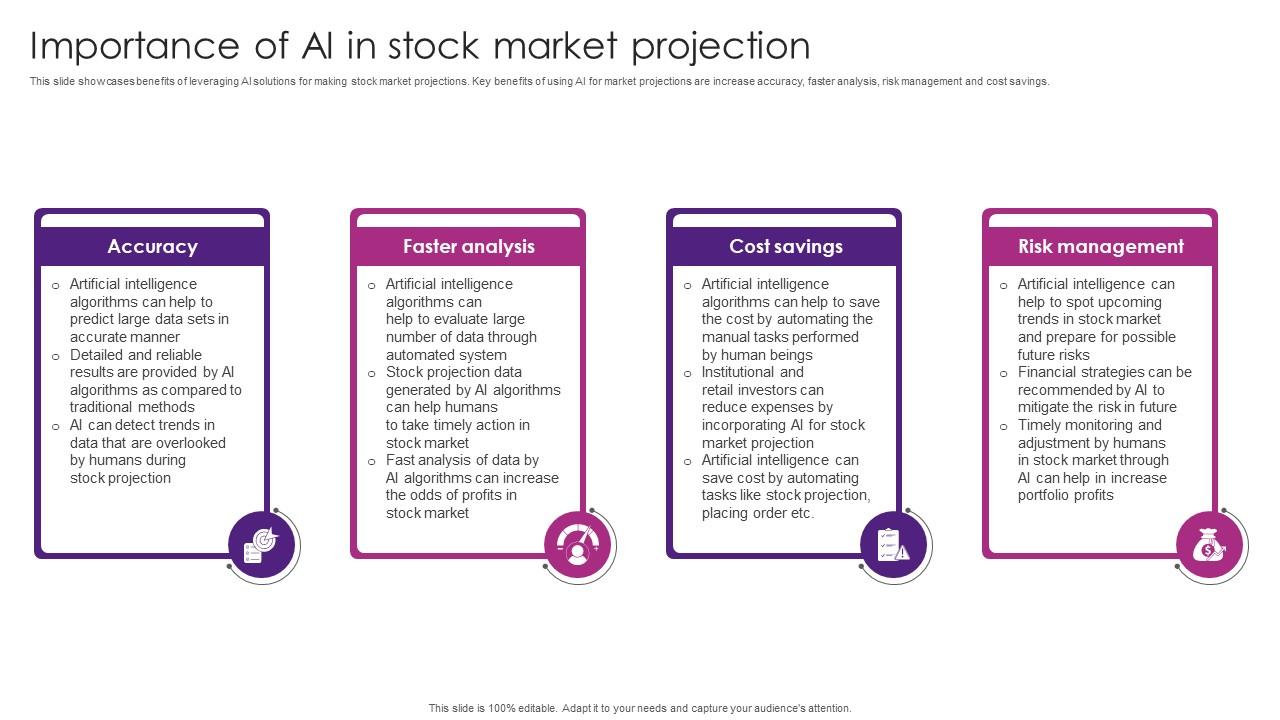
This slide showcases benefits of leveraging AI solutions for making stock market projections. Key benefits of using AI for market projections are increase accuracy, faster analysis, risk management and cost savings. Increase audience engagement and knowledge by dispensing information using Importance Of AI In Stock Market The Future Of Finance Is Here AI Driven AI SS V. This template helps you present information on four stages. You can also present information on Accuracy, Analysis, Savings using this PPT design. This layout is completely editable so personaize it now to meet your audiences expectations.

People who downloaded this PowerPoint presentation also viewed the following :

FAQs for Importance Of AI In Stock Market The Future Of Finance Is Here AI Driven

Dude, AI is like having a crystal ball for stocks but actually useful. These systems crunch insane amounts of data - market trends, news, even Twitter sentiment - way faster than we ever could. You know those trading bots doing thousands of trades per second? That's AI catching tiny patterns in real-time. It gets better over time too, learning from past market moves. Honestly, some of these AI trading platforms are pretty solid if you want to try one alongside whatever you're already doing. Just don't go all-in on robot advice, ya know?

ML algorithms are honestly a game-changer for stock forecasting. They can crunch through insane amounts of data - price history, trading volumes, news sentiment, economic indicators, even Twitter trends. What's really cool is they learn from past mistakes and get better over time. Traditional technical analysis? It'll miss those weird connections between random factors that actually move stocks. I'd definitely start with ensemble methods that combine multiple algorithms - way more reliable than betting on just one model. Though fair warning, nothing's foolproof in this market. But yeah, the pattern recognition is pretty incredible compared to old-school approaches.

Honestly, AI is a game-changer for risk stuff. It can chew through insane amounts of data way faster than you ever could and spots patterns that would take forever to find manually. The best part? It doesn't panic when markets go crazy like we do. You can run tons of scenarios to see how your trades might play out under different conditions - that alone is worth it. Oh, and it's watching everything 24/7, tracking correlations and weird market movements across the globe. I'd start with some AI risk tools that plug into whatever platform you're already using.

Look, the biggest thing is market fairness - AI gives huge advantages to firms with deep pockets while screwing over regular traders. When algorithms make lightning-fast moves, retail investors can't keep up. Then there's the whole "who's to blame" mess when your AI tanks and takes others down with it. Bias is another headache since these systems often make existing inequalities worse. Honestly feels like the regulatory side is playing catch-up right now. Just be upfront about using AI and don't build anything that'll prey on small investors or create some massive market meltdown.

So these NLP tools crawl through tons of news articles, earnings reports, social media - basically everything - and figure out if people are bullish or bearish on a stock. Pretty crazy how good they've gotten at reading the room. They'll catch stuff like CEO changes, product launches, regulatory drama that usually moves prices. Honestly, I was skeptical at first but the sentiment data can really help you time entries and exits better. Some people even set up automated trades when sentiment hits certain levels. Just backtest whatever strategy you're thinking about first - don't blow up your account on day one lol.

Yeah so trading bots are kinda wild - they definitely make markets more volatile, not less. When they all hit the same signals at once, small price moves turn into these massive swings. Picture thousands of algorithms panic-selling in the exact same millisecond, which is literally what happens. Some bots do add liquidity during quiet periods though, so there's that. But honestly? Flash crashes are way more common now. Your stop-losses and position sizing matter more than ever. I learned this the hard way last year when everything just... dropped out of nowhere.

So AI basically chews through tons of financial data at crazy speeds - stuff like earnings reports, balance sheets, even Twitter sentiment. It finds stocks trading below what they're actually worth by analyzing patterns you'd never catch manually. The thing processes thousands of companies at once while tracking dozens of valuation metrics. Pretty wild, honestly. It also learns from historical trends to spot which factor combinations usually signal undervaluation. I'd check out AI screening tools first - they'll filter based on your specific criteria and risk tolerance. Way easier than doing it yourself.

Look, AI's pretty good but it has major blind spots with stocks. Black swan events? Totally throws it off. Same with geopolitical stuff or anything that breaks from historical patterns - which honestly is when you actually make or lose real money. The models only know what they've been trained on, so new trends can catch them completely off guard. Plus they're basically black boxes, so good luck figuring out why they're telling you to buy or sell. I'd use it as just one piece of the puzzle, not your whole strategy. Combine it with actual fundamental analysis and trust your gut too.

So hedge funds are basically using AI to spot patterns and trade crazy fast - we're talking microseconds here. They'll analyze everything from Twitter sentiment to technical charts across tons of assets at once. The speed is honestly insane, way beyond what any human could do. Machine learning helps them adapt too, so the algorithms actually learn from previous trades. Oh and the data processing - they're crunching massive datasets to find opportunities most people would never see. If you're getting into this stuff, focus more on understanding the data side rather than trying to match their speed (spoiler: you won't).

So sentiment analysis tracks how people feel about stocks by scanning news, tweets, reddit posts - all that stuff. Remember when Musk's tweets would send Tesla flying or crashing? That's pure sentiment. The AI scores whether buzz around a company is positive/negative/neutral, then uses it for trades. Works great for short-term plays since emotions create these weird price moves that don't match the actual business performance. I've started checking sentiment alongside my usual charts - helps catch when everyone's either panicking or getting way too hyped about something. Pretty wild how much feelings drive markets honestly.

So AI can crunch through thousands of stocks at once, which honestly saves you from staring at spreadsheets all day. It picks up on market patterns and correlations that would take forever to spot manually. The cool thing is it builds portfolios around your actual risk tolerance - not some generic template. Rebalancing happens automatically when things get out of whack. Plus you won't panic-sell during market dips because emotions aren't involved. I'd check out some robo-advisors first, see what they'd do differently with your current setup. The diversification suggestions alone are pretty eye-opening.

So supervised learning is basically when you feed algorithms historical stock data where you already know what happened - like showing it past price movements so it can predict where things might go tomorrow. Pretty straightforward stuff. Unsupervised learning is trickier though - it hunts for hidden patterns without any "correct" answers to guide it. You'll see this used for grouping stocks that behave similarly or spotting weird trading activity. Honestly, most traders I know use supervised for price forecasting and unsupervised when they're trying to diversify portfolios or catch potential risks before they blow up.

Honestly, AI is a game changer for trading - it crunches market data in milliseconds while you'd be sitting there for hours doing the same analysis. Price movements, volume, news sentiment, technical stuff... it tracks everything at once. The algorithms spot patterns and weird market behavior across multiple streams simultaneously. Way better than making decisions based on hunches or old data, you know? I'd start with AI tools that focus on whatever sectors you're already trading. You'll probably notice your strategy getting way more responsive pretty quickly - it's actually kind of addictive once you see how fast it adapts.

Data quality is everything - bad data will wreck your models instantly. Your historical stuff needs to be spotless, plus reliable real-time feeds. Risk management gets tricky because AI moves way faster than traditional trading, so losses can spiral quick. Regulatory stuff is a nightmare honestly - algorithmic trading rules are super strict. You'll need serious computing power too since these models eat resources. Oh and definitely start with just a small test portfolio first. I learned that one the hard way. Scale up slowly once you see how it actually performs.

So basically AI is making investing way more fair for regular people like us. You can get the same algorithmic trading and robo-advisors that Wall Street used to hoard. Real-time market analysis too. These tools help you make smarter, data-driven moves without doing all the grunt work yourself. I mean, sometimes it feels weird trusting algorithms with our cash, but whatever works right? The cool part is sentiment analysis and pattern recognition - stuff that actually helps you compete with the big players. Definitely check out some AI investment apps and see what clicks.

Ratings and Reviews

90% of 100
Review Form
Write a review
Most Relevant Reviews
  1. 100%

    by Alexander Ramirez

    Easily Understandable slides.
  2. 80%

    by Byrne Cruz

    The PPTs are extremely simple to modify. Thank you for providing the slides that are ready to be used. They assist me in saving a lot of time.

2 Item(s)

per page: